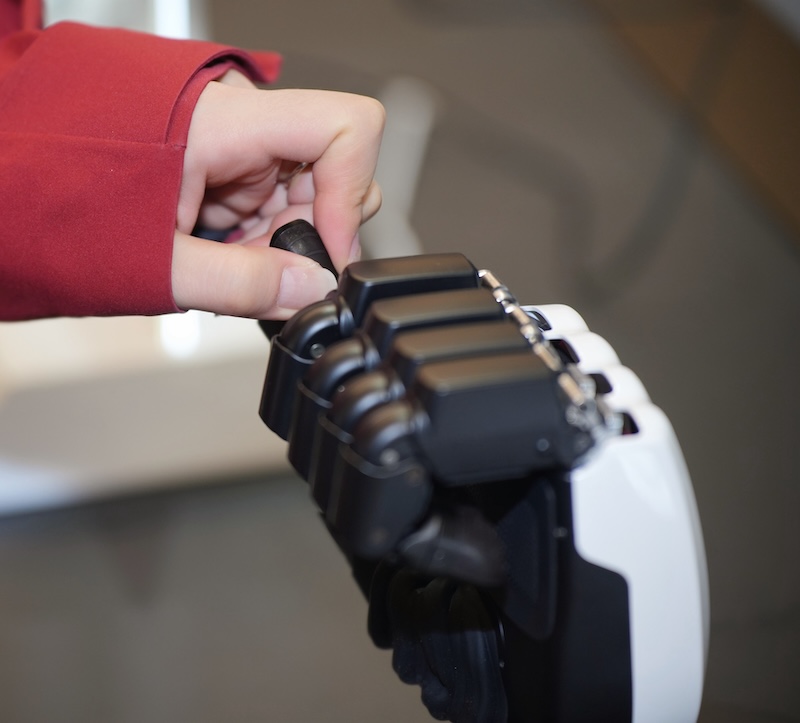
Daimon Robotics has launched Daimon-TWM, a new tactile-grounded world model designed to enable robots to interpret physical interactions such as force, friction, deformation and slippage rather than relying primarily on vision.
The Shenzhen-based robotics company says the technology is intended to address one of the major limitations of current robotic manipulation: while machine vision can identify an object and determine its position, visual information alone does not necessarily tell a robot how much force it should apply when grasping or manipulating it.
This becomes particularly important when robots handle delicate, deformable, irregular or contact-sensitive objects, where too much force can damage an item and too little can allow it to slip.
Daimon describes Daimon-TWM as a “tactile-grounded world model” that uses touch as a core source of information for physical intelligence.
The company says the model brings together physical cognition, predictive decision-making and real-time control, with the aim of enabling robots to understand what is happening during contact, anticipate how an interaction is likely to develop and adjust their actions accordingly.
Daimon-TWM builds on the company’s earlier Vision-Tactile-Language-Action, or VTLA, architecture, which integrates tactile information alongside vision and other inputs in robotic perception and control.
The approach potentially extends the role of touch beyond conventional force feedback. Rather than using tactile signals only after contact has occurred, Daimon is attempting to use tactile data as part of the robot’s decision-making process throughout manipulation.
Demonstrations associated with Daimon-TWM include contact-intensive tasks such as handling pieces of glass, preparing fruit skewers and organizing items inside a refrigerator.
Building a tactile data infrastructure
One of the challenges facing tactile AI is the relative shortage of training data.
Large AI models for text and images have benefited from enormous datasets gathered over many years. Equivalent datasets describing how objects physically respond when robots touch, grasp, move and manipulate them are much less widely available.
Daimon is attempting to build this infrastructure through Daimon-Infinity, its multimodal embodied AI data initiative, combined with its own vision-based tactile sensors and data-acquisition systems.
The company says its technology stack combines tactile sensing hardware, multimodal data collection and physical AI models.
Its vision-based tactile sensors are designed to capture information generated through physical contact, providing data that can be combined with visual perception and robot actions during model training.
Daimon says this combination could improve robotic manipulation in applications including manufacturing, logistics and service robotics, particularly where robots encounter objects or conditions that cannot be completely predefined.
Ant Group leads new investment
The launch comes as Daimon expands rapidly following two financing rounds this year.
In August, Daimon Robotics announced that it had raised several hundred million yuan in a strategic financing round led by Ant Group, with existing shareholders making additional investments.
The financing followed a 100-million-yuan Series A round completed approximately two months earlier.
Other investors in the company include China Merchants Capital, Lenovo Capital and Incubator Group, Inovance Industrial Investment, China Mobile and China Telecom.
Daimon Robotics originated from a robotics research team at the Hong Kong University of Science and Technology and officially began operations in 2023. The company is headquartered in Shenzhen and maintains an R&D operation in Hong Kong.
Its product portfolio now includes high-resolution vision-based tactile sensors, multimodal data-acquisition systems and tactile-native physical AI models.
The company says its ultimate aim is to create robots capable not simply of seeing their surroundings, but of understanding physical interactions well enough to perform dexterous manipulation reliably in complex, changing environments.
