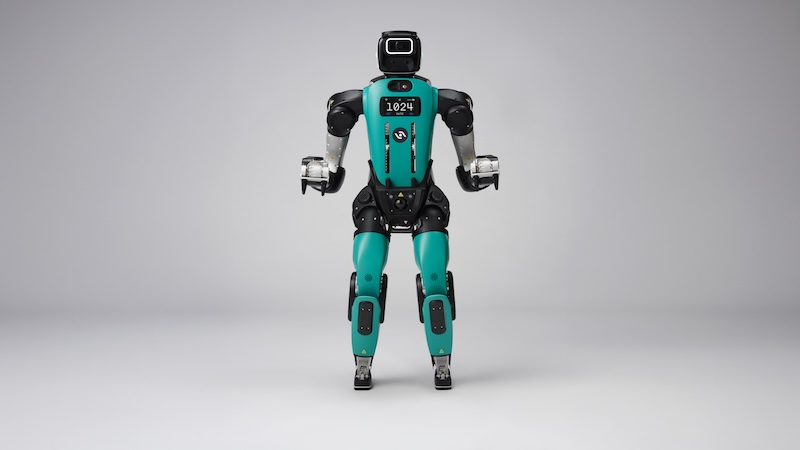
Agility Robotics has unveiled Digit 5, the latest generation of its humanoid robot, as the company reports more than $300 million in multi-year customer orders and prepares to become a publicly traded company.
The new robot substantially expands the capabilities of Agility’s existing commercial platform, increasing payload by 40 percent and introducing interchangeable end effectors, faster autonomous charging and a new safety architecture designed to allow Digit to operate in close proximity to people.
Agility says Digit 5 is designed to move beyond the tote-handling applications that have accounted for much of Digit 4’s commercial work and eventually perform multiple tasks across manufacturing and logistics facilities.
These include depalletizing, machine tending, kitting and sequencing, quality inspection and palletizing.
Peggy Johnson, CEO of Agility Robotics, says: “Digit 5 is removing a major barrier to scaling humanoid robots in industrial environments.
“We built it to the exact requirements our customers gave us after three years of Digit 4 working on their production floors.
“The market has responded with more than $300 million in multi-year orders and a growing pipeline of customers across manufacturing, warehousing and logistics. That’s value that compounds as Digit’s capabilities expand, backed by real demand.”
The $300 million represents multi-year customer orders for Digit 5 as of May 2026 and is subject to the satisfaction of certain contractual milestones.
The commercial commitments are particularly significant as Agility prepares to enter the public markets through its proposed merger with Churchill Capital Corp XI, a publicly traded special purpose acquisition company.
Agility and Churchill announced their definitive business combination agreement in June. The transaction values Agility at a pre-money equity value of $2.5 billion and is expected to provide the robotics company with more than $620 million in gross proceeds.
Agility says the proceeds will be used to fulfil existing customer orders, expand commercial deployments, increase production of Digit 5 and continue development of its robotics, physical AI, software and safety technologies.
Subject to completion of the transaction, the combined company will operate as Agility and is expected to trade on a major North American exchange under the ticker “AGLT”.
The transaction is expected to close in 2026, subject to Churchill XI shareholder approval, SEC review, regulatory approvals and other closing conditions.
From tote handling to complete workflows
Digit 4 has so far largely been deployed for tote-based material handling. Agility says the new machine is intended to considerably broaden the range of jobs that can be performed by the same humanoid platform.
The company says the upgrades enable a single Digit 5 to take on work that previously “used to require a specialized solution at every stage”.
Digit 5 can repeatedly lift loads of up to 50 lb – 22.7 kg – using a redesigned leg system powered by Agility’s proprietary cycloidal actuator technology.
The robot also introduces swappable grippers using ISO-standard mounting flanges, enabling different end effectors to be fitted for applications including tote handling and machine tending.
Its maximum reach increases from 5.5 ft on Digit 4 to 7.2 ft – approximately 2.2 m – while the robot itself stands 5 ft 11 in, or 1.81 m, tall and weighs 284 lb, or 129 kg.
Agility says the human-scale dimensions allow Digit to operate using shelves, aisles, doorways and workstations originally designed for people rather than requiring facilities to be redesigned around the robot.
Digit 5 also introduces a new battery system providing a claimed 90-minute runtime and nine-minute charging time.
That gives the machine a 10:1 run-to-charge ratio, compared with 2:1 for Digit 4, which Agility says makes more than 20 hours of productive operation possible within a 24-hour period.
Working alongside people
Another major focus of Digit 5 is removing some of the physical separation between industrial robots and human workers.
Agility describes Digit 5 as its first humanoid engineered for “cooperatively safe work at scale”, with a safety architecture intended to reduce dependence on physical safety barriers.
The robot combines multiple sensors with human-detection algorithms that continuously monitor its surroundings. When a person approaches, Digit can respond by avoiding the individual, stopping or assuming a seated position.
An independent safety controller monitors the distance between the robot and nearby people and can initiate safety responses.
Digit also uses visual and auditory signals to communicate its intended movements to people working nearby.
Agility is the first launch partner for Nvidia’s Halos for Robotics platform and is combining its safety systems with Nvidia IGX Thor and Halos Core infrastructure.
Deepu Talla, vice president of robotics and edge AI at Nvidia, says: “Safely operating around people and assets is what moves humanoid robots from pilots to industrial deployments at scale.
“Agility’s Digit 5 is building on more than 65,000 hours of real-world operation and pairing its new safety architecture developed on top of NVIDIA IGX Thor and Halos safety framework for Robotics to help humanoids collaborate safely in factories and warehouses.”
Agility is also participating in the development of ANSI/A3 TR R15.108, a technical report covering dynamically stable industrial mobile robots including humanoids, and ISO 25785-1, an international safety standard being developed for humanoid robots.
65,000 hours of operational experience
Agility says the previous generation of Digit has accumulated more than 65,000 hours of operation across customer facilities in North America.
Customers and deployment partners have included GXO, Schaeffler, Amazon and Toyota Motor Manufacturing Canada.
At GXO’s Flowery Branch facility near Atlanta, Digit 4 has passed a cumulative 100,000-tote handling milestone, according to Agility, while maintaining approximately 98 percent accuracy while on task.
Digit 5 remains integrated with Agility Arc, the company’s cloud-based robot management platform, which provides information on measures including uptime, throughput and mean time between incidents.
Arc can also connect Digit fleets with existing warehouse management, warehouse execution and manufacturing execution systems.
This enables Digit to coordinate material movements with other automation equipment including autonomous mobile robots and conveyors.
Production capacity of 10,000 robots a year
Digit is assembled at Agility’s 70,000 sq ft RoboFab facility in Salem, Oregon.
The company says the factory is designed to produce as many as 10,000 Digit robots annually at full capacity and eventually employ more than 500 people.
Agility also operates an engineering, testing and skills-development operation in Pittsburgh and opened a new facility in Fremont, California, in July to serve as its hardware and physical AI development hub.
Digit 5 will also mark Agility’s first planned commercial expansion outside North America.
The company intends to make the robot available in the European Union and United Kingdom and expects Digit 5 to carry the regulatory markings required for deployment in the EU, Great Britain and Northern Ireland.
Early access to Digit 5 is expected to begin during the first half of 2027, with general availability for manufacturing, warehouse and distribution operators planned by the end of 2027.
