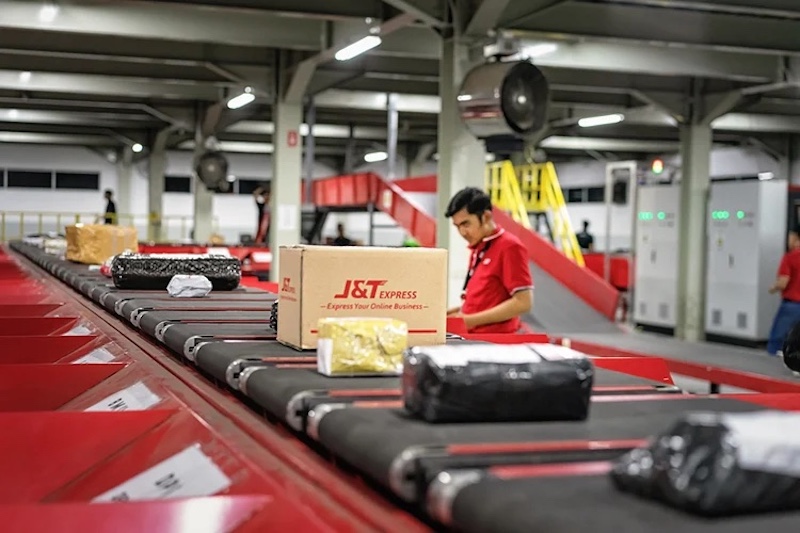
J&T Global Express has expanded automated sortation across its express network to 435 sets of automated sorting machines, adding 22 sets in the first half of 2026, while deployment of unmanned delivery vehicles rose 87 percent to more than 1,900 units.
J&T Global Express disclosed the figures in its interim results for the six months to 30 June 2026, during which it handled 17.50 billion parcels, up 25.1 percent year on year.
The new sorting systems were distributed across all three of the company’s operating regions. Eleven sets went into Southeast Asia, eight into China and three into what J&T calls Other Markets, covering the Middle East, Latin America and Egypt.
J&T operated 260 sorting centers globally at the end of June, an increase of 14 from the end of 2025
Of those, 127 are in Southeast Asia, where the company now runs 75 sets of automated sorting machines, while Other Markets accounts for 52 sorting centers and 14 automated sets.
According to the company, it has been exporting automated sorting equipment and intelligent management systems, integrating them across sorting, transportation, pickup and delivery globally.
In Southeast Asia, J&T has also established a dedicated team to design integrated automation packages for individual last-mile outlets, covering planning, customization and maintenance, with systems sized to each site’s footprint and throughput.
The company says the aim is to raise courier and outlet processing efficiency and reduce operating costs for both J&T and its network partners. It had approximately 1,300 network partners in Southeast Asia at the end of June.
J&T says it will continue increasing investment in outlet automation across the region as capacity grows.
In China, J&T had deployed more than 1,900 unmanned delivery vehicles by the end of June, up 87% from the end of 2025.
The company says prices for mainstream models have fallen from 2025 levels, while local governments have expanded road access for unmanned delivery vehicles.
J&T has encouraged network partners to adopt the vehicles in key cities through supportive policies and additional cooperation plans.
The company says the unmanned delivery sector has entered a phase of large-scale development, with leading suppliers reaching mass production.
J&T has encouraged network partners to adopt the vehicles in key cities through subsidy policies and additional cooperation plans, and describes the unmanned delivery sector as having entered a phase of large-scale development, with leading suppliers reaching mass production.
The company says it has moved from manual sampling to AI-powered full-volume quality inspection, significantly increasing inspection coverage.
J&T describes its wider digital program as building toward what it calls “multi-level agents plus intelligent analytics, prediction and decision support” across logistics scenarios, deployed from individual outlets up to national headquarters.
The company is also applying intelligent route planning across its line-haul fleet to improve vehicle loading rates, steering its capacity mix toward higher-load-factor vehicle types and introducing formal load factor assessment.
It operated approximately 13,380 line-haul vehicles globally at the end of June, around 8,500 of them self-owned.
J&T operated 272 fulfillment warehouses globally at the end of June covering more than 1.01 million square meters.
