
People tend to view modern electronics as magic boxes. You plug them in, turn them on, and they just work. But anyone who actually builds these devices knows there’s no magic involved. It’s just physics, heat management, and an endless battle for physical space.
Ten years ago, a standard consumer device pulled maybe 15 watts and processed a gigabyte of data over a few minutes. Now, we expect that same form factor to push 100 watts and stream complex data continuously.
All of this relies on the physical pathways inside the shell. We spend a lot of time talking about software optimization and microchip architecture. We spend much less time talking about the copper, shielding, and connectors that keep the whole thing from failing.
The wires inside a device don’t get marketing campaigns. They just sit in the dark and carry the load. But if you ignore them during the design phase, they will absolutely ruin your product launch.
Thermal Management in Tight Spaces
It used to be that you could get away with cheap bulk wiring if you had enough airflow. Those days are gone. Modern product design leaves almost zero room for thermal expansion or passive cooling.
When you cram processors, batteries, and sensors into a sealed aluminum chassis, heat becomes your biggest enemy.
This is where your component sourcing becomes a critical operational task. You can design the most efficient circuit on paper. But if you partner with a subpar fabrication facility, your thermal tolerances go out the window completely.
Many engineering teams find themselves jumping across the globe for reliable fabrication. They might source a display panel from South Korea and use a trusted PCB manufacturer lithuania to produce multi-layer boards that actually meet their rigid thermal specs. The logic is very simple. A board that delaminates under heat ruins the entire device.
Quality wiring and traces prevent localized hotspots. If a wire has inconsistent resistance because of cheap copper alloys, it generates excess heat at specific points. Over time, that heat degrades the surrounding insulation. Eventually, you get a short circuit that kills the device.
The Realities of High Power Delivery
Look at the shift toward electrification in vehicles, industrial tools, and even home appliances. We’re moving massive amounts of power through consumer equipment today. You simply can’t fake your way through power delivery.
If an engineer specifies high voltage cable harnesses for a new battery backup system, they do it because the math demands it. Cutting corners on these components leads directly to catastrophic failure.
Thick and well-insulated cables are heavy and hard to route through a chassis. They are also absolutely necessary for safety and function.
When you run heavy current, the physical integrity of the cable and its connectors is everything. A loose crimp or a brittle connector housing creates arcing. Arcing melts plastic, starts fires, and triggers massive product recalls.
I’ve seen companies try to shave pennies off their bill of materials by swapping out specified cables for generic alternatives. It almost always results in a massive spike in warranty claims within the first year of deployment.
You save fifty cents on the assembly line, and you spend fifty dollars managing the return shipping and replacement. It’s a terrible trade.
Signal Integrity and Data Transfer
Power is only half the equation here. The other half is data. Devices today are flooded with sensors, cameras, and communication modules. All of these components need to talk to the main processor instantly and without errors.
This requires perfectly clean signals. When you pack power delivery and data lines right next to each other, you invite electromagnetic interference. A poorly shielded power line will absolutely wreck the data integrity of an adjacent sensor wire. High frequency signals are notoriously fragile.
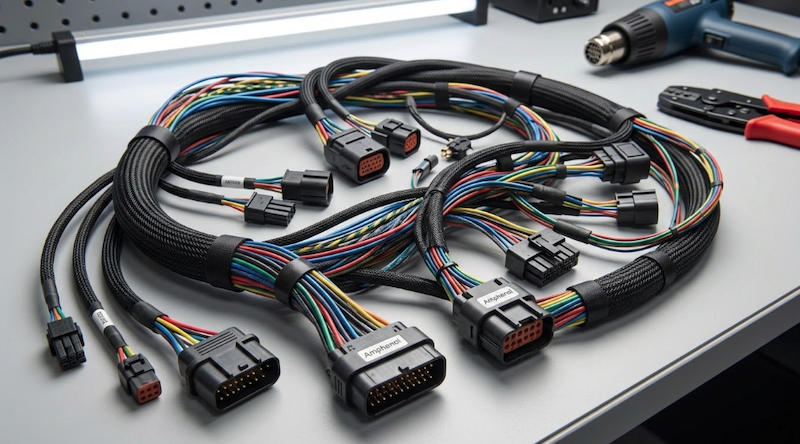
This is why customized electrical harnesses are becoming standard even in mid-tier products. You need precision shielding, twisted pairs, and exact lengths to ensure signal timing is correct.
A standard harness off the shelf might physically fit the connectors, but it won’t block the crosstalk effectively.
When your sensors start sending garbage data because of interference, the software tries to compensate. The device slows down. The battery drains much faster. The end user just assumes the product itself is junk. They never realize the problem is a poorly shielded wire hidden deep inside the plastic housing.
Supply Chain Specialization
Finding the right suppliers for all of this is a constant operational headache. You have to balance unit cost against quality and lead times. A lot of companies eventually realize that chasing the absolute lowest price per unit costs them more in the long run.
Different regions have built up highly specialized manufacturing hubs over decades. If you are building high-end automotive testing equipment or precision industrial controls, you know exactly where to look for parts.
Getting a specialized wire harness italy can make a massive difference in your assembly process because of their established automotive standards and incredibly tight quality control.
It sounds overly specific, but these regional specialties exist for a reason. Factories that spend thirty years building wiring assemblies for luxury sports cars know how to build a connector that won’t rattle loose under heavy vibration.
When you buy quality components, you’re paying for the quality control process at the factory. You’re paying for the assurance that someone actually tested the pull strength of every connector before it went into a shipping container. You’re buying sleep insurance for your engineering team.
The Impact on the Assembly Floor
The impact of good wiring is immediately obvious on the assembly floor. Stiff or cheap cables fight the assembly workers. Connectors that are molded slightly out of spec require excessive force to seat properly.
When workers have to fight the materials to assemble the product, mistakes happen. Pins get bent. Wires get pinched between casing halves during final closure. Insulation gets scraped off by sharp metal edges. This slows down your required production rate time and creates a bottleneck.
Quality wiring components snap together exactly as designed. The cables route cleanly through the designated channels. The connectors give a clear tactile click when seated fully. This speeds up the assembly line and drastically reduces the failure rate at the final quality check station.
It’s a basic operational reality. If you make the product easy to assemble correctly, your defect rate goes down.
Long-Term Reliability and Your Bottom Line
In the end, internal wiring isn’t a feature you can advertise on the retail packaging. No one buys a smart thermostat or an electric scooter just because it has great internal shielding. They buy it because they expect it to work flawlessly for years.
The wires inside your device are the physical infrastructure that allows everything else to function properly. If you compromise on that infrastructure, the entire system becomes unstable. The hardware components will starve for power. The data streams will degrade. The product will fail prematurely.
Managing reverse logistics for broken products destroys profit margins faster than anything else. You have to pay for shipping, labor to diagnose the fault, replacement parts, and the cost of a disappointed customer.
Spending the extra money on quality wiring materials is an investment in your brand reputation. It keeps your products out of the repair shop and keeps your customers from complaining online. It is unglamorous, hidden work. But it’s exactly what keeps a business running smoothly over the long haul.
