
Industry 4.0 carries an enormous promise. Connected sensors feeding real-time data into intelligent systems, machines that predict their own failures, production lines that self-optimise in response to demand signals, supply chains that adjust without human intervention. The technology is real, the investment is substantial, and the case studies are credible.
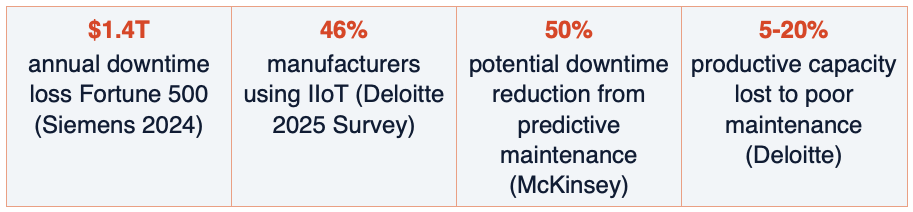
So why are so many manufacturers still fighting the same battles they were fighting a decade ago? Why does unplanned downtime still cost Fortune 500 companies an estimated $1.4 trillion per year, according to the Siemens True Cost of Downtime 2024 report?
Why do maintenance teams with IIoT sensors on half their assets still spend most of their time reacting to failures rather than preventing them?
The answer, more often than not, has nothing to do with the sensors or the algorithms. It has to do with the asset management infrastructure underneath them. The EAM layer, the systems, data models, and practices that govern how equipment records, spare parts catalogues, work orders, and maintenance decisions are organised and acted on, was built for a different era.
And when Industry 4.0 technology is layered on top of an EAM infrastructure that has not evolved to meet it, the result is islands of intelligence that cannot talk to each other and insights that do not reach the people who need to act on them.
The EAM Gap: Why Smart Technology is Running on Dumb Infrastructure
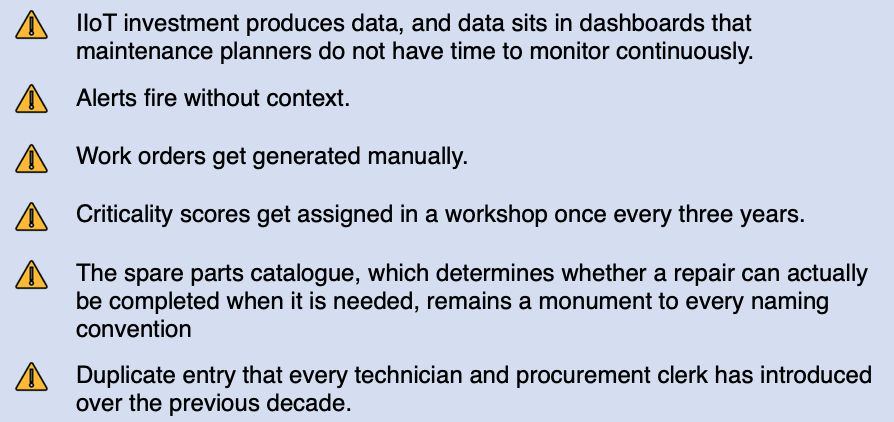
The Deloitte 2025 Smart Manufacturing and Operations Survey, which polled 600 senior executives from large manufacturers, found that 46% of respondents are actively using Industrial IoT solutions at the facility or network level. Nearly as many have deployed predictive maintenance in some form. These are no longer pilot programme numbers.
But as the broader picture of factory automation shows, the harder question is not whether connected systems are deployed, it is whether they interoperate. And in most facilities, they do not. A connected machine does not automatically create a better operation.
An IIoT sensor that streams vibration data to a dashboard that is not connected to the work order system does not prevent a failure. It just gives someone a graph to look at while the failure is happening.
This is the EAM gap: the space between the intelligence that modern technology is capable of generating and the operational decisions that actually get made. EAM systems that were implemented a decade or more ago were designed around a fixed-schedule, work-order-driven model.
They were not designed to ingest continuous sensor streams, apply dynamic criticality scoring, or automatically adjust reorder points in response to changing failure probabilities. They were designed to record what happened, not to anticipate what is about to happen.
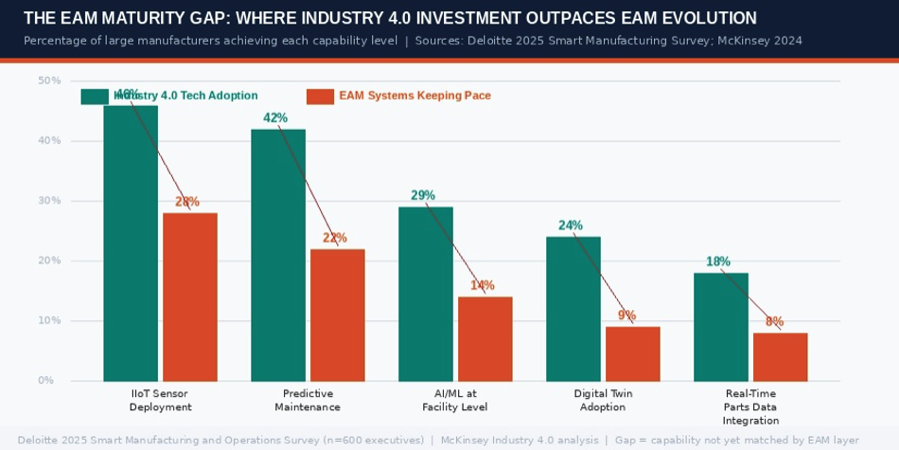
The practical consequence is a pattern that shows up repeatedly across heavy manufacturing, oil and gas, mining, and utilities:
Alerts fire without context. Work orders get generated manually. Criticality scores get assigned in a workshop once every three years. And the spare parts catalogue, which determines whether a repair can actually be completed when it is needed, remains a monument to every naming convention and duplicate entry that every technician and procurement clerk has introduced over the previous decade.
The data quality problem underneath everything
The Deloitte 2025 Smart Manufacturing Survey found that nearly 70% of manufacturers cite data quality, contextualisation, and validation as the most significant obstacles to AI implementation. That finding points directly at the EAM layer. IIoT sensors generate data.
EAM systems are supposed to give that data meaning, connecting a vibration reading to a specific asset, to its maintenance history, to its criticality score, to the parts required to repair it, and to the supplier capable of delivering those parts on time.
When the EAM data layer is fragmented, duplicated, and disconnected from real-time operational signals, none of those connections exist. The Industry 4.0 intelligence layer is being asked to make decisions on top of a foundation that cannot support the weight.
What EAM Was Designed for, and What Industry 4.0 Actually Needs
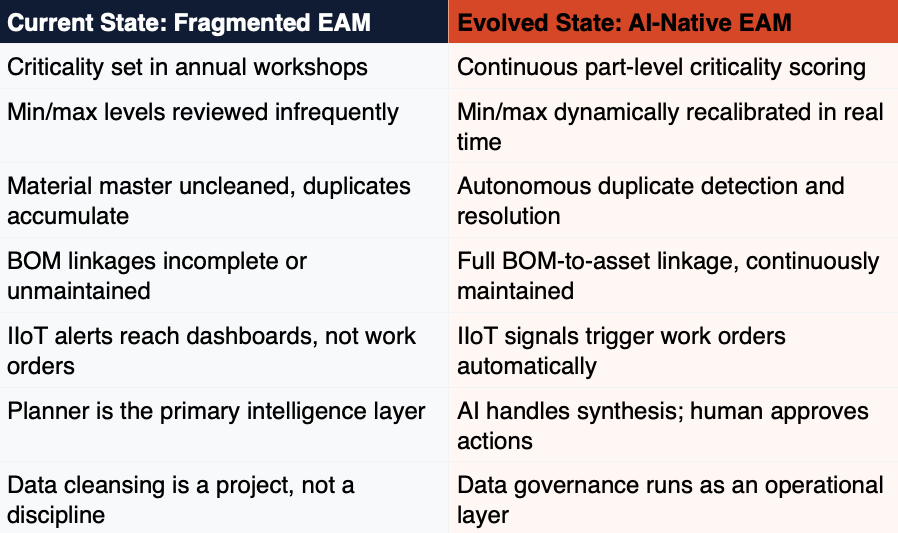
Traditional EAM architecture was built around three assumptions that Industry 4.0 has rendered obsolete. First, that maintenance events are discrete and scheduled.
Second, that asset data is relatively static between updates. Third, that human planners are the primary intelligence layer, with software serving as their administrative tool.
None of those assumptions hold in a connected industrial environment. Failure modes do not respect maintenance schedules. Asset condition changes continuously, sometimes faster than any planned inspection cycle can detect.
And the volume of data generated by a modern connected facility, sensor streams, work order patterns, consumption records, supplier lead time fluctuations, far exceeds what any human planning team can process and act on in real time.
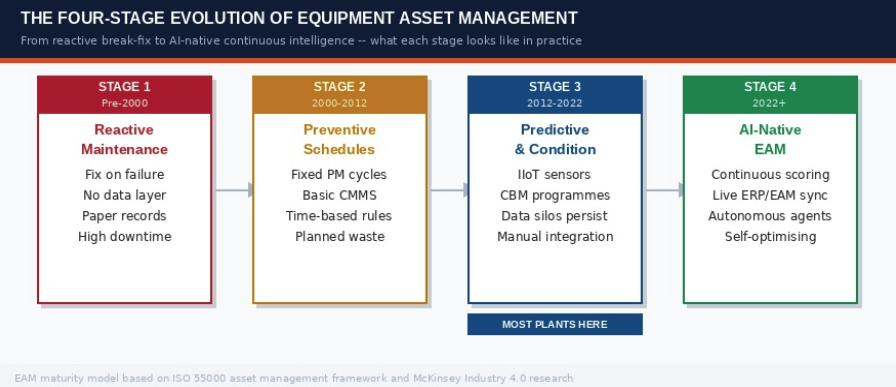
The four stages of EAM maturity illustrated above show where most organisations actually sit. Stage 3, predictive and condition-based maintenance, is where significant investment has been concentrated over the past decade. IIoT sensors are deployed. Condition monitoring programmes exist. Data is being collected.
The gap between Stage 3 and Stage 4 is not a technology gap. The technology exists. It is an integration and data infrastructure gap.
Stage 4 requires that the IIoT data layer, the EAM asset and work order layer, the ERP inventory and procurement layer, and the AI decision layer are all connected in real time, feeding each other continuously rather than operating in parallel silos that have to be manually reconciled.
What Changes When the Integration is Complete
When those four layers are genuinely integrated, the practical consequences are significant and measurable. McKinsey research documents maintenance cost reductions of 18 to 25% and unplanned downtime reductions of up to 50% from mature predictive maintenance implementations.
A Deloitte Industry 4.0 case study found that a chemical manufacturer achieved an 80% reduction in unplanned downtime for a specific asset class after deploying connected predictive capabilities, with cost savings of approximately $300,000 per asset.
These are not theoretical projections. They are documented outcomes from organisations that have advanced beyond Stage 3, where how AI and automation redefine industrial asset reliability becomes practical, not aspirational.
The difference between organisations achieving those outcomes and those still struggling is not the quality of their IIoT sensors. It is whether the intelligence those sensors generate is connected to the systems and processes that actually govern maintenance decisions.
The Four Evolutions EAM Practice Must Undergo
Getting from Stage 3 to Stage 4 requires specific changes across four dimensions of EAM practice. These are not technology purchases. They are fundamental shifts in how asset management data is structured, governed, and used.
Evolution 1: From Asset-Level to Part-Level Intelligence
Legacy EAM systems manage criticality and maintenance decisions at the asset level. An asset is classified as critical, and that classification cascades down to everything associated with it, including every spare part in its Bill of Materials.
This approach was practical when criticality analysis was a manual exercise conducted in workshops. It is structurally inadequate for an Industry 4.0 environment.
A low-cost seal with a 14-week sole-source lead time on a critical compressor carries a completely different risk profile from an identically priced seal with three qualified suppliers and next-day availability.
Asset-level criticality cannot distinguish between them. Part-level criticality scoring, driven by continuous analysis of lead times, supplier reliability, BOM linkages, and failure patterns, surfaces these distinctions automatically and adjusts inventory recommendations accordingly.
This is the kind of granular, part-level intelligence that platforms like Verdantis are built to operationalise, connecting criticality scoring directly to inventory decisions rather than leaving it as a periodic workshop output.
This is not a refinement of existing practice. It is a structural change to the data model that underpins every maintenance and procurement decision the organisation makes.
Evolution 2: From Periodic Reviews to Continuous Data Governance
The master data problem in industrial EAM is well established. As the evolution of industrial software capabilities shows, even the most capable EAM platforms depend entirely on the quality of the data layer underneath them.
Duplicate material records, inconsistent part descriptions, broken BOM-to-asset linkages, and obsolete parts linked to decommissioned equipment accumulate over years of normal operation and degrade every decision the EAM system is capable of making.
The traditional response has been periodic data cleansing projects: expensive, disruptive, and temporary. Within 18 to 24 months of a cleansing exercise, catalogue quality returns to its pre-cleanse level because the process that created the problem was never addressed.
Industry 4.0 EAM requires continuous data governance, an AI-native layer that monitors the catalogue in real time, surfaces duplicate records as they are created, flags obsolescence as equipment is retired, validates BOM linkages against the live equipment master, and maintains data standards automatically rather than relying on periodic manual intervention.
This is the difference between treating data quality as a project and treating it as an operational discipline.
Evolution 3: From Static Min/Max to Dynamic Inventory Optimisation
Most facilities set inventory min/max levels periodically, often annually, sometimes less frequently, and leave them in place until something goes wrong.
The result is stocking decisions made against operational conditions that no longer exist; production volumes have changed, supplier relationships have shifted, equipment configurations have been updated, and failure patterns have evolved. The stocking model has not.
Dynamic inventory optimisation connects stocking decisions to live operational signals: work orders in the current planning horizon, IIoT condition data flagging assets approaching failure thresholds, production schedule changes that affect maintenance demand, and real-time supplier lead time tracking.
Min/max levels are not set and forgotten. They are recalibrated continuously as the operational context changes, and they drive automated procurement triggers when critical parts fall below dynamically calculated safety stock thresholds.
Evolution 4: From Human-Mediated to Human-Supervised Decision Flows
The maintenance planner has historically been the intelligence layer in EAM, synthesising data from multiple systems, applying domain knowledge, and making decisions about work order priority, parts procurement, and maintenance scheduling.
This model worked when the volume of relevant data was manageable by a human analyst. It does not scale to the data environment created by Industry 4.0.
The evolution required is not the elimination of human judgment. It is the repositioning of human judgment. AI agents handle the data synthesis, pattern recognition, anomaly detection, and initial scoring. Human planners review, validate, override where their domain knowledge warrants it, and approve actions.
The human becomes the quality control layer on top of an AI processing layer, rather than the primary processing layer itself. This preserves the institutional knowledge and contextual judgment that no algorithm fully replaces, while eliminating the cognitive bottleneck that manual data synthesis creates.
The Cost of Getting This Wrong
The financial scale of the gap between current EAM practice and what Industry 4.0 enables is not abstract. Siemens’s 2024 True Cost of Downtime report found that the average manufacturing facility loses approximately $260,000 per hour of unplanned downtime. In the automotive sector, that figure reaches $2.3 million per hour.
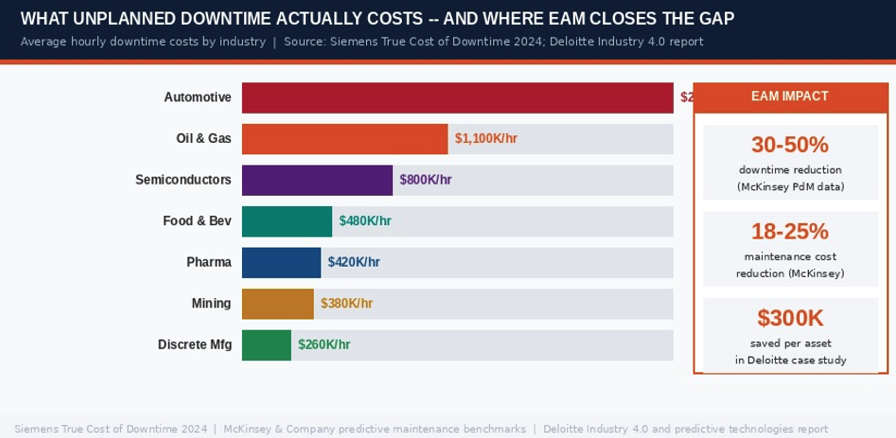
Deloitte’s Industry 4.0 research found that poor maintenance strategies reduce a plant’s overall productive capacity by between 5% and 20%.
These costs are not evenly distributed. They cluster around predictable failure points: assets whose criticality was underestimated because part-level analysis was never performed, spare parts that ran out because reorder points were set against obsolete consumption data, work orders that were deprioritised because the planning system had no real-time visibility into the consequence of the delay.
In each case, the failure is not a technology failure. It is a data and process failure that sits exactly at the EAM layer.
“The gap between Industry 4.0’s promise and its delivered results is almost always an EAM problem in disguise. The sensors are generating the right data. The algorithms are capable of the right analysis. The asset management layer is not ready to act on either.”
The inverse case is equally well documented. McKinsey research demonstrates that organisations achieving mature predictive maintenance see maintenance cost reductions of 18 to 25%, downtime reductions of up to 50%, and asset life extensions of up to 40%.
An IoT Analytics survey found that 95% of organisations that implement predictive maintenance properly report positive ROI, with 27% achieving full payback within 12 months. The underlying factor in every case is whether the EAM infrastructure was capable of connecting the predictive insight to the maintenance action.
What the Architecture of Evolved EAM Looks Like
The architecture of an Industry 4.0-ready EAM system is not a single platform. It is an integration layer that connects four data domains, IIoT sensor streams, ERP inventory and procurement data, EAM asset and work order records, and unstructured OEM documentation, into a unified intelligence loop.
As the trajectory of smart manufacturing investment shows, the organisations pulling ahead are not necessarily the ones that have bought the most advanced point solutions. They are the ones that have built the connective tissue between their existing systems most effectively.
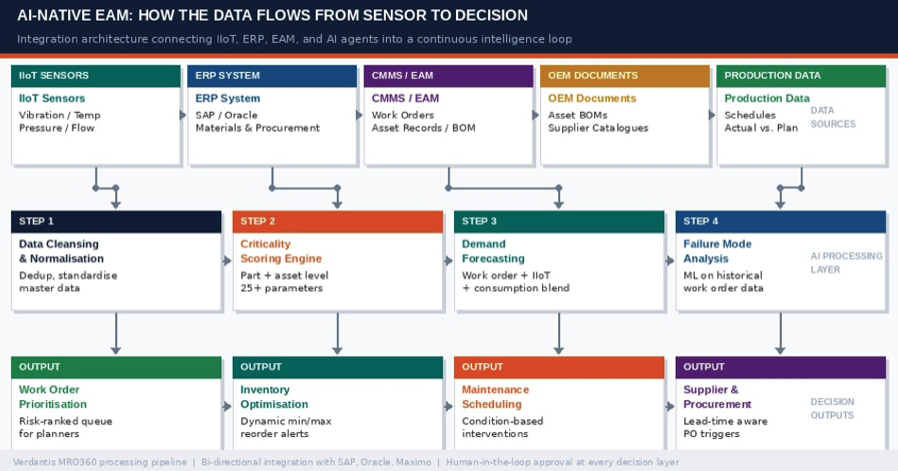
The architecture illustrated above shows the data flow in an AI-native EAM implementation. Three things are worth highlighting about what makes this different from conventional EAM.
First, every data domain feeds every other. The IIoT layer does not just feed the predictive maintenance module. It feeds the criticality scoring engine, which adjusts spare parts stocking recommendations, which updates procurement triggers.
A single sensor reading that indicates elevated bearing vibration initiates a chain of data updates that flows through asset criticality, parts availability, work order scheduling, and supplier lead time checking, automatically, before a failure has occurred.
Second, the human approval layer exists at the decision output stage, not at the data processing stage. Planners are not reviewing sensor readings. They are reviewing proposed actions, a work order priority change, a procurement trigger, a criticality score adjustment, with the full reasoning chain visible.
This is what makes the system auditable and improvable. When a planner overrides an AI recommendation, the rationale is captured and fed back into the model.
Third, the architecture is bi-directional. Decisions made in the EAM layer feed back into the data sources.
A work order completion record updates the asset history, which updates the failure probability model, which updates the criticality score, which adjusts the stocking recommendation. The system is continuously learning from operational reality rather than being updated periodically from outside.
The Practical Readiness Assessment
For organisations looking to close the gap between their current EAM practice and what Industry 4.0 requires, the starting point is an honest assessment of where the infrastructure actually stands. Four questions define the readiness baseline.
1. How complete is your BOM-to-asset linkage?
For the assets generating the most work order activity in the last 24 months, what percentage of their spare parts have a verified, current linkage to the equipment record in your EAM?
Below 80% means your criticality analysis is missing the part-level context that drives the most consequential stocking decisions. This single metric predicts more about parts-related downtime risk than any other indicator.
2. How stale are your min/max levels?
When were the min/max inventory levels for your top 100 critical spare parts last reviewed and updated? If the answer is more than 12 months, your safety stock settings reflect operational conditions that no longer exist. Production volumes, supplier lead times, and failure patterns all change faster than annual review cycles can capture.
3. How clean is your material master data?
Run a duplicate analysis on your material descriptions. Any duplicate rate above 5% means your planners are making stocking and procurement decisions against a catalogue that is actively misleading them.
Nearly 70% of manufacturers cite data quality as the primary obstacle to AI implementation, according to the Deloitte survey. Fixing the data layer is not a prerequisite for starting, but not fixing it guarantees that the AI investment will underperform.
4. Are your IIoT signals connected to your maintenance decisions?
Can a condition monitoring alert on a specific asset automatically generate a work order, check parts availability, and update the job priority queue without human intervention? If the answer is no, your IIoT investment is generating insight without action. The sensor data is doing half its job. The EAM integration is the other half, and it is currently missing.
The Sequencing That Works in Practice
The biggest risk in EAM evolution programmes is attempting to build everything simultaneously. Organisations that try to deploy AI criticality scoring, real-time IIoT integration, dynamic inventory optimisation, and continuous data governance in parallel typically achieve none of them well. The sequencing matters as much as the ambition.
- Clean the material master, validate BOM linkages, and establish continuous governance before deploying AI scoring or predictive algorithms. The AI layer will produce better outputs in six months than the data cleansing would have produced in six years on its own. But AI on dirty data produces confidently wrong recommendations, which erodes trust faster than no AI at all. Start with data infrastructure, not intelligence.
- The criticality scores drive every downstream stocking decision. Running them first means that when min/max levels are recalibrated, they are recalibrated against accurate risk data rather than against whatever the previous scoring exercise produced. Run part-level criticality before touching inventory settings.
- ERP procurement and inventory data is the highest-value integration for most facilities because it directly affects stocking decisions and procurement triggers. IIoT integration delivers more value once the inventory intelligence layer is operating, because the condition signals have somewhere to land. Integrate one data domain at a time, starting with ERP.
- Every AI recommendation should have a visible rationale and a clear approval workflow before the system is deployed at scale. This is not a concession to scepticism – it is how the system learns. Planner overrides with documented rationale are the primary feedback mechanism for model improvement. Establish human-in-the-loop approval before scaling.
On integration compatibility
Verdantis MRO360 integrates bi-directionally with SAP, Oracle, and IBM Maximo. The integration does not require replacing the existing EAM system, it augments it with a continuous intelligence layer that feeds enriched data back into the platform your teams already work in.
The criticality scores, reorder point recommendations, and work order priority adjustments appear in the workflows planners already use, rather than requiring a new system to be adopted alongside existing ones.
Industry 4.0 is Not Waiting for EAM to Catch Up
The smart factory investment cycle has created enormous momentum. Sensors are being deployed, connectivity is expanding, and the data infrastructure for intelligent manufacturing is being built at significant scale across the industrial economy. What has not kept pace is the asset management practice layer that determines whether that investment translates into operational outcomes.
The organisations that will realise the most from Industry 4.0 over the next decade are not necessarily those with the most advanced sensor networks or the most sophisticated ML models.
They are the ones that have built an EAM infrastructure capable of connecting those sensors and models to maintenance decisions, inventory decisions, and procurement decisions in real time, continuously, at scale, with human judgment applied where it adds the most value.
The EAM evolution is not a technology project. It is a data discipline and an operational commitment. The technology to support it exists. The question for each organisation is whether the infrastructure underneath their Industry 4.0 investment is ready to carry the weight it is being asked to bear.
“Industry 4.0 is not a failure of technology. In most facilities, it is a failure of the data and process layer that was supposed to connect technology to action.”
