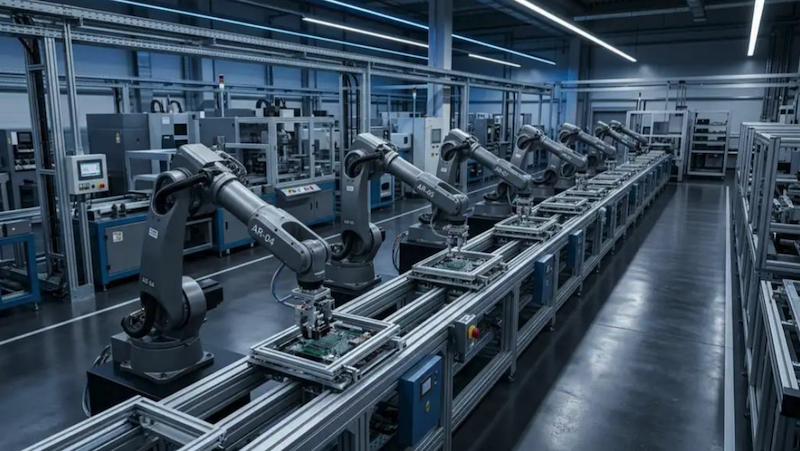
Walk into a modern shop floor and the contrast is immediate. Bright collaborative robot arms move with practised precision next to conveyors that have been running since the 1990s.
Touchscreen dashboards glow above workstations where an operator still keeps a grease-stained notebook with the real setup parameters.
That juxtaposition is the current state of factory automation: a layered environment where each new capability has to coexist with what came before.
Cobot arms
The market numbers tell one story. Industrial automation sits at roughly $137.4 billion this year and is projected to reach $234.7 billion by 2035, a compound annual growth rate of 5.5%, according to widely cited market research summarised by Fortune Business Insights and Precedence Research.
But headline figures don’t capture the three-hour debugging session caused by a 1998 PLC that won’t talk to a cloud gateway without a protocol translator that costs more than the original controller did.
Factory automation today is less a technology problem than an integration problem, a workforce problem, and a question of how to move toward a more capable plant without taking the line down.
This article looks at that transition from the engineer’s perspective rather than the vendor’s.
Technology trends reshaping the plant floor
Three forces are converging: artificial intelligence and machine learning, the Industrial Internet of Things (IIoT), and deeper robotics integration. None of these are new in themselves. What has changed is their maturity and, in many facilities, their economics.
The International Federation of Robotics recorded 541,302 new industrial robot installations globally in its most recent World Robotics report, with preliminary figures for 2025 projecting the highest annual total on record.
More notable than the volume is the distribution. Automotive final assembly is no longer the dominant sector. Electronics, food processing, and life sciences are deploying articulated arms, SCARA units, and delta robots in configurations that would have been impractical only a few years ago.
The software layer is maturing in parallel. AI-driven vision systems for defect detection – fundamentally different from the rule-based systems of the late 2010s – are now fast enough to fold quality inspection directly into the production station rather than requiring a separate quality cell.
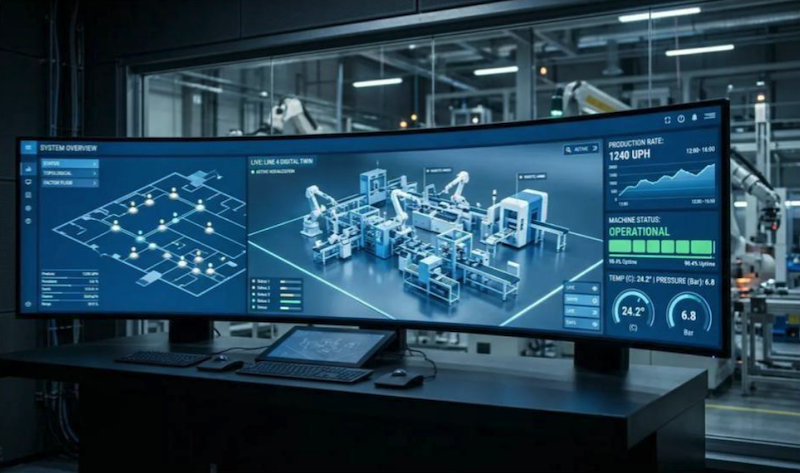
Digital twins are moving from pilot projects into daily operations, allowing schedule changes, tooling swaps, and capacity rebalancing to be simulated before any physical change is made.
Adoption metrics reflect the shift. Industry surveys from Deloitte and the MPI Group indicate that roughly 45% of manufacturers now have IIoT connectivity on at least some equipment, and around 42% have deployed predictive maintenance in some form.
These are no longer early-adopter numbers. The harder question is whether the connected systems actually interoperate, and in most facilities they do not. Adoption and integration are two separate problems.
Implementation challenges: where projects stumble
The technology case is compelling. Execution is where projects succeed or fail, and the technology itself is rarely the limiting factor.
Workforce readiness
Labour shortages receive most of the attention, but the deeper issue is institutional knowledge leaving the organisation. The technician who has troubleshot Line 3 for thirty years is retiring, and much of what they know was never documented. The skills gap is not generational; it reflects a job that has changed.
Mechanical troubleshooting is still essential, but it now needs to sit alongside data interpretation, basic network security, and enough scripting ability to read a log file. Training programmes exist; production schedules rarely accommodate them.
Integration complexity
Legacy equipment remains the central challenge. Proprietary protocols, closed architectures, and controllers never designed to share data with external systems make retrofitting connectivity an ongoing exercise.
Edge devices, protocol gateways, and sensor overlays make it possible, but each addition introduces cost, a potential failure point, and a long-term support obligation. It is not unusual to see production cells bridging three decades of control technology in a single rack.
ROI justification
Capital investment in automation remains significant. Recent industry data from VDMA showed a 6% decline in turnover across German automation suppliers, bringing the sector to €15.2 billion.
The picture is one of more disciplined buyers rather than a contracting market. Projects without a clear payback window, typically 18 to 36 months, are being shelved or scaled down. This has driven sustained interest in modular, scalable systems that allow incremental capability additions rather than line-wide overhauls.
Application focus: precision manufacturing and enabling technologies
One area where automation investment is delivering measurable returns is precision manufacturing – micro-scale components for electronics, medical devices, and photonics. Tolerances in these applications are unforgiving, and traditional mechanical processes often struggle to hold them at production volumes.
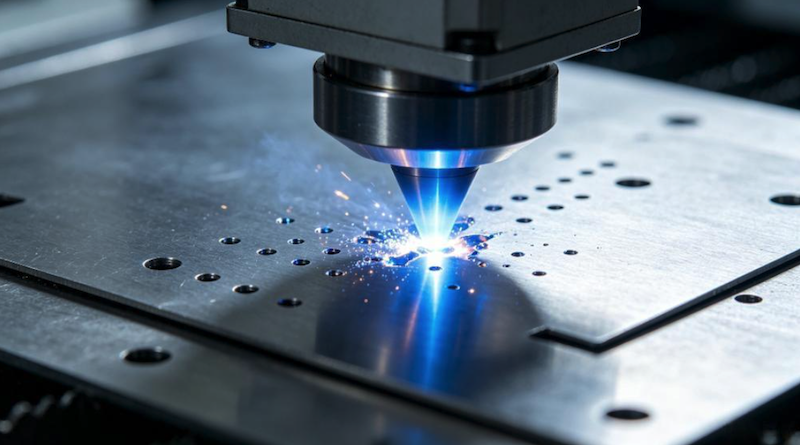
Laser-based processing has become a key enabling technology. In automated production environments, cutting, perforating, or patterning materials at micron-level precision, with no tooling wear and no mechanical contact, changes the economics of changeover and maintenance.
For lines producing SMT stencils, micro-components, or precision perforations, laser micromachining capability is best treated as a production constraint that defines what the line can do, not as a discretionary upgrade.
Systems at the leading edge of this space achieve accuracy in the single-digit-micron range with minimal heat-affected zones, which is often the difference between a process that meets the requirements of quality-sensitive automated workflows and one that does not.
The strategic implication, which matters for line design rather than vendor selection alone, is that factory automation is expanding into sectors where tolerances continue to tighten: wearable electronics, implantable medical devices, optical sensors. If the precision fabrication processes cannot keep up, the automation line is limited before it is built.
Collaborative robots are also performing well in these environments. Flexible manufacturing for mass customisation is where cobots add the most value: they reconfigure quickly for smaller batch sizes without the safety-cage infrastructure and programming overhead of traditional industrial robots.
The shift from dedicated lines optimised for a single product toward flexible cells that absorb variability in demand and product mix is well underway, and cobots are central to making it practical.
Future outlook: flexible manufacturing and sustainable operations
The direction of travel is being shaped less by any single breakthrough than by an accumulation of incremental advances that, taken together, are beginning to add up to something significant.
Flexible manufacturing systems – lines designed to reconfigure quickly rather than maximise throughput on a single SKU – are becoming the baseline expectation. Demand fragmentation is the driver: customers want customisation without the traditional small-batch premium.
Delivering this at scale requires more than cobots and modular hardware. It requires software-defined workflows in which routing, scheduling, and quality parameters can be updated by configuration rather than by mechanical intervention.
Automatic factory control console
Sustainability is being reframed on the plant floor, from a compliance requirement to an operational efficiency and equipment longevity question.
Reduced material waste through tighter process control, energy optimisation via load-aware scheduling, and extended equipment life through predictive maintenance all serve environmental goals while improving unit economics. Factory automation is the mechanism that makes both achievable at production scale.
The fully autonomous AI-driven smart factory – systems coordinating production in near-real time from demand signals, supply status, and equipment condition – remains aspirational for most operations.
The building blocks exist, but they are not yet connected in operationally meaningful ways. The remaining gap is integration discipline: standardising data formats and developing the operational expertise to manage software-centric environments.
Conclusion
Factory automation in its current form is not a revolution, nor is it a solved problem.
It is a transition – uneven across industries, constrained by legacy infrastructure, and ultimately dependent on people who understand mechanical, electrical, and software systems well enough to make them work together in real production environments.
The technology is ready. Market indicators support continued investment, and projections pointing toward a $234.7 billion automation market are realistic.
What determines success is execution.
Manufacturers that succeed will be the ones that integrate systems incrementally, justify investments with realistic timelines, and build operational teams capable of supporting a fundamentally different kind of factory than the one most production environments were originally designed around.
For engineers and decision-makers planning the next phase of automation, the most practical approach is to focus less on the most visible equipment and more on building a credible path from current operations to a more capable plant – step by step, with full awareness of the realities on the shop floor.
That is where automation initiatives succeed.
Or fail.
