Arduino has spent more than two decades making electronics and embedded programming accessible to students, hobbyists, engineers and product developers around the world.
What began as an open-source microcontroller platform has evolved into a widely used development ecosystem, with its technology now helping to prototype products across industries ranging from automotive and industrial automation to connected devices and robotics.
The company’s acquisition by semiconductor giant Qualcomm marks a new chapter in that evolution. By combining Qualcomm’s AI and computing technologies with Arduino’s developer tools and open-source philosophy, the company aims to lower the barriers to developing intelligent machines, particularly in robotics and edge AI applications.
Robotics & Automation News spoke with Marcello Majonchi, Arduino’s chief product officer, about what the acquisition means for both companies and why he believes robotics is entering a phase similar to the early days of the Internet of Things.
He also discusses Arduino’s latest Qualcomm-powered hardware, including the Uno Q and Ventuno Q, and explains how the company hopes to accelerate the journey from prototype to production for robotics developers.
Majonchi also reflects on Arduino’s Italian heritage, arguing that the country’s contributions to computing are often overlooked despite pioneering innovations such as the Olivetti Programma 101 and the work of semiconductor pioneer Federico Faggin.
Looking ahead, he identifies robotics, industrial automation, and building and home automation as the company’s three biggest growth opportunities, while reaffirming Arduino’s commitment to open standards and making advanced technology accessible to a wider community of developers.
Interview with Marcello Majonchi

Robotics & Automation News: Let’s start with the news. What’s the latest development at Arduino?
Marcello Majonchi: The last year has been very busy for us. In October, Qualcomm acquired Arduino, alongside the first product resulting from our collaboration.
Arduino celebrated its 21st anniversary this year, and I see three distinct phases in its evolution.
The first was democratizing electronics. The second focused on IoT and connectivity. Now, with Qualcomm, we’re entering a third phase centred on edge AI, particularly for automation and robotics.
Our mission has always been to make complex technology easier to use, and that remains our focus.
Our latest product is the Ventuno Q, which begins shipping in August. It’s the most powerful Arduino we’ve ever built and has a strong focus on robotics.
R&AN: I’ve always found Arduino interesting. Years ago I bought one because I use Apple Macs and, at the time, Arduino supported them while Raspberry Pi didn’t. I never got very far with it, but it made me wonder: is Arduino still more Mac-friendly than Raspberry Pi?
MM: Yes. Our developer tools support Windows, macOS and Linux, including Apple Silicon.
The bigger difference isn’t Mac compatibility but philosophy. Raspberry Pi is primarily a hardware platform, while Arduino is a development platform built around software tools.
Our latest Qualcomm-based boards combine Raspberry Pi-class computing performance with the real-time capabilities of a microcontroller and AI-focused developer tools.
R&AN: The Qualcomm acquisition struck me as a masterstroke. Qualcomm is a much larger company, while Arduino is comparatively small, but I can see significant potential, especially in robotics. What do you see as the strategic benefits for both companies?
MM: The acquisition is really about two things: strategy and culture.
Strategically, Arduino has always focused on making complex technology more accessible. We applied that to electronics, then IoT, and now to robotics by lowering the barriers for developers.
Culturally, Arduino remains an independent Qualcomm subsidiary. That gives Qualcomm direct feedback from customers working in IoT, robotics and edge AI, while giving Arduino access to Qualcomm’s AI technologies and a much broader ecosystem.
We’re combining Qualcomm’s power-efficient AI hardware with the Arduino developer stack to make technologies such as AI models and ROS 2 much easier to deploy.
R&AN: I find it fascinating that Arduino emerged in Italy. Raspberry Pi became well known in the UK, but Italy isn’t a country most people associate with computing. How did Arduino come out of that environment?
MM: I love this question.
Italy is known for football and food, but it’s also made major contributions to computing – it just hasn’t always been good at promoting them.
The Olivetti Programma 101, regarded as one of the first desktop personal computers, was developed in Italy and used by NASA during the Apollo 11 mission. Federico Faggin, who pioneered silicon gate technology, was also Italian.
Today, Italy remains an important semiconductor centre through companies such as STMicroelectronics.
Arduino itself grew out of the heritage established by Olivetti and continues that tradition.
R&AN: I started my journalism career using those old typewriters, including ones made by Olivetti, and they were beautifully engineered. Italy has a reputation for elegant industrial design. Does that design philosophy influence Arduino? And what hardware have you and Qualcomm developed together so far?
MM: We already have products on the market.
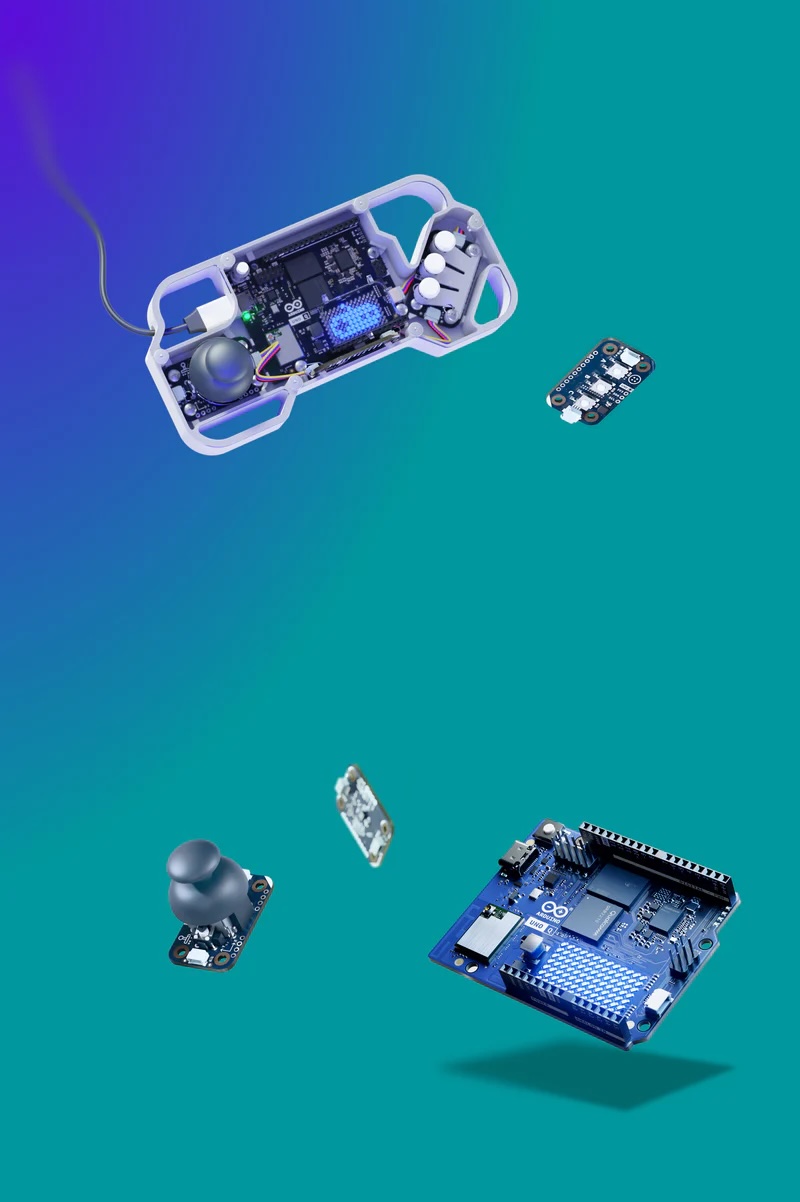
The Arduino Uno Q is the first product from our collaboration with Qualcomm. It combines a Qualcomm chipset with a microcontroller in the traditional Arduino form factor and, for just over $50, can run edge AI models and power robots.
We’re also launching the Ventuno Q, which delivers 40 TOPS of AI performance – enough to power a fully autonomous AMR with a robotic arm. We demonstrated exactly that at Embedded World.
R&AN: What is your view of the robotics industry? We’re seeing an explosion of innovation, particularly in humanoid robotics, but the market is still taking shape. Where do you see Arduino fitting into that landscape?
MM: Today’s robotics market reminds me of IoT in its early days. There’s enormous innovation, with many startups experimenting and competing. Some will become industry leaders, while others will inspire the next generation of technologies.
Arduino’s role is to lower the barriers to robotics development and speed up the journey from prototype to production.
More than 95 percent of automotive manufacturers already prototype on Arduino, including companies such as BMW, because it reduces development time and complexity. We believe robotics will follow the same path as more developers gain access to these technologies.
R&AN: So Arduino is used by 95 percent of automotive manufacturers for prototyping, and companies such as BMW, Rolls-Royce and Mercedes-Benz use it in their development work?
MM: Yes. We have a detailed case study on our website showing how BMW Group standardized its prototyping on Arduino.
It’s a collaboration that continues today, and Mercedes-Benz has adopted a similar approach.
R&AN: I’m about to start a cabinet-making course, and one area that interests me is smart furniture. I like the idea of adding electronics to furniture, such as motorized chairs with adjustable controls. Is Arduino being used for projects like that?
MM: Absolutely.
Our websites, blog.arduino.cc and projecthub.arduino.cc, feature dozens of smart furniture, home automation and other community projects built with Arduino.
R&AN: Do you think smart furniture is a growing market?
MM: Yes.
Alongside hobbyists building custom furniture and connected home projects, more companies are using Arduino to develop commercial smart products.
We also introduced one of the first prototyping platforms for the Matter protocol, allowing developers to build interoperable smart-home devices without going through the full certification process during development.
It’s an area that’s growing rapidly.
R&AN: Is there a business opportunity in developing standards that everyone adopts?
MM: We’re committed to open standards, so we don’t make money from the standards themselves.
Our business is providing high-quality tools that make those standards easier to adopt.
R&AN: If you had to choose one area for Arduino’s future growth, whether it’s autonomous vehicles, humanoid robots or smart furniture, which would interest you the most?
MM: Three sectors stand out: robotics, industrial automation, and building and home automation.
Those are where we see the strongest customer demand and the greatest number of projects.
Beyond that, Arduino is used in everything from satellites to baby products. That’s the strength of the platform – people continually find new applications we never imagined.
