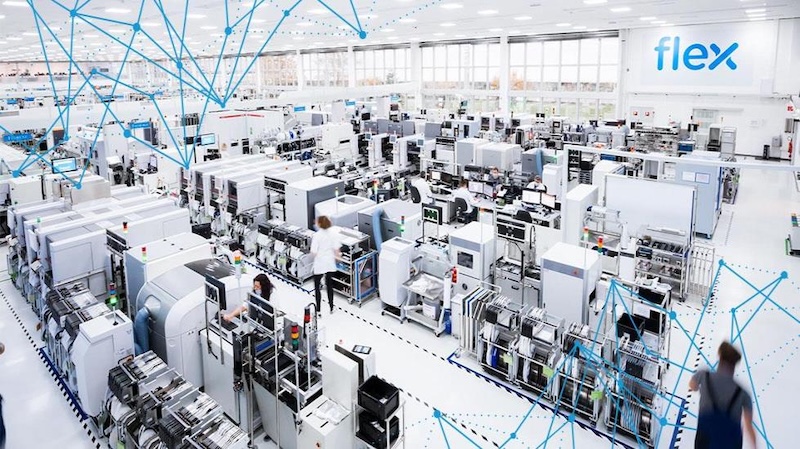
As manufacturers face increasing pressure to improve productivity, quality, and resilience while managing growing product complexity, automation is becoming a central part of modern factory operations.
Technologies such as collaborative robots, autonomous mobile robots (AMRs), and emerging forms of physical AI are moving beyond pilot projects and into large-scale production environments.
One company at the forefront of this trend is Flex, one of the world’s largest contract manufacturers, which serves customers across industries including automotive, healthcare, industrial equipment, communications, and consumer electronics.
The company recently announced an expansion of its long-standing partnership with Teradyne Robotics, under which Flex will both deploy robotics solutions within its own facilities and manufacture key robotics components for Teradyne customers worldwide.
The agreement reflects a broader shift taking place across manufacturing as companies seek to scale automation technologies that can improve operational flexibility while helping address labor shortages, supply chain uncertainty, and increasing demands for efficiency.
In this Q&A, Rodrigo DallOglio, president of operational excellence and transformation at Flex, discusses what the company has learned from deploying automation across its own global operations and why moving from pilot projects to large-scale implementation remains one of the industry’s biggest challenges.
DallOglio also explains how collaborative robots and AMRs are helping manufacturers balance flexibility with standardization, and offers his perspective on the growing role of physical AI in factory environments.
While fully autonomous factories remain some distance away, he argues that AI-enabled robotics is already delivering practical benefits by making manufacturing operations more adaptable, scalable, and resilient.
The conversation provides insight into how one of the world’s largest manufacturing organizations views the future of industrial automation and the technologies that are likely to shape the next generation of production systems.
Interview with Rodrigo DallOglio

Robotics & Automation News: Flex operates at a global scale across multiple industries. How does deploying robotics internally – while also manufacturing components for partners like Teradyne Robotics – change the way you think about scaling automation compared with traditional factory upgrades?
Rodrigo DallOglio: Flex’s position as both a manufacturer and user of advanced robotics gives us firsthand insight into how automation scales effectively.
It starts with validating workflows and optimizing processes within a single environment, then replicating proven approaches across additional sites and operations.
That continuous feedback loop helps Flex scale automation to improve productivity, quality, flexibility, and operational resilience across increasingly complex manufacturing environments.
R&AN: Contract manufacturing is highly competitive. To what extent is automation now a necessity rather than a differentiator for companies like Flex to remain competitive on cost, quality, and speed?
RD: Automation is a key driver of performance, quality, and responsiveness in contract manufacturing. As products grow more complex and demand shifts rapidly, manufacturers need solutions that improve precision, accelerate production timelines, and enable faster responses to operational changes.
For Flex, the focus is less on competitive positioning and more on using automation to strengthen execution, scale proven solutions across facilities, and build more resilient global operations.
R&AN: Many manufacturers struggle to move from pilot automation projects to full-scale deployment. What have you learned in Flex’s own factory environments about what works – and what doesn’t – when scaling robotics across global production networks?
RD: One of the biggest lessons is that a successful automation solution must solve a real operational need and be designed with scale in mind from the beginning.
Pilots can demonstrate technical feasibility, but scaling requires standardized solutions, strong integration with operations, and clear feedback from teams using the technology.
Successful deployments typically start with a focused, high-impact use case inside a single facility, where teams can measure performance, refine the technology using live operational data, and establish a repeatable model before expanding to additional facilities and production lines.
Ultimately, scaling automation is an interactive process that rewards careful planning and real-world validation.
R&AN: Contract manufacturers must handle high product variation and frequent design changes. How do collaborative robots and AMRs help balance the need for flexibility with the efficiency of standardized production processes?
RD: Collaborative robots (cobots) and AMRs (autonomous mobile robots) are especially useful because they avoid locking manufacturers into rigid production models, compared to more traditional material handling solutions.
Cobots can handle repeatable tasks such as assembly and handling, while AMRs streamline material movement and reduce manual transport across facilities.
Together, they enhance efficiency while preserving the flexibility needed to manage product variation, shifting demand, and frequent design changes.
R&AN: The announcement references emerging “physical AI” capabilities. In practical terms, what does that mean on a factory floor today – and how far are we from systems that can adapt in real time to changing production conditions without human intervention?
RD: Physical AI refers to artificial intelligence systems that operate in and interact directly with the physical world, moving beyond digital-only AI (like chatbots) and applying AI intelligence in robots, vehicles, and sensors.
These systems perceive their surroundings through cameras, lidar, and microphones, and reason in real time to perform tasks such as navigation, manipulation, and autonomous decision-making.
While fully autonomous systems that can adapt to every condition without human intervention are still evolving, the near-term opportunity is very real: using AI-enabled robotics to make factory operations more flexible, efficient, and easier to scale.
