• Skip to primary navigation
  • Skip to main content
  • Skip to primary sidebar
  • Skip to secondary sidebar
  • About
    • Contact
    • Privacy
    • Terms of use
  • Shop
    • Cart
    • Checkout
    • My Account
  • Advertise
    • Advertising
      • Buy ad space
    • Case studies
    • Design
    • Email marketing
    • Features list
    • Lead generation
    • Magazine
    • Press releases
    • Publishing
    • Sponsor an article
    • Webcasting
    • Webinars
    • White papers
    • Writing
  • Subscribe to Newsletter

Robotics & Automation News

Where Innovation Meets Imagination

  • Home
  • News
  • Features
  • Editorial Sections A-Z
    • Agriculture
    • Aircraft
    • Artificial Intelligence
    • Automation
    • Autonomous Vehicles
    • Business
    • Computing
    • Construction
    • Culture
    • Design
    • Drones
    • Economy
    • Energy
    • Engineering
    • Environment
    • Health
    • Humanoids
    • Industrial robots
    • Industry
    • Infrastructure
    • Investments
    • Logistics
    • Manufacturing
    • Marine
    • Material handling
    • Materials
    • Mining
    • Promoted
    • Research
    • Robotics
    • Science
    • Sensors
    • Service robots
    • Software
    • Space
    • Technology
    • Transportation
    • Warehouse robots
    • Wearables
  • Press releases
  • Events

Human-Robot Collaboration: How Modern Workplaces Can Be Designed for Safety, Productivity, and Employee Wellbeing

June 1, 2026 by Sam Francis

Physical barriers are disappearing from the modern production floor, with the $85 billion industrial robotics market creating a shared environment where people and machinery work side by side.

Successfully managing this transition requires a deep understanding of spatial geometry, workforce psychology, and functional safety standards.

There are millions of industrial robots deployed worldwide, and each unit requires a workspace specifically engineered to balance operational speed with human safety.

Designing Shared Workspaces for Human-Robot Teams

When humans and machines share a workspace without physical fencing, the floor layout determines safety outcomes.

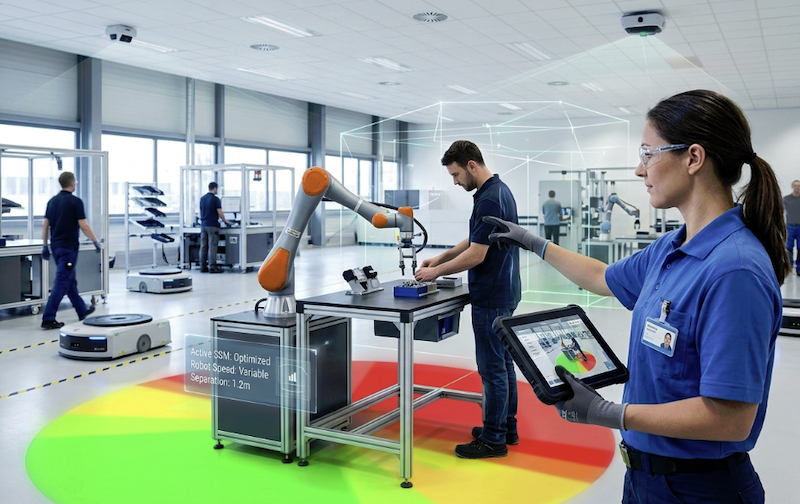
Area scanners and computer vision systems must be integrated into the physical environment to establish active, multi-zone safety perimeters. Facilities can maximize floor space efficiency by zoning areas based on operational risk.

  • Green zones allow unrestricted human movement while robots operate at baseline speeds
  • Yellow zones trigger an automatic reduction in machine velocity as a worker approaches
  • Red zones act as an immediate safety stop to prevent any physical contact

Maintaining open sightlines across these zones prevents collisions and lowers the cognitive burden on your workforce. If employees cannot easily predict machine movements, stress levels rise, and overall productivity drops.

Successfully integrating robots into the workplace depends on building a reliable framework where employees feel physically secure and mentally supported. Specialist oversight and ongoing monitoring matter most, so it’s not a process worth rushing.

Regulatory Compliance and Force Dynamics

The regulatory landscape governing automated workplaces has shifted toward stricter functional requirements. The updated ISO 10218-1:2025 standard introduces specific classifications for functional safety and clarifies cybersecurity requirements in industrial robotics.

This update reflects the reality that modern software security directly impacts physical safety on the factory floor.

Deploying autonomous systems requires conducting a comprehensive risk assessment that accounts for the specific tools attached to the robotic arm.

A robot operating under force-limiting thresholds can still cause injury if it handles sharp or heavy components. Designers must evaluate the entire application, rather than analyzing the robotic unit in isolation.

Supporting Workforce Well-being and Mental Comfort

Employee wellness in automated environments extends beyond basic physical protection to include psychological comfort. Introducing heavy machinery into a human workspace can cause anxiety if the deployment process lacks transparency.

Operators need clear, predictable visual and auditory feedback mechanisms to understand what a robot plans to do next.

Using intuitive human-machine interfaces reduces the daily stress associated with managing complex hardware. When workers undergo thorough training on safety systems, they stop viewing automation as a threat and start treating it as a functional tool.

This transition allows your staff to hand over repetitive, ergonomically hazardous tasks to machines and focus on higher-value work.

Data-Driven Safety and Real-Time Telemetry

Modern collaborative environments rely heavily on continuous data loops to optimize both protection and throughput.

Beyond static zone configurations, advanced facilities deploy real-time telemetry systems that aggregate data from edge sensors, wearable worker badges, and robotic controllers.

By analyzing this stream via localized machine learning algorithms, the system can predict potential spatial conflicts before they occur.

For instance, if an operator’s movement patterns suggest they are approaching a yellow zone at an unusually high speed, the system can preemptively decelerate the machinery.

This shifting from reactive safety to predictive spatial management minimizes sudden emergency stops, reducing mechanical wear and maintaining a steadier production cadence.

Furthermore, logging these near-miss events allows safety engineers to identify systemic layout flaws and redesign traffic patterns based on empirical evidence rather than assumptions.

Kinetic Energy Management and Speed-Separation Monitoring

At the core of collaborative robotics is the strict management of kinetic energy. While ISO standards outline force-limiting thresholds, achieving true optimization requires implementing Speed and Separation Monitoring (SSM).

SSM systems dynamically calculate the minimum protective distance between a human and a robot based on their relative velocities and the machinery’s total stopping time.

Instead of relying on fixed physical zones, the safety perimeter expands or contracts in real time. If a worker moves quickly, the protective bubble around the robot grows; as the worker slows down or changes direction, the bubble shrinks, allowing the robot to resume higher operational speeds.

By precisely controlling the robot’s kinetic energy in relation to human proximity, facilities can maintain peak productivity without compromising the physical integrity of the workforce.

Optimizing Long-Term Spatial Workflows

A successful floor design adapts to changing production needs without sacrificing safety baselines. Scalable layouts use modular workstations and flexible safety-sensor grids to accommodate future hardware upgrades.

Regular safety audits and sensor calibrations ensure that proximity detection zones remain accurate as workflows evolve over time.

Facility managers should actively involve floor workers in the spatial planning process to capture nuanced operational insights.

This collaborative approach ensures that safety configurations do not accidentally create bottlenecks in daily production. Check out our other posts on robotics and safety for a broader overview of where things stand and why this topic matters so much.

Print Friendly, PDF & Email

Share this:

  • Print (Opens in new window) Print
  • Share on Facebook (Opens in new window) Facebook
  • Share on LinkedIn (Opens in new window) LinkedIn
  • Share on Reddit (Opens in new window) Reddit
  • Share on X (Opens in new window) X
  • Share on Tumblr (Opens in new window) Tumblr
  • Share on Pinterest (Opens in new window) Pinterest
  • Share on WhatsApp (Opens in new window) WhatsApp
  • Share on Telegram (Opens in new window) Telegram

Related stories you might also like…

Filed Under: Engineering, Robotics Tagged With: automation news, automation strategy, cobots, collaborative automation, collaborative robots, employee wellbeing, factory design, future of work, human machine interaction, human robot collaboration, human-centered automation, industrial automation, industrial robotics, industry 4.0, manufacturing technology, robotics and automation, robotics and automation news, robotics in manufacturing, robotics news, robotics safety, robotics.integration, smart factories, warehouse automation, workplace productivity, workplace safety

Primary Sidebar

Search this website

Latest articles

  • FORT Robotics extends physical AI safety platform with Nvidia Halos
  • Fieldwork Robotics secures SEED Innovations investment to scale berry harvesting robots
  • Multi-robot demo showcases new UK’s Plymouth subsea test range
  • Tech company AVI-SPL launches autonomous Dallas-Houston freight operations with Volvo Autonomous Solutions
  • RoboDK unveils CAM software that cuts robotic machining deployment time ‘by up to 40 percent’
  • Richtech Robotics launches 24/7 interactive livestream featuring AI robot ADAM
  • Cognibotics selected for €6.5 million in EU accelerator funding
  • CS2 Skin Marketplace Comparison: Which Platform Offers the Best Prices and Security?
  • How Automation is Changing Employee Performance Tracking and Recognition
  • What Can Delay a Car Accident Settlement and How an Attorney Helps

Secondary Sidebar

Latest news

  • FORT Robotics extends physical AI safety platform with Nvidia Halos
  • Fieldwork Robotics secures SEED Innovations investment to scale berry harvesting robots
  • Multi-robot demo showcases new UK’s Plymouth subsea test range
  • Tech company AVI-SPL launches autonomous Dallas-Houston freight operations with Volvo Autonomous Solutions
  • RoboDK unveils CAM software that cuts robotic machining deployment time ‘by up to 40 percent’
  • Richtech Robotics launches 24/7 interactive livestream featuring AI robot ADAM
  • Cognibotics selected for €6.5 million in EU accelerator funding
  • CS2 Skin Marketplace Comparison: Which Platform Offers the Best Prices and Security?
  • How Automation is Changing Employee Performance Tracking and Recognition
  • What Can Delay a Car Accident Settlement and How an Attorney Helps

Copyright © 2026 · News Pro on Genesis Framework · WordPress · Log in

We use cookies on our website to give you the most relevant experience by remembering your preferences and repeat visits. By clicking “Accept”, you consent to the use of ALL the cookies.
Do not sell my personal information.
Cookie SettingsAccept
Manage consent

Privacy Overview

This website uses cookies to improve your experience while you navigate through the website. Out of these, the cookies that are categorized as necessary are stored on your browser as they are essential for the working of basic functionalities of the website. We also use third-party cookies that help us analyze and understand how you use this website. These cookies will be stored in your browser only with your consent. You also have the option to opt-out of these cookies. But opting out of some of these cookies may affect your browsing experience.
Necessary
Always Enabled
Necessary cookies are absolutely essential for the website to function properly. These cookies ensure basic functionalities and security features of the website, anonymously.
CookieDurationDescription
cookielawinfo-checkbox-analytics11 monthsThis cookie is set by GDPR Cookie Consent plugin. The cookie is used to store the user consent for the cookies in the category "Analytics".
cookielawinfo-checkbox-functional11 monthsThe cookie is set by GDPR cookie consent to record the user consent for the cookies in the category "Functional".
cookielawinfo-checkbox-necessary11 monthsThis cookie is set by GDPR Cookie Consent plugin. The cookies is used to store the user consent for the cookies in the category "Necessary".
cookielawinfo-checkbox-others11 monthsThis cookie is set by GDPR Cookie Consent plugin. The cookie is used to store the user consent for the cookies in the category "Other.
cookielawinfo-checkbox-performance11 monthsThis cookie is set by GDPR Cookie Consent plugin. The cookie is used to store the user consent for the cookies in the category "Performance".
viewed_cookie_policy11 monthsThe cookie is set by the GDPR Cookie Consent plugin and is used to store whether or not user has consented to the use of cookies. It does not store any personal data.
Functional
Functional cookies help to perform certain functionalities like sharing the content of the website on social media platforms, collect feedbacks, and other third-party features.
Performance
Performance cookies are used to understand and analyze the key performance indexes of the website which helps in delivering a better user experience for the visitors.
Analytics
Analytical cookies are used to understand how visitors interact with the website. These cookies help provide information on metrics the number of visitors, bounce rate, traffic source, etc.
Advertisement
Advertisement cookies are used to provide visitors with relevant ads and marketing campaigns. These cookies track visitors across websites and collect information to provide customized ads.
Others
Other uncategorized cookies are those that are being analyzed and have not been classified into a category as yet.
SAVE & ACCEPT