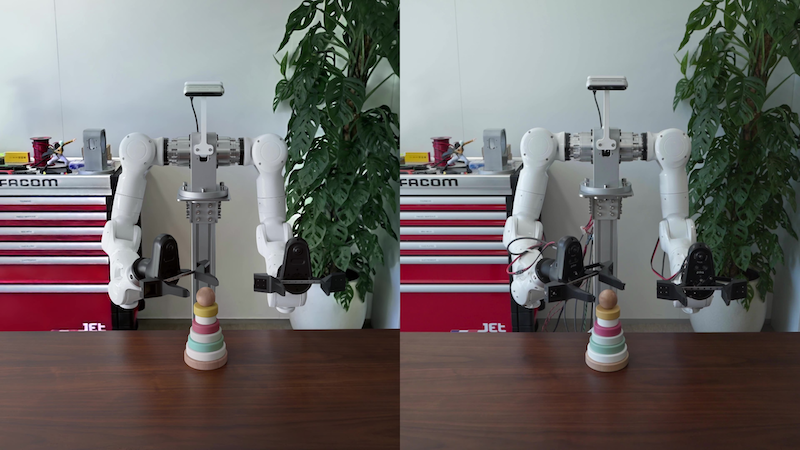
Genesis AI has launched Genesis World 1.0, a new robotics simulation platform designed to dramatically reduce the time required to develop, test, and evaluate robotic AI systems.
The company says the platform can compress robotics evaluation cycles from days to minutes by enabling large-scale testing in photorealistic virtual environments rather than relying solely on physical robots.
According to Genesis AI, a robotics foundation model evaluation that would typically require nearly a week of continuous testing on real hardware can be completed in approximately 30 minutes using Genesis World 1.0 running on GPU infrastructure.
Simulation has long been used in robotics research, but Genesis argues that it should be viewed as more than a tool for generating training data.
Instead, the company sees simulation as a critical infrastructure layer that accelerates the entire robotics development process by enabling rapid experimentation, repeatable testing, and large-scale performance evaluation.
A key challenge in robotics is that testing and validation are often constrained by access to physical hardware, human operators, and laboratory space.
Evaluating a robot’s ability to perform hundreds of tasks across different conditions can require hundreds of hours of real-world testing. By contrast, simulation allows thousands of test scenarios to be run in parallel.
As an example, Genesis says a typical object-handling evaluation involving around 40,000 individual attempts would require approximately 166 hours of continuous testing using a physical robot.
The same workload can be completed in around 30 minutes using simulation running across a GPU cluster.
The company has spent the past year improving the realism of its simulation environment to reduce the so-called “sim-to-real” gap – the difference between a robot’s performance in simulation and its performance in the real world.
Genesis reports that its simulation results now correlate with real-world robot performance at approximately 89 percent, allowing researchers to use virtual testing as a reliable indicator of how systems will behave on physical hardware.
Genesis World 1.0 combines several core technologies. These include:
- Nyx, a new photorealistic rendering engine designed specifically for robotics applications;
- Genesis World, a physics platform that supports rigid bodies, deformable materials, fluids, and other complex interactions; and
- Quadrants, a GPU-accelerated compiler that enables simulation workloads to run efficiently across multiple hardware platforms.
The platform also supports digital twin creation through photogrammetry, allowing real-world workspaces to be reconstructed and simulated using data captured from cameras and mobile devices.
Researchers can then evaluate robotic systems across thousands of variations in lighting conditions, object placement, camera positions, and task configurations.
Looking ahead, Genesis plans to use simulation not only for evaluation but also for reinforcement learning and autonomous robotics training.
The company believes increasingly realistic simulation environments will become a key component of future robotics foundation models, allowing robots to learn, test, and improve continuously in virtual environments before deployment in the real world.
Main image: Genesis World 1.0 side by side of simulation (left) vs reality (right)
