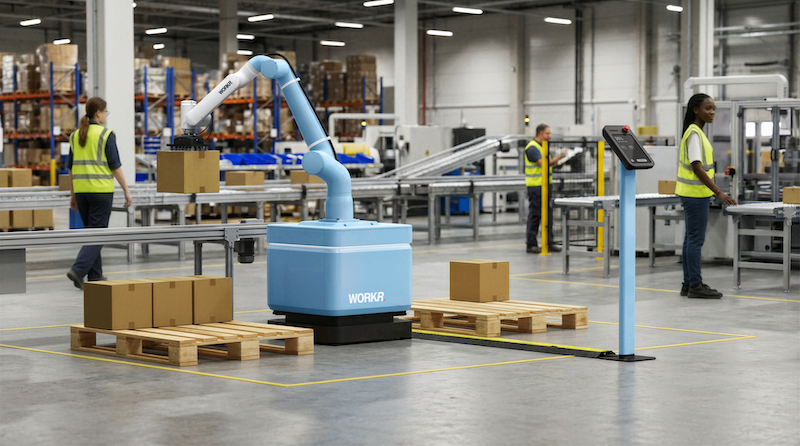
Industrial robotics is entering a new phase. Advances in artificial intelligence, large language models, and so-called embodied AI have sparked renewed excitement about robots that can understand, reason about, and interact with the physical world.
High-profile collaborations between companies such as Google DeepMind and Boston Dynamics have fueled speculation that increasingly capable general-purpose robots may soon find their way onto factory floors.
But not everyone in the industry is convinced that these developments represent an immediate breakthrough for manufacturing.
Ken Macken, founder and CEO of Workr Robotics, takes a more pragmatic view. While he welcomes advances in AI and robotics research, he argues that many of the capabilities attracting headlines today remain a long way from solving the practical challenges manufacturers face every day.
In his view, factory operators care far less about whether a robot can reason than whether it can perform a specific task accurately, reliably, and repeatedly across an entire shift.
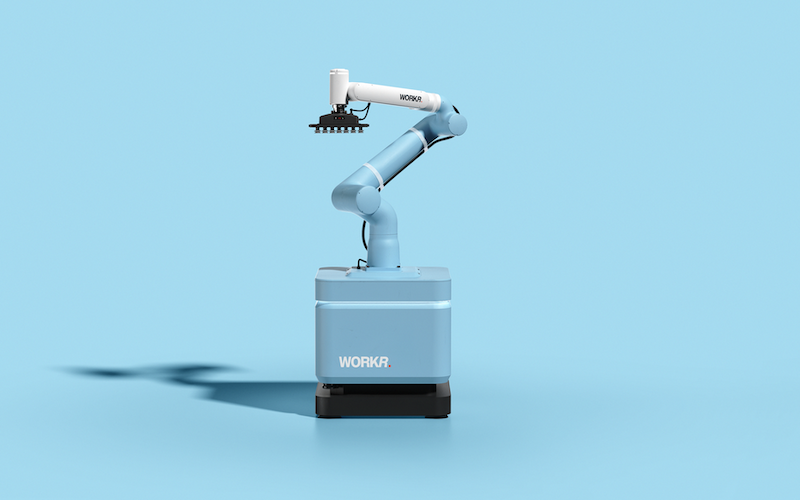
Workr Robotics focuses on automating repetitive industrial tasks such as palletizing, machine tending, and pick-and-place operations.
Rather than pursuing broad general-purpose autonomy, the company emphasizes rapid deployment, operational reliability, and a robotics-as-labor business model designed to lower the barriers to automation adoption.
In this interview, Macken discusses why he believes the robotics industry sometimes confuses impressive demonstrations with production-ready systems, why operational consistency matters more than general intelligence in manufacturing environments, and how manufacturers are increasingly prioritizing flexibility alongside throughput.
He also explains why traditional industrial robot purchasing models can be difficult for many manufacturers to justify, shares lessons learned from deploying robots in real-world factory environments, and argues that successful automation projects require a deep understanding of how work is actually performed on the shop floor – not simply how it appears on process diagrams.
The result is a grounded perspective on where industrial robotics is today, where AI can genuinely add value, and what manufacturers should be looking for beyond the hype.
Interview with Ken Macken

Robotics & Automation News: There’s currently a huge amount of excitement around embodied AI and reasoning models, especially after collaborations such as Google DeepMind working with Boston Dynamics. You’ve argued that much of this is being overstated for manufacturing. What do you think people misunderstand most about the difference between impressive demos and production-ready automation?
Ken Macken: People are mistaking a viral demo for evidence the technology works, and it doesn’t, yet. The tasks manufacturers need automated are surprisingly basic, but they demand 100 percent reliability.
Watching an Atlas robot do parkour is great fun, but putting a robot on a chaotic factory floor that picks the right part every single time, for an entire shift, is a completely different problem.
The vision around embodied AI is exciting and I’m glad people are talking about it. The reality is the technology isn’t ready to do what manufacturers need it to do today, and confusing the two can cost people real money.
R&AN: You’ve said “reasoning is the wrong frame for manufacturing tasks” because factory environments demand near-perfect reliability. Do you think the robotics industry is currently prioritizing general intelligence over the operational consistency manufacturers actually care about?
KM: Yes, and this prioritization matters. A manufacturer doesn’t care whether a system is general or not. What they care about is whether it can do the specific job they hired it to do, every time, every shift. We don’t need a robot to philosophize its way through stacking pallets, we just need it to stack the pallets.
The question a plant manager is asking is, “Can this thing learn my task in under a day, and will it run reliably tomorrow?” Chasing general intelligence in robotics solves problems manufacturers don’t have, while ignoring the operational consistency they actually need to be successful.
R&AN: Workr positions itself around practical deployment, palletizing, machine tending, pick-and-place, and other repetitive factory tasks. In your experience, what are the biggest pain points manufacturers are trying to solve right now, and where does automation genuinely deliver measurable ROI today?
KM: I see three consistent pain points: finding reliable staff, dealing with staff churn, and hitting output targets. Automation delivers real ROI when it gives a facility a capability that lets them take on work they couldn’t before, do more of the work they already have, and drive revenue.
General-purpose automation doesn’t currently solve any of those issues. Factories need specialized tools that produce reliable, predictable output quickly, not slower general-purpose novelties.
R&AN: One interesting aspect of your model is the “robotics-as-labor” pricing approach, charging roughly $25 per hour instead of selling a large capital system upfront. Why do you think the traditional industrial robotics purchasing model has become a barrier for many manufacturers?
KM: Because the traditional model asks a manufacturer to make a huge capital bet on a rigid system before they know what the outcomes will be, and processes change. Why sink seven figures into something built for one task when next quarter the line might look different?
On top of that, traditional robots are sold on the assumption they will run 24/7 which doesn’t represent most factories. Instead, running 12 hours a day, five days a week might be a more realistic schedule, in which case you’re paying for utilization you’ll never use.
Paying for automation by the hour, the way you’d pay a person, takes most of the risk off the table. Workr is priced at $25 an hour with no capital outlay, and if it doesn’t perform, you stop paying.
In our mind that’s the easiest way to remove common automation barriers and help manufacturers solve their problems quickly.
R&AN: Your platform emphasizes high-mix manufacturing and rapid changeovers, claiming part changes can happen in minutes rather than hours. How important is flexibility becoming compared with traditional industrial robotics priorities such as maximum speed and throughput?
KM: Flexibility is now table stakes. Traditional robotics were built for one thing, executed at maximum speed, forever. But tomorrow’s production almost always looks slightly different from today’s, with quality variations, customer customizations, and new SKUs.
The old assumption was that you had to trade flexibility for throughput but that’s no longer true. The technology has caught up and specialized AI models combined with automation now let you have both high-speed throughput and the ability to handle small variations on the same line.
Anyone still framing this as a trade-off is working with last decade’s tools.
R&AN: A lot of AI robotics startups talk about autonomy, but manufacturers often care more about uptime, maintainability, and ease of integration. What lessons have you learned from deploying robots into real factory environments rather than controlled lab settings?
KM: Real factories are infinitely messier than any lab. Lab teams tend to think about a single process in isolation. On a real factory floor, you don’t realize how many upstream and downstream processes one robot is touching until it stops, and suddenly the whole line is feeling it.
Plant managers don’t care about autonomy for its own sake, they care about uptime and high yield output. Their worst day is the day the line goes down. As a robotics solution provider in a factory you have to remember that you’re one piece in a much bigger system.
The biggest lesson for us has been to talk to and watch as many people as possible actually doing the task on the floor. What a plant manager describes in a meeting room is almost never exactly how the task gets done in reality. Workers have hacks, workarounds, little adjustments they’ve developed over years that aren’t written down anywhere.
If you don’t capture those, you end up with a robot that does the described task perfectly and still fails the moment it’s installed next to the real equipment. The job on paper and the job on the floor are two different things, and the floor wins every time.
I’ve seen some startups deploy a solution, congratulate themselves, and then discover they didn’t solve the problem, they just moved the bottleneck somewhere else. It’s the classic mistake of using a hammer to hit in a screw. The tool looks impressive, it makes a lot of noise, but you’re not actually doing the job.
