By Kevin Price, logistics consultant, Dematic
Supply chains are under intense pressure due to constantly shifting order volumes and increased customer expectations, which has made effective management essential.
At the same time, rising operational costs are pushing many warehouse operators to test new ways of running their businesses.
To meet this challenge many organisations have turned to on-demand robotics-as-a-service (RaaS) and warehouse-as-a-service (WaaS), particularly small and midsized operators.
However, while they initially offer flexibility, reduced upfront CapEx (capital expenditure) and the ability to scale capacity up or down as needed, as our recent study found, they do not guarantee long-term success.
On demand robots
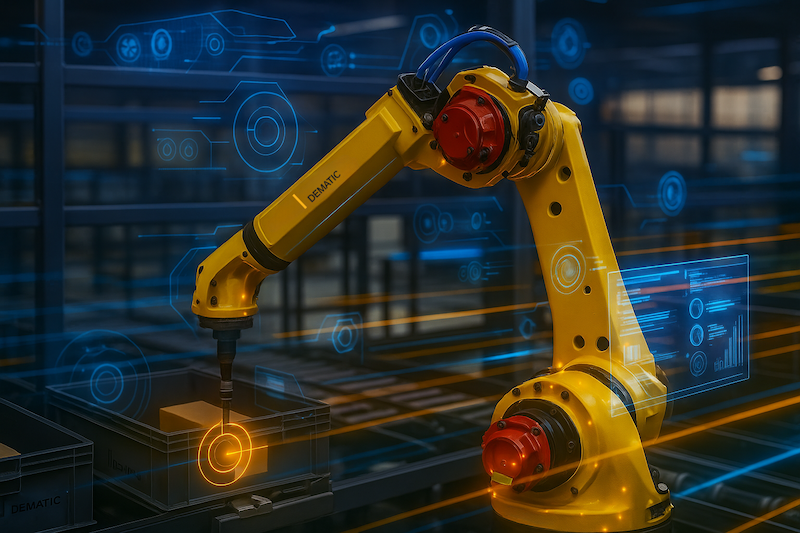
A subscription model allows businesses to lease robots and automation tools rather than buying them outright.
This allows businesses to avoid large upfront investments and can give greater flexibility around peak periods in line with demand or supporting short bursts of growth.
However, this should be considered a temporary solution rather than a long-term business strategy. Subscription fees can quickly exceed the total cost of comparable systems, particularly in stable, high‑volume environments, while the model can also limit opportunities for customisation.
Instead, businesses should focus on investing in their own tools or leasing technology in key, high-impact areas.
A further concern, highlighted across the industry, is what happens if the vendor, or even the finance provider, goes out of business.
Larger organisations with more available capital are already taking a more cautious route, choosing to buy automation outright and outsourcing operations to reduce risk exposure.
At the same time, operators are beginning to recognise the need to award third-party logistics providers (3PLs) longer-term contracts, allowing them to make the substantial infrastructure investments required to deliver futureproof solutions.
For SMEs, however, the landscape is shifting. Affordable and scalable automation can open the door to service levels traditionally associated with major retailers, so that organisations can start small and expand as required.
We’ve seen around 80 per cent of the projects we’re supporting focus on incremental, modular automation rather than entry-level solutions. This signals a dual appetite for flexibility and for control.
Warehousing subscriptions
Building and managing a warehouse requires large amounts of capital. WaaS offers an alternative route. Instead of owning facilities or equipment, companies rent capacity and services from 3PLs, specialists who manage outsourced supply chain operations.
This enables businesses to access flexible inventory storage and manage fulfilment without the initial cost and allows businesses to scale with demand.
For many businesses, especially ones unable to invest heavily upfront, working with 3PLs offers a practical, low-risk entry point into more modern and efficient operations as the automation infrastructure has already been developed.
It also spreads the risk between the 3PL and business, and when combined with flexible contract durations, helps businesses plan confidently for the future.
Shared user facilities run by 3PLs make it easier for organisations to justify new investments and recover costs of pay-as-you-go (PAYG) options that reduce barriers to automation. As a result, organisations can transition strategically from manual processes to more sophisticated systems.
The balanced approach
A balanced approach to automation is the best route for long-term results. This incorporates some fixed automation with newer, more flexible solutions to suit individual circumstances, laying the groundwork for the best return on investment.
For instance, a full shuttle system may be cost-prohibitive. Instead, a business might deploy a mix of fixed automation and shuttles, supported by a core fleet of owned or rented AMRs, and then lease additional shuttles or AMRs to handle peak periods.
While fixed automation remains the right choice for predictable, long-term operations, many companies cannot forecast their needs decades ahead. For them, pursuing a blended strategy offers the best combination of agility, long-term value and accessible ROI.
What every organisation needs to know
Leasing robots can be an effective way to test automation and handle short-term demand spikes. However, it shouldn’t define the entire automation strategy.
For larger organisations with established infrastructure and strong capital investment capacity a blended approach is more effective, spreading risk across a mix of automation models within the distribution network rather than relying on a single solution.
For SMEs at the early stage of their automation journey, using a 3PL model enables them to spread the financial risk, manage contract timelines, ensure smoother integration, and build capability over time.
However, having a full understanding of the cost implications and integration requirements is vital. When approached this way, the model can strengthen operations and improve resilience, but the focus should remain on developing long-term capability, not just renting it.
About the author: Kevin Price is a logistics consultant at Dematic, where he focuses on delivering new-build automation projects and transformation programs for warehouse and fulfillment operations. His work centers on improving operational efficiency and optimizing supply chain performance through advanced material handling solutions.
