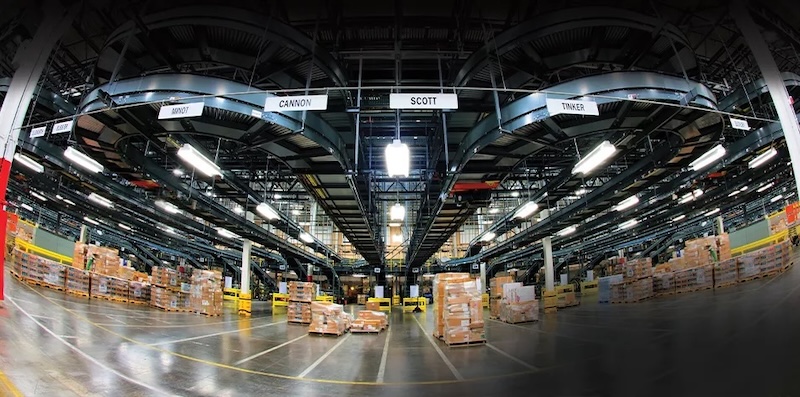
Honeywell has agreed to sell its Warehouse and Workflow Solutions (WWS) business – which operates under the Intelligrated and Transnorm brands – to American Industrial Partners in an all-cash transaction, as part of a wider restructuring of its automation portfolio.
The financial terms of the sale were not disclosed.
The deal, expected to close in the second half of 2026, follows closely on the company’s recent agreement to divest its Productivity Solutions and Services (PSS) division to Brady Corporation for $1.4 billion.
Together, the two transactions mark a decisive step in Honeywell’s multi-year effort to simplify its business and sharpen its focus on core automation technologies.
Warehouse automation business changes hands
WWS, which generated approximately $935 million in revenue in 2025, is a major provider of warehouse automation systems, including sortation equipment, conveyors, palletizing systems, robotics, and associated software and services.
The business has long been a significant player in the intralogistics sector through its Intelligrated and Transnorm brands, serving customers across e-commerce, retail, and manufacturing supply chains.
Under the agreement, WWS will combine with AIP’s existing investment in Trew, creating a broader automation platform aimed at delivering integrated solutions across warehouse and distribution environments.
Honeywell said the divestiture concludes its strategic review of WWS, which began in 2025 alongside the review of the PSS business.
Strategic shift toward ‘automation to autonomy’
The sale reflects Honeywell’s repositioning of its Industrial Automation segment, with a growing emphasis on sensing, measurement, controls, software, and services – areas the company sees as critical to enabling the transition from traditional automation to more autonomous systems.
In a statement, CEO Vimal Kapur said the latest divestments represent the final phase of a broader transformation effort that has included acquisitions, spin-offs, and portfolio simplification.
The moves are also tied to Honeywell’s planned spin-off of its aerospace business, now scheduled for June 29, 2026, which will further separate its operations into more focused entities.
Implications for the warehouse automation market
The exit from WWS signals a shift in how large industrial conglomerates are approaching the warehouse automation space.
Rather than offering end-to-end intralogistics systems, Honeywell appears to be stepping back from hardware-heavy integration projects in favor of higher-margin, software-driven and control-layer technologies.
For the market, the transaction strengthens AIP’s position in warehouse automation by combining WWS with Trew, potentially creating a more agile competitor in a sector dominated by players such as Dematic, Daifuku, and SSI Schaefer.
It also raises questions about the long-term structure of the automation industry, as companies increasingly separate physical infrastructure businesses from digital and AI-driven capabilities.
Financial performance and outlook
Honeywell reported first-quarter 2026 sales of $9.1 billion, up 2 percent year over year, with orders rising 7 percent and backlog reaching approximately $38 billion.
Operating income declined due to impairment charges and costs associated with the divestitures, while adjusted earnings per share rose 11 percent to $2.45.
The company reaffirmed its full-year outlook, projecting sales of between $38.8 billion and $39.8 billion and continued growth in segment margins.
