• Skip to primary navigation
  • Skip to main content
  • Skip to primary sidebar
  • Skip to secondary sidebar
  • About
    • Contact
    • Privacy
    • Terms of use
  • Shop
    • Cart
    • Checkout
    • My Account
  • Advertise
    • Advertising
      • Buy ad space
    • Case studies
    • Design
    • Email marketing
    • Features list
    • Lead generation
    • Magazine
    • Press releases
    • Publishing
    • Sponsor an article
    • Webcasting
    • Webinars
    • White papers
    • Writing
  • Subscribe to Newsletter

Robotics & Automation News

Where Innovation Meets Imagination

  • Home
  • News
  • Features
  • Editorial Sections A-Z
    • Agriculture
    • Aircraft
    • Artificial Intelligence
    • Automation
    • Autonomous Vehicles
    • Business
    • Computing
    • Construction
    • Culture
    • Design
    • Drones
    • Economy
    • Energy
    • Engineering
    • Environment
    • Health
    • Humanoids
    • Industrial robots
    • Industry
    • Infrastructure
    • Investments
    • Logistics
    • Manufacturing
    • Marine
    • Material handling
    • Materials
    • Mining
    • Promoted
    • Research
    • Robotics
    • Science
    • Sensors
    • Service robots
    • Software
    • Space
    • Technology
    • Transportation
    • Warehouse robots
    • Wearables
  • Press releases
  • Events

Emerging trends in robotics and AI for high-risk industries: Construction, oil and gas, and mining

March 29, 2026 by Sam Francis

By Gary Ng, CEO and co-founder of viAct

There is a major shift occurring at some of the most hazardous workplaces on the planet: oil refineries, large construction projects, and underground mines, as new and improving technologies are being used for the initial line of defence.

Technologies, like Artificial Intelligence (AI), robotics, and IoT wearables, especially smartwatches, have replaced the hard hat and safety supervisor as the last line of defence against workplace hazards by providing a first layer of protection against them.

Over the past few years, world has witnessed a rapid increase in both quantity and variety of robotic and automated systems being deployed to monitor, detect, and respond to workplace hazards in real-time, and there has probably never been a more opportune time for these technologies to evolve from being part of pilot programmes to permanent fixtures of the industrial workplace.

Autonomous robotics and smartwatches: The new safety stack

For years, manual inspection, periodic audits and stretched-thin human supervisors have provided the basis for establishing safety in high-risk industries. Pressurised pipelines managed by oil and gas facilities, construction sites with thousands of workers routinely exposed to extreme heat, and mining operations conducting blasting and excavating operations underground all share one vulnerability in common: the gap between when a hazard occurs and when a human identifies it.

Two converging technologies are reducing this gap. Autonomous robotics, including drones, and mobile inspection units are extending the area of safety monitoring significantly beyond what human supervisors could physically cover.

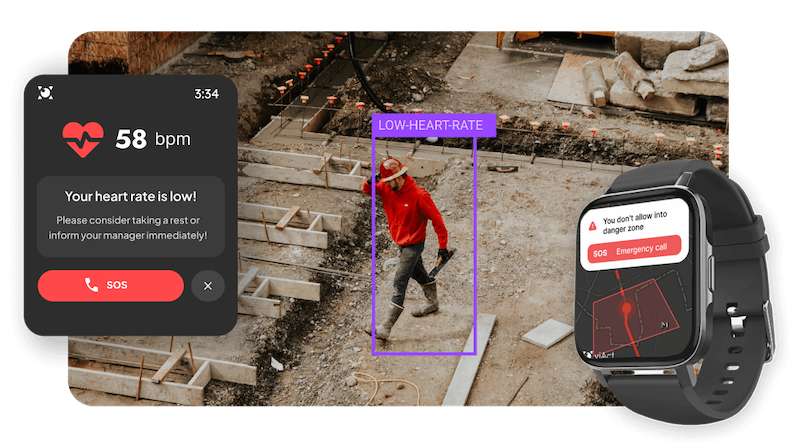
Simultaneously, AIoT-enabled smartwatches, are changing what happens in seconds after a hazard is detected. This is how it works: the AI CCTV identifies a safety violation, like PPE non-compliance or danger zone intrusion, identifies the worker involved, and sends real-time alert, via haptic vibration, directly to the concerned worker.

The worker corrects the behaviour and shares proof of their corrective action, thus creating an auditable trail with date, time and locations of the whole process. What typically took 24 to 48 hours under the previous manual system now occurs in less than five minutes.

This closed-loop model with AI CCTV used as the brain and the smartwatch as the last mile, is now being deployed across various oil and gas facilities, large construction jobsites, and mining sites worldwide, where the amount of industrial work and the intensity of operating conditions have made the case for “always-on AI safety” impossible to ignore.

Where are robotics and AI making the biggest difference?

In all the high-risk industries, the baseline capabilities such as PPE detection, danger zone intrusion and confined space monitoring are considered as the minimum layers of AI safety that operators are expected to have in place. Beyond these, each industry is driving AI adoption around their specific challenges.

For example, in the oil and gas sector, one of the critical applications centres around lone worker monitoring in remote and offshore environments, where a smartwatch detecting and alerting worker malaise can mean the difference between a rescue and a fatality.

Similarly, in a construction site, AI CCTV monitoring combined with biometric data from smartwatches for heat stress management enables early intervention before situations become critical.

Likewise, in mining, blast zone clearance monitoring is one of the priorities where haptic alerts from the smartwatch cut through noise and darkness, ensuring every worker is accounted for before detonation.

Real-world deployments are already translating these capabilities into measurable safety outcomes on the ground. One such deployment, currently underway in the Middle East, offers a particularly compelling example of what this integrated model can deliver.

A real-world success story: viAct begins Middle East trials of AI CCTV integrated with smartwatches for real-time industrial safety

viAct, an HSE-focused AI company operating across the GCC, has begun implementing its integrated closed-loop technology model with several of its current clients throughout the region, like Aramco, Neom, Sajco, Adnoc Gas, Saudi Telecom Company, ACWA Power, SABIC, and Oxagon Industrial Complex – all utilizing this integrated approach in the oil & gas, construction, and manufacturing in Saudi Arabia and the UAE particularly.

The outcomes from the existing deployments provide evidence to support this next phase of expansion. On a construction site in Saudi Arabia, for managing large numbers of workers under extreme desert conditions, viAct combined its AI video analytics solutions with its IoT smart watches. This connected worker-safety technology provided real-time heat stress alerts, resulting in a 63 percent reduction in on-site medical incidents.

In addition, 95 percent compliance rates were achieved with automatic logging of hydration breaks and PPE compliance. These results directly reflect the kind of measurable, ground-level impact this integrated closed-loop technology model is capable of delivering at scale.

What comes next for AI-driven industrial safety?

With increasing global regulatory pressure and increased demand from project owners for easily verifiable safety compliance data, the use of AI and robotics in many high-risk industries will rapidly accelerate for the duration of this decade.

Governments throughout the Middle East, Southeast Asia, and beyond are increasing their occupational safety mandates, which means that the burden of proof has shifted from post-incident reporting to continuous and documented compliance that is being done in real-time.

The companies that are getting ahead of the game right now, by incorporating computer vision and AIoT-enabled smartwatches, into their safety programs, will likely set the standard that other companies must eventually meet. The closed-loop safety model has transitioned from a competitive advantage for first-movers to an expected minimum requirement across the global oil and gas, construction, and mining industries.

Gary Ng

About the author: Gary Ng, CEO and co-founder of viAct, comes with a background of building engineering who turned into AIpreneur with inception of viAct in 2016. He has 10+ years of experience in implementing technological innovations in construction industry. Before viAct, he was the managing director of 3D fashiontech EFI Optitex. Also rewarded as the best regional senior executive in Nasdaq listed technology enterprise Stratasys. With his ultimate strength of analytical thinking and strategic decision making, Gary was also the advisory board member for SXSV in his early career. Gary believes in the concept of transferring knowledge from experienced to youngsters and is a renowned academic professional. Currently he is a visiting faculty professional at The Hong Kong Polytechnic University. Gray is also an active public speaker & preacher of AI driven sustainability in workplaces.

Print Friendly, PDF & Email

Share this:

  • Print (Opens in new window) Print
  • Share on Facebook (Opens in new window) Facebook
  • Share on LinkedIn (Opens in new window) LinkedIn
  • Share on Reddit (Opens in new window) Reddit
  • Share on X (Opens in new window) X
  • Share on Tumblr (Opens in new window) Tumblr
  • Share on Pinterest (Opens in new window) Pinterest
  • Share on WhatsApp (Opens in new window) WhatsApp
  • Share on Telegram (Opens in new window) Telegram

Related stories you might also like…

Filed Under: Artificial Intelligence, Industry Tagged With: AI CCTV, ai safety systems, aiot, automation news, computer vision safety, construction robotics, hazard detection AI, industrial automation safety, industrial safety, mining robotics, oil and gas automation, real-time monitoring, robotics and automation, robotics and automation news, robotics in construction, robotics in mining, robotics in oil and gas, robotics news, smartwatches industrial, wearable technology safety, workplace safety technology

Primary Sidebar

Search this website

Latest articles

  • Intrinsic’s vision for physical AI: Building the software-defined factory
  • AI-powered robot automates Serrano ham labeling for the first time
  • Siemens partners with Databricks and FFT to turn production data into scalable AI-driven insights
  • Eclipse Automation unveils immersive factory planning platform at Automate 2026
  • Doosan Robotics launches AI-powered palletizing solution for high-mix manufacturing
  • How a Parking Management System Boosts Revenue and Cuts Overhead
  • Manufacturing future: the best countries to start or relocate your tech startup in 2026
  • How JLCMC is Redefining Industrial Automation Solutions for Modern Factories
  • 8 Red Flags to Watch for When Hiring a Web Design Agency
  • Opinion: Why robot dogs are leading the pack in factory floor efficiency

Secondary Sidebar

Latest news

  • Intrinsic’s vision for physical AI: Building the software-defined factory
  • AI-powered robot automates Serrano ham labeling for the first time
  • Siemens partners with Databricks and FFT to turn production data into scalable AI-driven insights
  • Eclipse Automation unveils immersive factory planning platform at Automate 2026
  • Doosan Robotics launches AI-powered palletizing solution for high-mix manufacturing
  • How a Parking Management System Boosts Revenue and Cuts Overhead
  • Manufacturing future: the best countries to start or relocate your tech startup in 2026
  • How JLCMC is Redefining Industrial Automation Solutions for Modern Factories
  • 8 Red Flags to Watch for When Hiring a Web Design Agency
  • Opinion: Why robot dogs are leading the pack in factory floor efficiency

Copyright © 2026 · News Pro on Genesis Framework · WordPress · Log in

We use cookies on our website to give you the most relevant experience by remembering your preferences and repeat visits. By clicking “Accept”, you consent to the use of ALL the cookies.
Do not sell my personal information.
Cookie SettingsAccept
Manage consent

Privacy Overview

This website uses cookies to improve your experience while you navigate through the website. Out of these, the cookies that are categorized as necessary are stored on your browser as they are essential for the working of basic functionalities of the website. We also use third-party cookies that help us analyze and understand how you use this website. These cookies will be stored in your browser only with your consent. You also have the option to opt-out of these cookies. But opting out of some of these cookies may affect your browsing experience.
Necessary
Always Enabled
Necessary cookies are absolutely essential for the website to function properly. These cookies ensure basic functionalities and security features of the website, anonymously.
CookieDurationDescription
cookielawinfo-checkbox-analytics11 monthsThis cookie is set by GDPR Cookie Consent plugin. The cookie is used to store the user consent for the cookies in the category "Analytics".
cookielawinfo-checkbox-functional11 monthsThe cookie is set by GDPR cookie consent to record the user consent for the cookies in the category "Functional".
cookielawinfo-checkbox-necessary11 monthsThis cookie is set by GDPR Cookie Consent plugin. The cookies is used to store the user consent for the cookies in the category "Necessary".
cookielawinfo-checkbox-others11 monthsThis cookie is set by GDPR Cookie Consent plugin. The cookie is used to store the user consent for the cookies in the category "Other.
cookielawinfo-checkbox-performance11 monthsThis cookie is set by GDPR Cookie Consent plugin. The cookie is used to store the user consent for the cookies in the category "Performance".
viewed_cookie_policy11 monthsThe cookie is set by the GDPR Cookie Consent plugin and is used to store whether or not user has consented to the use of cookies. It does not store any personal data.
Functional
Functional cookies help to perform certain functionalities like sharing the content of the website on social media platforms, collect feedbacks, and other third-party features.
Performance
Performance cookies are used to understand and analyze the key performance indexes of the website which helps in delivering a better user experience for the visitors.
Analytics
Analytical cookies are used to understand how visitors interact with the website. These cookies help provide information on metrics the number of visitors, bounce rate, traffic source, etc.
Advertisement
Advertisement cookies are used to provide visitors with relevant ads and marketing campaigns. These cookies track visitors across websites and collect information to provide customized ads.
Others
Other uncategorized cookies are those that are being analyzed and have not been classified into a category as yet.
SAVE & ACCEPT