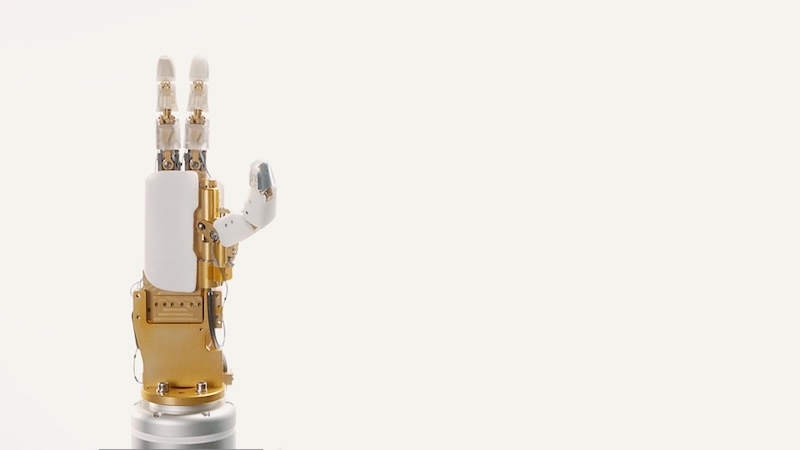
Tacta Systems has unveiled a robotics platform designed to bring human-like dexterity and touch to industrial automation, with the company targeting applications in electronics, AI infrastructure and automotive manufacturing.
The company’s first product, TactaBot, combines a robotic hand, a wearable skill capture system and an artificial intelligence engine that it says enables robots to perform complex manufacturing tasks requiring precision, adaptability and tactile feedback.
Tacta plans to begin deploying the technology with manufacturing customers in early 2027.
The company says the system addresses three longstanding challenges in robotics: building a robotic hand capable of industrial-scale performance, giving robots a sense of touch, and collecting large datasets of human manipulation skills to train AI models.
At the centre of the platform is the Tacta Hand, which uses the company’s proprietary Fluidic Tendon actuation technology. The human-sized hand features 15 independently actuated joints and is designed to deliver the precision, strength and durability needed for millions of manufacturing cycles.
The robotic hand is paired with tactile sensors that detect force and temperature, allowing robots to handle delicate and complex assembly operations.
To train its AI models, Tacta has also developed the Tacta Glove, a wearable device that records force, motion, temperature and video as workers perform manufacturing tasks. The resulting data is used to build what the company calls its Dexterous Intelligence AI model, enabling robots to learn new skills more quickly and adapt to changing production requirements.
According to Tacta, the integrated platform is intended to automate tasks that have traditionally remained difficult for robots, including precision electronics assembly, inserting connector cables and assembling wire harnesses.
Vikram Pavate, co-founder and CEO of Tacta Systems, said: “Everyone is talking about a trillion-dollar market for robots, but the technology isn’t there yet, because robots still can’t use their hands.
“The hand is the hardest problem in robotics, and it can’t be solved without touch. We built the entire stack, the hands, the sensing, and the intelligence, so robots can finally do the physical work our economy depends on, and so we can start bringing that work home.”
Tacta says the first commercial deployments are planned for electronics, AI infrastructure and automotive manufacturing before expanding into sectors including medical devices, aerospace and defence.
Founded in Palo Alto, California, the company has raised $75 million in funding from investors including Matter Venture Partners, SoftBank, Woven Capital, America’s Frontier Fund and B Capital.
