Femtosecond lasers are among the most advanced tools in precision manufacturing and can shape materials with great precision without damaging surrounding structures.
According to experts at LITILIT, one of the biggest barriers to mass adoption of femtosecond lasers is that they evolved from laboratory-grade systems and are notoriously difficult to produce at scale.
Researchers at EPFL university in Switzerland recently demonstrated a lab concept of an ultrafast laser integrated onto a photonic chip, showing how rapidly the technology is becoming smaller.
According to experts at femtosecond laser company LITILIT, industrial femtosecond lasers are already used to cut display glass, create colours without paint and perform precision eye surgery, but their complexity continues to limit wider adoption.
Femtosecond lasers, a group of ultrafast lasers, are among the most advanced tools in precision manufacturing. They fire pulses of light so brief that trillions of them fit inside a single second.
This is what allows materials to be shaped with great precision, without damaging surrounding structures in many applications, ranging from manufacturing electronics to medicine.
Smartphone screens
Nikolajus Gavrilinas, the CEO of LITILIT, says that the high precision makes femtosecond lasers one of the few methods for manufacturing day-to-day electronics. For example, many screens and camera lenses of the latest smartphones are cut with a femtosecond laser.
Gavrilinas explains: “Femtosecond lasers are used across electronics manufacturing because they can process delicate materials with extremely high precision and minimal heat damage.
“They help cut display glass, ceramics, circuit boards and semiconductor components, while also drilling microscopic holes and creating fine structures that would be difficult to produce with conventional tools.”
‘Painting’ with light
Another growing application of ultrashort-pulse lasers is replacing toxic chemicals with physics. Laser pulses are short enough to sculpt a material’s surface at a nanoscale level without melting or damaging what’s underneath. This makes it possible to add color to metal without paint or ink.
“The colour comes from how that microscopic texture bends light, the same physics that gives a peacock feather its colour without any pigment at all,” Gavrilinas says.
The same principle can be applied to make surfaces water-repellent, and to replace PFAS-based coatings and other toxic chemical treatments.
Eye surgery
For years, femtosecond lasers have been used in ophthalmology. They revolutionized ophthalmic surgery by enabling high-precision procedures with minimal tissue damage and rapid recovery times.
“In LASIK surgery, the laser cuts a thin flap on the surface of the eye so precisely and evenly that a blade never could. In cataract surgery, it does the same careful cutting and even softens the lens before the surgeon removes it, so there’s less manual cutting involved than there used to be,” Gavrilinas says.
Now, as technology progresses, femtosecond lasers could extend to other fields of medicine. A study published this year by researchers at Heriot-Watt University and the University of Edinburgh found that femtosecond lasers can also remove tissue with unprecedented accuracy, potentially helping treat cancer.
The adoption gap
While the EPFL research showed that ultrafast lasers could one day be integrated onto photonic chips, Gavrilinas says the more immediate challenge is bringing today’s higher-power femtosecond laser systems into industrial production.
Gavrilinas says: “Many existing femtosecond laser systems trace their design back to complex laboratory instruments. Although they can achieve very high performance, they are often difficult to assemble and depend on highly qualified specialists.
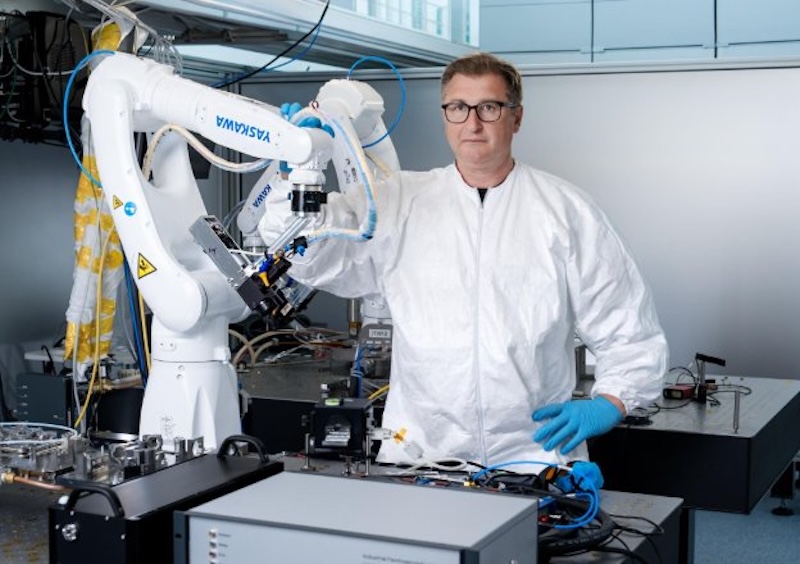
“To address this gap, we built lasers on a purpose built design, high level of automation and easily integrated into factories, which makes them suitable for a wide range of applications.”
The company’s technology is based on patented inventions developed by LITILIT co-founders Kęstutis Regelskis, Nerijus Rusteika and Gavrilinas in close collaboration with the Center for Physical Sciences and Technology in Vilnius.
