Industrial robots have become extraordinarily good at performing repetitive tasks with speed and precision. But ask one to pick up an unfamiliar object, work out how best to grasp it, or adjust when something moves unexpectedly, and the limitations of conventional automation quickly become apparent.
For decades, manufacturers have addressed these challenges through carefully engineered production environments, specialized tooling and extensive robot programming. The result is an industry capable of remarkable productivity, but one in which changing a product or production process can require substantial investment in new equipment and integration work.
CynLr, an Indian robotics company specializing in visual object intelligence, believes a different approach could make industrial automation considerably more flexible.
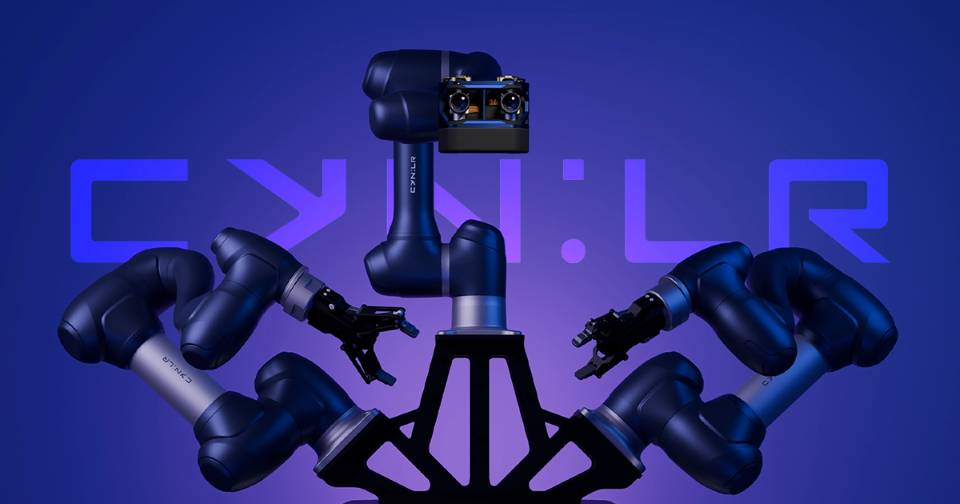
The company is developing technology that enables robots to understand and manipulate objects through a combination of visual perception, physical interaction and continuous feedback. Its dual-arm robotic system, CyRo, which could be described as a humanoid, is designed to handle objects without requiring a separate training process or predefined manipulation program for every new item it encounters.
The distinction is important. Recognizing an object is not necessarily the same as knowing how to pick it up, move it or place it accurately. And even a robot that can perform those actions successfully under laboratory conditions may struggle when confronted with the unpredictable realities of a working factory.
CynLr’s longer-term ambition is what it calls the “universal factory” – a manufacturing environment in which the same robotic infrastructure could be adapted to produce different products without extensive physical re-engineering.
In this interview with Robotics & Automation News, Gokul N A, co-founder of CynLr, explains the company’s approach to object intelligence, why physical interaction matters as much as visual recognition, and where large AI models may fall short in robotic manipulation.
He also discusses CyRo’s ability to recover from failed grasps, the difficulties posed by reflective and deformable objects, and the technical and commercial obstacles that must be overcome before genuinely flexible robotic manufacturing becomes commonplace.
Interview with Gokul N A
Robotics & Automation News: CynLr says CyRo can manipulate unfamiliar objects without being trained or programmed for each one. What does “unfamiliar” mean in practice, and how do you test whether the robot is genuinely generalizing rather than encountering variations of objects it already knows?

Gokul N A: By unfamiliar, I mean that the robot does not need a previously taught identity or an object- specific template before it can begin interacting with the object. Give a baby a crumpled piece of paper. It has never seen that particular shape, but that does not prevent it from picking it up. That is the distinction we are working on.
There are two different questions here: can the robot handle an unknown object, and does it know what task you want performed with it? We are not claiming that the second follows automatically from the first. Generalisation has to be judged by whether the manipulation capability carries over to new objects and conditions, not simply whether a recognition score improves.
R&AN: Vision can tell a robot a great deal about an object, but some properties – weight, friction, flexibility or whether something will move when touched – may only become apparent through physical interaction. How does CyRo combine visual perception with information gained through contact?
GNA: We tend to separate sensing and action: first see, then decide, then move. But take a coin whose embossing you cannot read. You tilt it. The movement improves the information available to your eyes. Your arm has become part of the sensing process.
That is how we approach object intelligence. CyRo combines visual feedback with force and torque sensing, so movement is continually informed by what happens at contact. It can change its view, adjust its grasp and respond to the object rather than merely execute a recorded trajectory. Seeing the shape is one part of understanding it. How the object responds when you touch or move it is another. Those cannot be treated as independent problems.
R&AN: What happens when CyRo gets a manipulation task wrong? Can it recognize that a grasp, reorientation or placement has failed and autonomously try a different approach, or does recovery still require human intervention?
GNA: Repeating a movement precisely is not the same as knowing whether the movement achieved its purpose. That distinction matters enormously in a factory.
CyRo has an autonomous picking-failure reattempt capability. When a pick fails, it can adjust its position and attempt the pick again. Force and torque feedback also help it respond during contact, rather than rely only on where the part was expected to be.
But a failed pick and a failed assembly sequence are not the same problem. I would not extend that capability into a claim that every reorientation or placement failure is autonomously recoverable. The useful question is which failures the cell can recover from within the particular task, and which still need a person.
R&AN: Factory conditions are rarely as controlled as laboratory demonstrations. Parts shift, lighting changes, surfaces become dirty and objects arrive in unexpected orientations. Which kinds of real-world variation can CyRo handle reliably today, and which still present significant problems?
GNA: A reflective object is a good example of why this is difficult. Its image contains the reflection of the environment, not just information about the object. Change the viewing angle and what the camera sees changes again. Collecting more pictures is not the only answer; the system must be able to look differently.
Our work addresses changes in part position and orientation, illumination, and reflective and transparent surfaces through active vision and feedback during manipulation. But I would separate those capabilities from a claim of unrestricted factory reliability. A flexible wire changes as you touch it; a rigid component does not behave that way. Dirt, occlusion, deformability and the task itself need to be evaluated together. One successful demonstration cannot establish the operating limits of an entire production cell.
R&AN: Much of the current embodied AI industry is pursuing large-scale robot learning, foundation models and world models trained on enormous datasets. CynLr appears to be taking a somewhat different approach to object intelligence. Where do you think large learned models are useful for manipulation, and where do they fall short?
GNA: My objection is not to learning. It is to assuming that enough examples will compensate for missing information. A photograph cannot tell you everything that will happen when a gripper touches an object. The robot has to obtain that information through interaction.
Large models can be useful in giving a task context and relating it to knowledge already available. But identifying a spoon, or describing what to do with one, does not give the machine the ability to grasp it under changing reflections and contact conditions. We are building that underlying layer. A baby manipulates objects before it has language for them. In robotics, we have often tried to build the language and recognition first, and assumed the physical capability would follow.
R&AN: CynLr has talked about “universal factories” that can be reconfigured to manufacture very different products. What technological capabilities are still missing before a robotic cell can move from making one product to another without the extensive re-engineering and integration work required by conventional automation?
GNA: Imagine if every application needed a different, specially built phone. That is close to how we organise manufacturing today: a new product often requires new machinery around it.
Object intelligence is a foundation for changing that, but it is not the whole factory. We still need richer sensing, adaptable manipulation, coordination between arms, suitable tools and ways to teach and reuse tasks. These layers have to work together reliably. There also has to be an ecosystem that can turn the underlying technology into a supported production solution.
The direction is to change what a factory produces through software rather than rebuild the physical infrastructure each time. A universal factory is the destination. It should not be confused with a claim that one cell can already manufacture any product.
R&AN: If we returned to a factory using CyRo five years from now, what would you expect to see it doing that today’s industrial robots generally cannot do – and what needs to happen technically and commercially before that becomes commonplace? I would look for a cell that remains useful when the product changes. Can the same infrastructure handle a different part, learn a new task and adapt to variations within that task, without rebuilding the surrounding machinery?
GNA: That is a more meaningful change than making the same movement faster.
Technically, perception and manipulation have to mature together, including the ability to recover when reality differs from expectation. Commercially, the customer needs a dependable system, not a research project: integration, support, component consistency and an economic reason to adopt it.
Five years should be judged by progress towards that flexibility, not a promise that every factory will be universal. The value is in making manufacturing infrastructure reusable across products, rather than tying its usefulness to one product’s life.
