FMC³ Robotics has introduced its Doceo series, a collection of data acquisition and processing technologies designed to help industrial robots learn manufacturing tasks from real-world human activity.
The Germany-based industrial embodied AI company says the system is intended to address one of the main challenges facing intelligent robotics: obtaining sufficiently detailed physical-world data to train robots for tasks that involve complex movements, object handling and changing production conditions.
Rather than relying entirely on dedicated robot training facilities or simulated environments, FMC³ aims to collect data directly from factory operations while workers carry out their normal duties.
The resulting information can then be used to train, test and refine robot capabilities through the company’s Industrial Embodied AI Agent Platform.
Four components of the Doceo system
The Doceo series consists of four interconnected technologies covering data collection, processing, training infrastructure and robot integration.
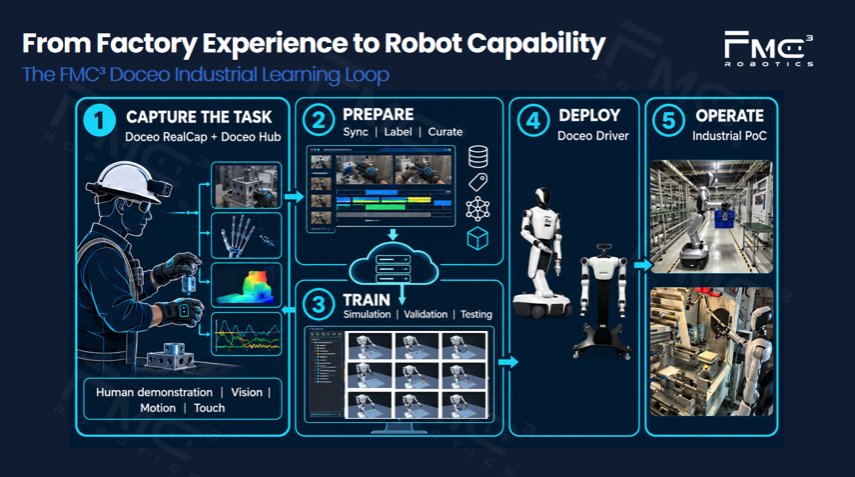
Doceo RealCap uses smart camera headsets, external cameras and optional touch-sensitive gloves to capture visual, depth, movement and tactile information as workers perform industrial tasks.
Doceo Hub synchronizes these data streams, combines multiple perspectives and provides tools for recording, playback, annotation and data management.
Doceo Cloud is designed to support data ingestion, automatic labeling, curation, model training, simulation and testing. The system draws on data infrastructure and cloud technologies from Vector Informatik.
Doceo Driver connects the resulting robot capabilities to different robotic platforms and control systems.
Together, the components form what FMC³ describes as an industrial learning loop, connecting real-world task demonstrations with AI model development, validation and subsequent robot operations.
Dr. Joachim Fetzer, president of Europe at FMC³ Robotics, says: “The real shortage is not data in general. It is qualified physical-world data that reflect how a task is actually performed in a certain environment: the movement, physical interactions, process sequence, quality outcomes, and also the errors and corrections.”
Testing the technology in factories
FMC³ is also advancing two industrial proof-of-concept projects intended to evaluate its approach under manufacturing conditions.
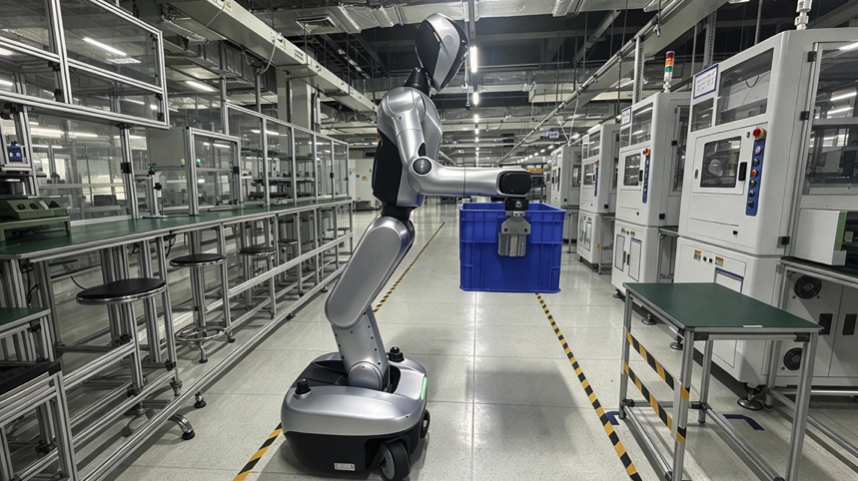
At a consumer electronics plant, the company is testing a wheeled robot that picks up bins, transports them through the facility and places them at designated production-line locations.
The challenge is to handle different container sizes and serve multiple workstations without extensive modifications to the existing factory layout.
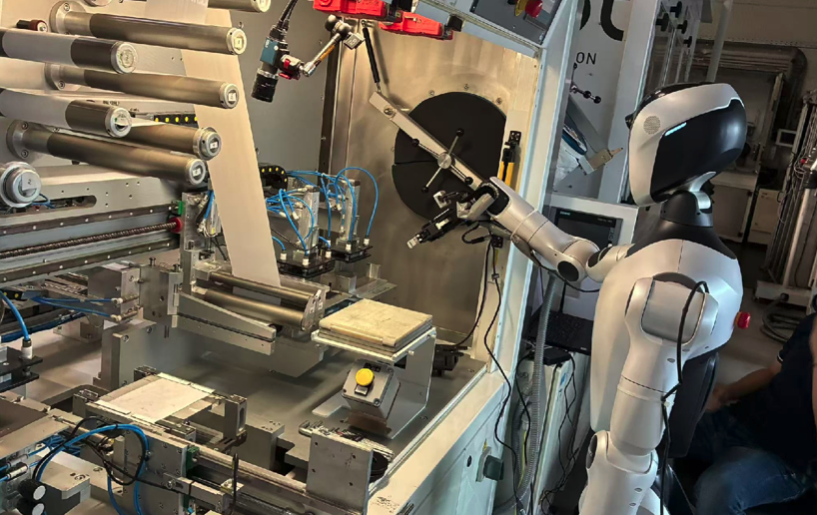
A second project, at a battery cell production facility, focuses on handling electrode sheets.
The robot is being developed to pick up the sheets, transfer them to trays and position them accurately within an existing manufacturing process.
Both projects remain at the proof-of-concept stage, with performance measures including cycle times, positioning accuracy and continuous operating time.
Building a wider industrial data infrastructure
FMC³ is also working with Vector Informatik and PEM Motion on a planned German joint venture to establish standardized data infrastructure for industrial embodied AI.
The proposed collaboration would combine FMC³’s robotics and data acquisition technologies with PEM Motion’s production engineering expertise and Vector Informatik’s data management, communication and cloud technologies.
The objective is to make industrial training data more consistent, traceable and reusable across different factories and robotic applications.
FMC³ ultimately wants robots to improve their capabilities through feedback from actual production operations, reducing the amount of engineering and retraining required when manufacturing tasks change.
For now, the company’s factory trials will help determine how effectively its data collection and learning technologies can translate human manufacturing experience into reliable robot operations.
