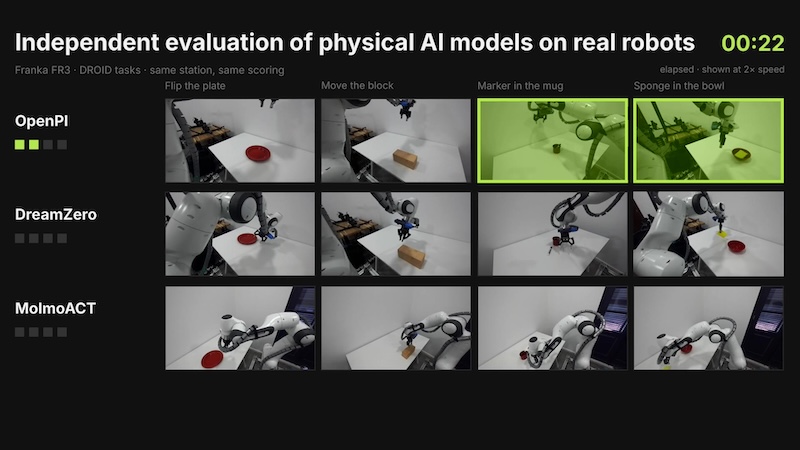
Positronic Robotics and Nebius have launched an international physical AI competition aimed at improving robotic manipulation and establishing more consistent methods for evaluating AI models on real-world tasks.
Announced on October 26, the Nebius × Positronic Physical AI Competition runs through December 2026, inviting developers and research teams to submit robotic AI models for independent evaluation.
Participants will initially be assessed in simulation, with the 10 highest-performing teams advancing to testing on a physical robot arm.
The competition offers more than $20,000 in Nebius GPU computing credits and Positronic evaluation credits.
Testing AI models beyond demonstrations
Positronic Robotics, which operates the independent PhAIL.ai physical AI leaderboard, says the competition is intended to address the lack of standardized, independent comparisons between robotic foundation models.
According to the company, evaluations conducted through its DROID benchmark have tested open models across more than 1,000 episodes involving over 100 everyday manipulation tasks, using the same Franka robotic arm.
The results indicate considerable differences in performance, with the strongest models completing approximately 70 percent of tasks on average, compared with around 12 percent for the weakest.
The organizers believe these differences demonstrate that robotic manipulation remains an open research challenge, with opportunities for smaller development teams to compete against established laboratories.
Nebius is providing GPU infrastructure and its Physical AI Workbench, while Positronic will oversee model evaluation.
The organizers have drawn inspiration from competitions such as the DARPA Grand Challenge, which helped accelerate autonomous vehicle development through standardized technical challenges.
The competition builds on the companies’ existing collaboration, under which Nebius became a founding partner of Positronic’s PhAIL.ai leaderboard.
Registration and submission details are available at competition.phail.ai.
