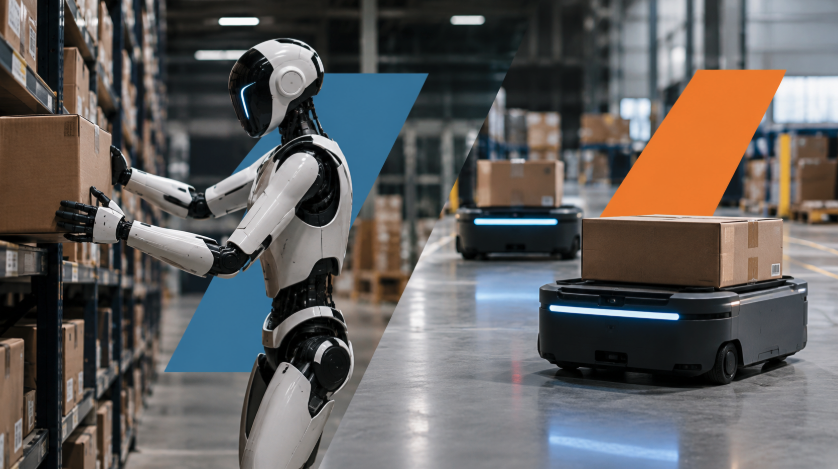
Every warehouse automation conference seems to have the same scene: a crowd gathered around a walking humanoid robot, while a quieter booth nearby showcases autonomous mobile robots (AMRs) already moving goods in thousands of facilities.
Both technologies promise to change logistics. But in 2026, they are at very different stages of commercial maturity.
AMRs are a proven option for moving totes, carts, and inventory across warehouses. Humanoid robots offer a different promise: handling objects and working with equipment designed for people, without requiring a complete redesign of the facility.
The difference comes down to task fit, operating costs, reliability, and the data used to train robotic systems. Humanoids must learn to handle unfamiliar objects and respond to changing physical conditions, making high-quality robotics training data an important part of their development.
This guide compares both technologies, examines a practical payback example, and outlines a framework for deciding which type of robot to pilot first.
First, What Are We Actually Comparing?
Autonomous Mobile Robots (AMRs) are wheeled robots that move goods around a building on their own. They use cameras, lidar, and onboard software to plan routes and avoid people. Unlike older AGVs (automated guided vehicles), they don’t need magnetic tape or fixed tracks.
Example: A picker stands in one zone. An AMR rolls up with a tote, the screen shows which item to grab, and the robot drives the tote to packing. The person walks less; the robot does the travel.
Humanoid robots have a human-like body: two legs (or a wheeled base), a torso, two arms, and hands or grippers. The pitch is simple. Warehouses are built for people, so a robot shaped like a person can work in them without rebuilding the site.
Example: A humanoid lifts a tote off an AMR and places it on a conveyor. That small hand-off is hard for wheeled robots without adding an arm or redesigning the station.
In short: AMRs automate movement. Humanoids try to automate manipulation in spaces designed for human bodies.
Where Things Stand in 2026
A useful example is GXO’s partnership with Agility Robotics. In June 2024, the companies announced a commercial Robots-as-a-Service agreement to deploy Digit in warehouse operations. The robot handles repetitive material-moving tasks, including transferring totes to conveyors, while working alongside existing automation such as AMRs.
The lesson is important: humanoids do not have to replace existing automation to create value. They can take over specific manual steps that other robots cannot easily perform.
Humanoid Robots vs AMRs: Side-by-Side Comparison
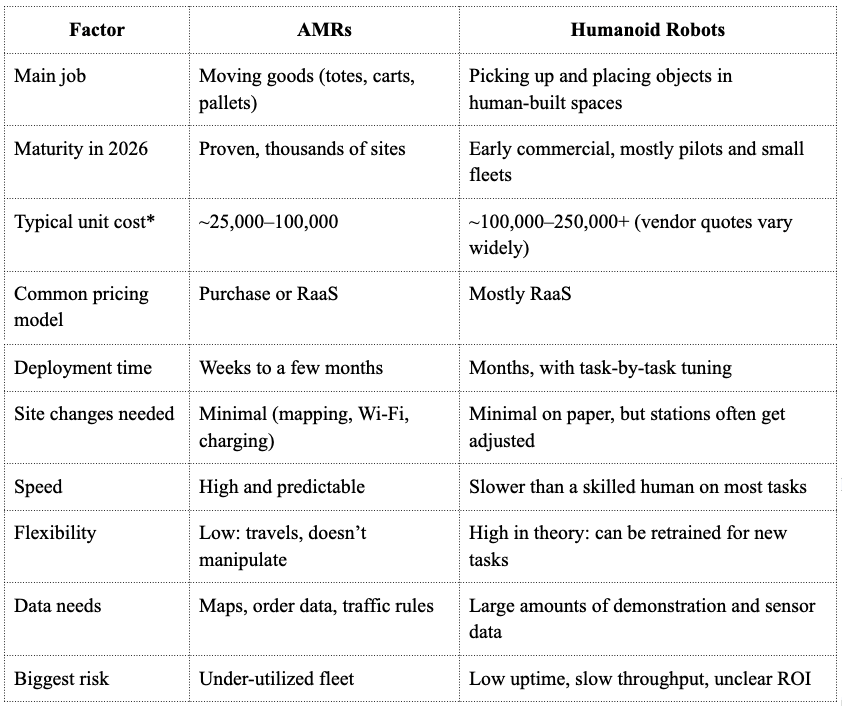
* These figures are approximate planning estimates, not standardized market prices. Actual costs vary by robot model, payload capacity, configuration, software, and deployment requirements. Integration, maintenance, and ongoing service fees may add to the total cost. Request vendor quotes to estimate the cost for your specific operation.
The Payback Math: A Worked Example You Can Copy
The following example illustrates how warehouse operators can estimate the payback period for AMRs and humanoid robots. The figures are hypothetical and intended for planning purposes, not as a forecast of actual savings.
Assume a mid-size e-commerce warehouse operates two shifts and has a fully loaded labor cost of $50,000 per worker per year. The model estimates the labor costs that automation could avoid, then subtracts annual service and software expenses. Actual savings will depend on whether the freed-up labor hours translate into lower payroll costs or additional operational capacity.
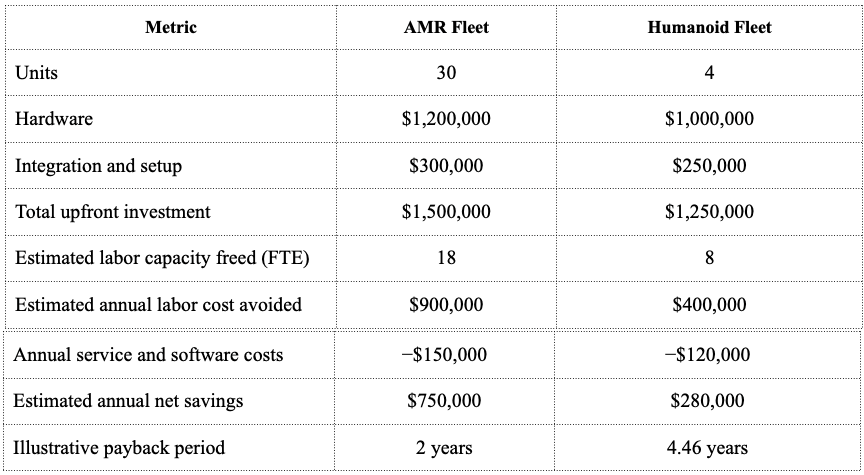
Illustrative payback period = Total upfront investment ÷ Estimated annual net savings.
Illustrative estimates only, not guaranteed results. The model excludes potential costs related to downtime, additional training, energy, charging infrastructure, and future hardware upgrades unless already covered by the service or integration budgets. Actual payback will depend on vendor pricing, system uptime, throughput, maintenance requirements, and the extent to which labor savings translate into reduced costs or increased capacity.
Why the gap? AMRs remove walking, which can eat a big share of a picker’s shift. Research on AMR-assisted picking published in the European Journal of Operational Research shows that pairing human pickers with mobile robots cuts this unproductive walking time.
The humanoid case improves when:
- You run three shifts, so each robot covers more labor hours.
- The task has high employee turnover or involves physically demanding, repetitive work, such as lifting heavy objects or working in cold storage.
- You use RaaS and avoid the big upfront cost.
- One robot can be moved between two or three tasks during the day.
When AMRs Are the Right Call
Choose AMRs if most of these are true:
- Your workers spend a lot of time walking. Person-to-goods picking in large buildings is the classic AMR win.
- Volumes are high and fairly steady. AMRs pay back through repetition.
- You need results this fiscal year. AMR projects are well understood by vendors and integrators.
- Your floors are flat and aisles are reasonably clear.
Example: A 3PL handling apparel for several brands adds 40 AMRs for peak season. Pickers stay in zones, the robots carry totes, and new temp workers become productive in hours instead of days because the screen tells them what to pick.
When Humanoid Robots in Warehouses Make Sense
Humanoids are worth a pilot when:
- There’s a hand-off nobody wants to redesign. Moving totes from AMRs to conveyors, loading carts, or feeding a machine that was built for a person.
- The job has high turnover or injury risk. Repetitive lifting, awkward reaches, or cold rooms.
- You can’t justify a fixed robotic arm because the task changes every few months.
- You want to build internal know-how early. Some companies pilot humanoids mainly to learn how to operate them before prices drop.
Example: A distribution center already uses AMRs to bring totes to a packing line. The last step, lifting each tote onto the conveyor, still needs two people per shift. A humanoid takes that one job. It’s slower, but it runs through breaks and frees those workers for exception handling.
7 Practical Tips Before You Sign Anything
1. Measure the task before you shop.
Time the job for a week. Count lifts per hour, walking distance, and error rates. Without a baseline, every vendor demo will look great.
2. Ask for uptime, not just speed.
A robot that works fast for 20 minutes and then needs a reset is worse than a slower one that runs all shifts. Ask vendors for real uptime numbers from live sites.
3. Start with RaaS for humanoids.
Hardware is changing quickly. A monthly fee protects you from owning outdated robots in two years.
4. Check how the robot learns new tasks.
Ask who collects the demonstration data, how many examples a new task needs, and whether your own team can retrain it. This matters more than the robot’s top speed.
5. Plan the integration with your WMS.
Both AMRs and humanoids need to talk to your warehouse management system. Ask if there’s a ready-made connector or if you’ll pay for custom work.
6. Run AMRs and humanoids together.
For some warehouses, a mixed fleet may offer the most practical path: AMRs handle material transport, while humanoids take on selected handling tasks that are difficult to automate with existing equipment. GXO’s deployment of Digit illustrates how humanoids can work alongside established warehouse automation rather than replace it entirely.
7. Involve the floor team early.
Workers who help pick the task and test the robot are far more likely to support it. They’ll also spot problems engineers miss.
Why Data Decides the Winner Long-Term
AMRs primarily address navigation and material transport, although reliability, obstacle detection, traffic management, and system integration remain important challenges. Humanoids face an additional layer of complexity: handling soft bags, damaged boxes, unfamiliar objects, and changing physical conditions.
Their progress depends partly on training data collected through teleoperation, simulation, and real-world operation. For ML practitioners and data scientists, this creates opportunities to develop high-quality demonstrations, label failure cases, and test models in simulation before deploying them around real inventory.
For business leaders, the implications extend beyond robot selection. Vendor evaluations should also consider who owns the data generated during operation, whether it can be used to improve the system, and how retraining is managed as tasks change.
Conclusion
For most warehouses, AMRs are still the smarter first investment in 2026. They’re proven, faster to deploy, and often pay back in about two years.
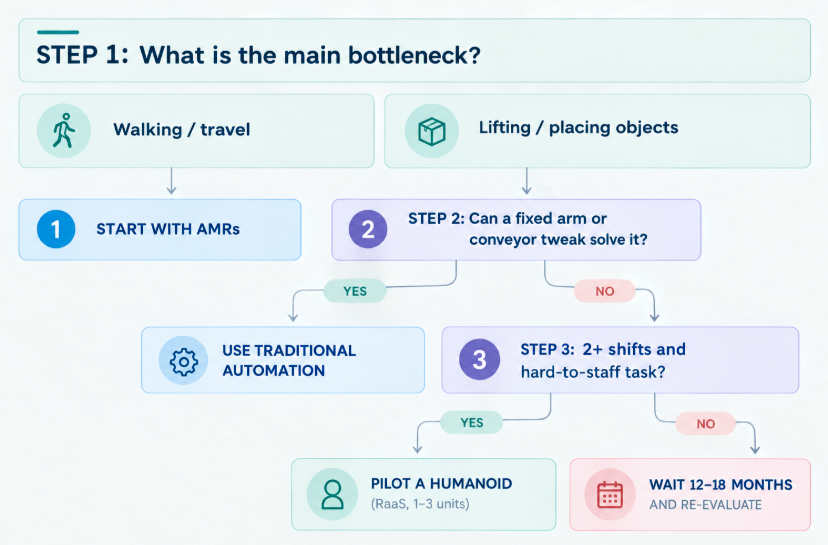
Humanoid robots in warehouses make sense as targeted pilots, not fleet-wide rollouts. Pick one awkward, hard-to-staff hand-off, run it on multiple shifts, pay through RaaS, and measure everything.
The smartest operators aren’t choosing one or the other. They’re using AMRs to fix today’s travel costs while running small humanoid pilots to be ready when prices fall and capabilities catch up. Given how fast forecasts are rising, that window may arrive sooner than most budgets expect.
