
Drug companies demand speedier launches and don’t want to relax quality standards. That puts pressure on the shop floor as well as on the software above it.
Rockwell Automation’s October 1 report found that 90 percent of life sciences manufacturers call digital transformation necessary.
Nearly 58 percent are already using smart manufacturing technology in their entire operation or in portions of their operation.
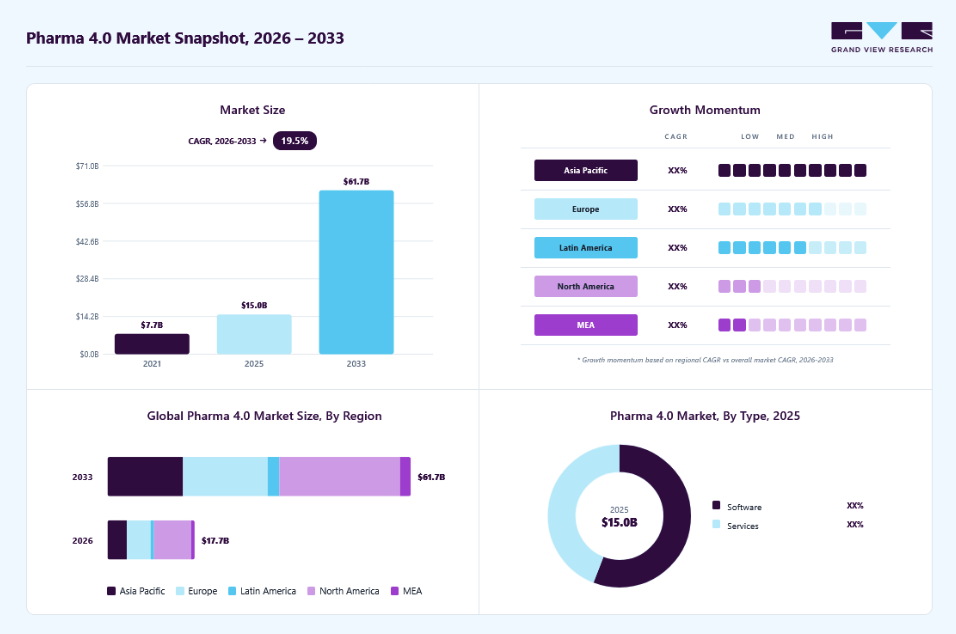
According to Grand View Research, the global Pharma 4.0 market is expected to be valued at $17.7 billion in 2026 and $61.7 billion in 2033.
We chose the five firms below for their relevance to pharmaceutical manufacturing, their documented automation work, and their activity over the past year.
DXC Technology

DXC approaches pharma manufacturing from the IT/OT side. Avasant named it a Leader in its Manufacturing Digital Services 2026 RadarView. That report covers manufacturing broadly, not life sciences specifically.
It points to Manufacturing Insight Cloud, which gives multiplant visibility across IT and OT data, and to VisionIQ, a digital twin platform for real-time monitoring. DXC also works with Wandelbots and NVIDIA on robot-agnostic programming and physical AI for smart factories.
In September, Arrive AI said DXC is expected to connect its autonomous delivery points, where drones, robots and couriers hand off materials, to the IT and operational systems of large plants.
The life sciences side fits alongside that. Its FirstPoint RIM.AI suite has more than 500 clients. In a July article on eCTD 4.0 readiness, DXC reported digital twin pilots that cut document quality check time by 40 percent.
Rockwell Automation

Rockwell works on the machines and the data around them. At INTERPHEX in April it showed OTTO autonomous mobile robots next to its PharmaSuite MES and PlantPAx control system.
On April 29 it launched Figurate SCADA with Cytiva. The open system oversees unit operations from different equipment vendors through one interface. On October 8 Rockwell became a founding member of the Digital CMC Consortium.
Matt Weaver, its life sciences vice president, said digital transformation “is not just about technology adoption.”
Siemens

Siemens ties execution software straight to equipment. Opcenter Execution Pharma connects the MES with the distributed control system layer. It can run both manual steps and operations controlled by the automation layer.
The 2605 release in June added a modular weighing and dispensing framework, a wider web-based operator experience and AI-assisted design. In August, Nucleus Research named Siemens a leader in its 2026 MES Technology Value Matrix.
Cognizant

Cognizant’s manufacturing group, built on Zenith Technologies and TQS Integration, handles batch automation, MES and lab automation under GMP rules.
On October 8, Seeq named it a lead collaborator on an OEE solution for pharma. The tool compares equipment performance across lines and sites and supports continued process verification.
Accenture

Reinventing Biopharma from Lab to Line, a February report from Accenture, includes robotic high-throughput process design and real-time analytics with AI. It attributed 64 percent of the launch delays analyzed for 2024 to chemistry, manufacturing, and controls issues.
Just 35 percent of executives surveyed reported that their companies are “connected organizations” in the manufacturing industry. Accenture also made an investment in Iridius, a startup that’s developing compliance-ready AI, in April.
What comes next
If the data behind the robot and control systems is not usable, then they are not helpful. Rockwell’s survey revealed that only 32 percent of life sciences manufacturers are successfully using more than 50 percent of the data they gather. It also revealed that 54% said that they experienced cyberattacks in the last year.
