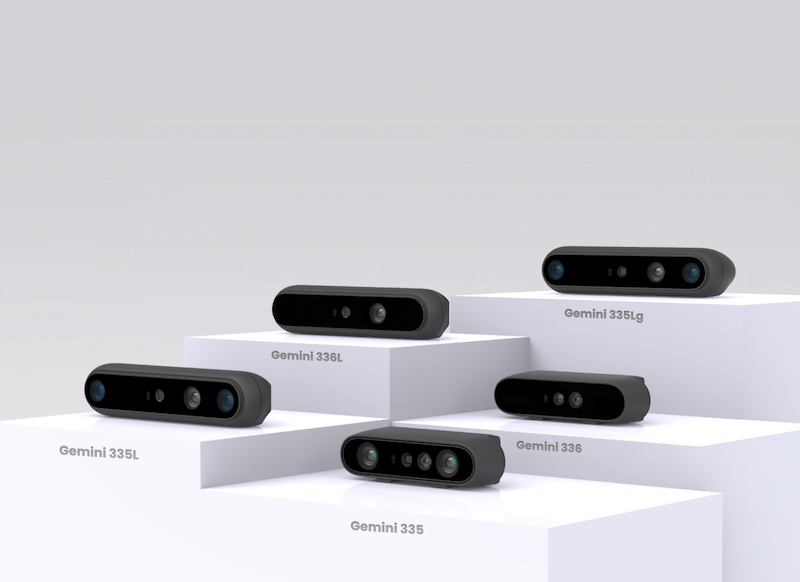
Engineers evaluating active stereo cameras usually compare baseline, accuracy at range, and field of view first. Where the depth map gets computed tends to come later, often after the host computer has already been specified.
That order is backwards for many robotics and automation builds. The Orbbec Gemini 330 series active stereo cameras are a useful case study because the whole family is organized around one design decision. Every model computes depth and aligns it to color inside the camera, on Orbbec’s own MX6800 depth-engine ASIC.
The series has been shipping since Orbbec introduced the Gemini 335 and 335L in April 2024, and the lineup has since grown to cover different baselines, optical filters, interfaces, and enclosure ratings. This overview looks at what that architecture does in practice and where the family sits in the stereo vision market.
Active and passive stereo running together
Every Gemini 330 camera is a stereo pair with an active IR speckle projector at 850nm. Most active stereo designs use the projector to add texture where the scene has none, such as blank walls, painted floors, and cardboard. The weakness shows up in sunlight, which carries enough near-infrared energy to wash the speckle out.
The Gemini 330 series runs active and passive stereo simultaneously. The stereo matcher works with the projected pattern and the scene’s natural texture at the same time, so when sunlight overwhelms the projector, matching continues on the texture that sunlight makes visible.
In low light and darkness, the projector carries the load. Orbbec calls this hybrid stereo imaging and lists the operating environment for the whole series as indoor and outdoor.
For integrators, the practical effect is fewer per-site tuning decisions. A camera covering a dock door, a skylit aisle, or a robot that crosses from a building into a yard doesn’t need a separate configuration for each lighting condition.
What the MX6800 does inside the camera
Orbbec’s Gemini 330 documentation states that the cameras perform depth image generation and spatial alignment of depth to color internally on the MX6800. Each of those tasks would otherwise land on the host.
Depth generation is the heavy part. Stereo matching across a 1280 × 800 image pair at 30fps is a sustained compute load.
Run on a host CPU or GPU, it competes with the navigation stack, perception models, and motion planning that the same embedded computer has to run. With the MX6800 doing the matching, the host receives a finished depth map.
Depth-to-color alignment is the second task. On the long-baseline models, aligned depth covers up to the full 90° × 65° depth field of view at 2m.
Doing the registration in hardware means every RGB pixel arrives with a matching depth value without a reprojection step on the host.
Applications that segment objects in color and then measure them in depth, such as parcel dimensioning, item detection for picking, and person detection for AMRs, use that alignment on every frame.
The datasheet also lists HDR depth and hardware timestamps. HDR depth helps in scenes with both very bright and very dark regions, which is common at loading docks and in mixed-reflectivity bins.
Hardware timestamps matter as soon as the camera’s data has to be fused with LiDAR, wheel odometry, or a second camera, because software timestamps on a busy host drift by milliseconds.
Lower latency follows from the same design. Orbbec describes the in-camera pipeline as minimizing data latency and reducing reliance on host computing power. Teams should still measure end-to-end latency on their own hardware, since USB stacks, drivers, and post-processing filters on the host add their own delay.
A chip-to-camera story
The MX6800 is the latest in a line of Orbbec depth-engine ASICs that includes the MX400, MX6300, MX6000, and MX6600. The MX400 came first, in 2015. Orbbec designs the depth engine, the camera, the calibration process, and the manufacturing in-house.
For an integrator, that vertical integration matters mostly in two places. Calibration and depth processing are tuned together, and the product roadmap doesn’t depend on a third-party vision processor staying available.
Gemini 330 series specifications and recommended applications
The family splits into foundational models, IR-enhanced models, and models with expanded connectivity. The figures below come from the specification table on the Gemini 330 series page.
Gemini 335 and Gemini 336
These are the compact members, with a 50mm baseline in a 90 × 25 × 30mm body. Depth range runs from 0.10m to beyond 20m, with an ideal range of 0.3m to 3m and spatial accuracy of ≤1.5% at 2m. Depth output reaches 1280 × 800 at 30fps, and the RGB sensor delivers up to 1920 × 1080 at 30fps.
The enclosure is rated IP5X, and average power is 2.3W over USB Type-C. The 335 uses an all-pass filter. The 336 adds an IR-pass filter that blocks visible light from the depth imagers, which helps in scenes with glare.
The 50mm baseline and short minimum range suit compact mobile robots, kiosks, and fixed stations where the working distance stays within a few meters. For arm-mounted pick-and-place and bin picking, Orbbec’s Gemini 305 is the better fit, with a 4cm minimum working distance and an ideal range of 7 to 50cm.
Gemini 335L and Gemini 336L
The long-baseline models use a 95mm baseline. Depth range runs from 0.17m to beyond 20m, with an ideal range of 0.25m to 6m. Spatial accuracy is ≤0.8% at 2m and ≤1.6% at 4m. Depth output reaches 1280 × 800 at 30fps or 848 × 480 at 60fps.
The RGB sensor uses a global shutter at up to 1280 × 800 at 60fps, so color and depth both avoid rolling-shutter skew on a moving platform. The enclosure is rated IP65, and the operating range is −10°C to 50°C.
These are the default choices for AMR navigation and obstacle detection, where planners need dependable depth at several meters. The 336L adds the same IR-pass filter as the 336 for reflective floors and strong lighting.
Ethernet and GMSL2 variants
The Gemini 335Le and 338Le carry the long-baseline design over Gigabit Ethernet with PoE through an M12 X-coded connector. They add PTP time synchronization and RS-485 communication, and they’re rated IP67.
The Gemini 335Lg and 338Lg use GMSL2 with FAKRA-Z connectors for long, locking cable runs on vehicles and large robots, with an IP65 rating. The 338Le and 338Lg use IR-bandpass filtering, with the 338Lg’s filter centered at 850nm.
Choosing between them is usually a system architecture question. Ethernet fits fixed installations and robots that already run an industrial network. GMSL2 fits platforms built around an Nvidia Jetson or similar deserializer-equipped compute module.
Robust design
Across the series, enclosure ratings scale with the interface. The USB compact models are IP5X, the USB long-baseline models and GMSL2 models are IP65, and the Ethernet models are IP67.
Orbbec notes that the stated rating applies only when the camera is used with cables that meet the same IP requirements. The datasheet estimates a five-year lifespan under default operating conditions at 16 hours a day.
For full outdoor exposure, including submersion during washdown and temperatures beyond the 330 series range, Orbbec’s Gemini 345Lg is the dedicated outdoor model. It’s IP67 rated and operates from −20°C to 65°C.
Integration and software
All Gemini 330 cameras run on Orbbec SDK v2, which is open source and actively maintained. It ships ROS and ROS 2 wrappers along with Python support, and it runs on Windows, Ubuntu, macOS, and Android.
The USB models are also UVC compliant. Multi-camera rigs use hardware timestamping and multi-device synchronization on the USB models, PTP on the Ethernet models, and hardware synchronization over GMSL2 on the Lg models.
On the Nvidia side, Orbbec reports that the series is integrated with Isaac Perceptor and Nvidia’s AMR workflow, and that Gemini cameras completed system-level validation with the Jetson Thor module.
The Orbbec Perceptor Dev Kit bundles the cameras with Nvidia’s robotics platform for teams that want a reference AMR configuration.
Where the series fits in the stereo vision market
Stereo depth cameras for robotics fall into two broad architectures. In the first, depth is computed on the device. Intel RealSense D400 cameras, Luxonis OAK devices, and the Gemini 330 series all work this way, using a dedicated vision processor or ASIC.
In the second, the camera streams raw stereo images and depth is computed on the host. Stereolabs ZED cameras work this way, with depth computed on an Nvidia GPU through the ZED SDK. Host-side processing gives developers more control over the matching algorithm.
On-device processing frees host compute and makes performance more predictable across different host platforms.
Within the on-device group, the Gemini 330 series stands apart in three ways. First, it runs active and passive stereo simultaneously for operation across indoor and outdoor lighting.
Second, it performs depth-to-color alignment in hardware. Third, its modular lineup lets an integrator keep one SDK and one depth pipeline while changing baseline, filter, interface, or enclosure rating to suit each robot.
The series targets robotics and industrial automation, which shows in the global-shutter sensors, hardware synchronization options, industrial connectors, and IP ratings.
Frequently asked questions
Does the Gemini 330 series need a GPU on the host?
No. The MX6800 generates the depth map and aligns it to the color image inside the camera, so the host receives finished depth data. You’ll still want enough host capacity for point-cloud conversion, filtering, and whatever perception models run on top of the depth stream.
Do Gemini 330 cameras switch between active and passive stereo depending on lighting?
They don’t switch. Active and passive stereo run simultaneously. The projected 850nm pattern supplies texture in dark or featureless scenes, and passive matching on natural texture carries on when strong sunlight overwhelms the projector.
How do I choose between the Gemini 335 and Gemini 335L?
Start with working distance. The 335’s 50mm baseline and 0.3 to 3m ideal range suit compact platforms and close work.
The 335L’s 95mm baseline extends the ideal range to 0.25 to 6m and improves accuracy to ≤0.8% at 2m, which is what most AMR navigation needs. If the scene has glare from reflective floors or bright lighting, look at the IR-pass 336 or 336L.
