Paris-based startup Physicl has raised $10 million in seed funding to develop technology that helps robotics and physical AI researchers identify and address weaknesses in their AI models.
The funding round was led by Inovia Capital, with participation from US Venture Partners, and will support the expansion of Physicl’s team and further development of its synthetic data generation platform.
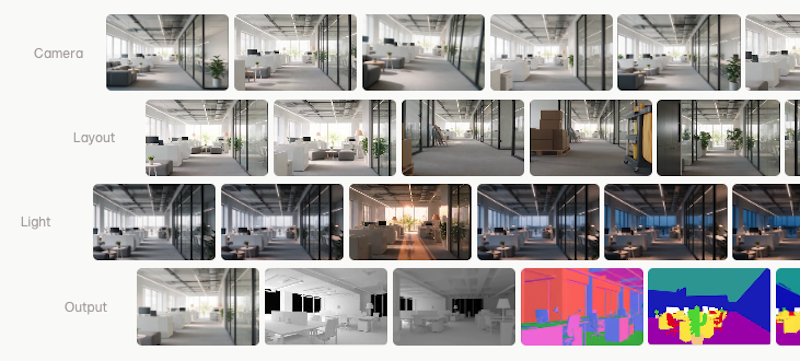
The company has also introduced Studio, an application that allows researchers to create customized 3D environments and generate training data targeting specific situations in which AI models struggle.
Addressing the problem of edge cases
One of the challenges facing physical AI developers is preparing models to operate reliably in unpredictable real-world environments.
Although models can perform well in controlled demonstrations, they may struggle when encountering unusual lighting conditions, unfamiliar objects or unexpected physical arrangements.
These situations, commonly described as edge cases, are difficult to capture comprehensively through conventional data collection.
Physicl’s approach allows researchers to reproduce problematic scenarios in simulation, generate variations and use the resulting data to improve model performance.
Alex de Vigan, founder and CEO of Physicl, says: “Models fail on edge cases. When researchers find these weaknesses, they need a way to generate data that specifically addresses them and test whether the model improves. We built Physicl to make that process easy and repeatable.”
Generating targeted training environments
Studio provides access to 10,000 ground-truth 3D environments, more than 100,000 digital assets and billions of potential scene variations.
Researchers can select environments or describe situations where their models encounter difficulties, adjusting variables such as lighting, camera angles and object placement.
The platform then generates training data designed to address those particular weaknesses, allowing developers to test whether subsequent model versions perform better.
Physicl says it works with AI laboratories including Meta, World Labs, Epic Games and SpAItial.
In one example, SpAItial, which develops world models capable of generating explorable 3D environments, used Physicl-generated data to improve its model’s ability to reconstruct real rooms.
According to the companies, incorporating the additional training data reduced the model’s reconstruction error rate by more than half.
Matthias Niessner, CEO of SpAItial and professor of computer science at the Technical University of Munich, says: “Physicl gives any researcher access to virtually any physical training data they can imagine. That changes what a small team can build in physical AI, and we saw it in our results right away.”
Physicl says its technology is intended to support the development of robotics systems and world models as researchers work to improve their reliability in real-world applications.
The company plans to use the new investment to expand its platform and make targeted physical AI training data more accessible to developers.
