
New A3 data shows second-quarter growth across semiconductors/electronics, automotive components, food and consumer goods, metals and life sciences
North American companies ordered 8,940 robots valued at $622 million in the second quarter of 2026, according to new data released by the Association for Advancing Automation (A3).
Compared to the second quarter of 2025, this represents a 4.3 percent increase in units ordered and a 21.3 percent increase in revenue.
Second-quarter results brought first-half totals to 17,995 units valued at $1.166 billion, representing 2 percent growth in units and 6.6 percent growth in order value over the first half of 2025.
General industry continues to offset automotive OEM softness
The first half of 2026 continued a trend that has been building over the past several quarters: robotics demand is becoming increasingly diversified across industries.
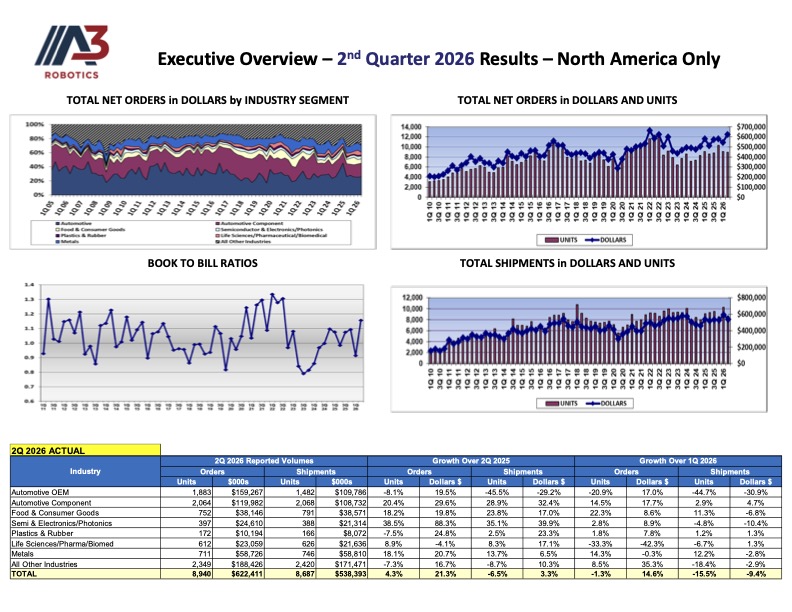
While Automotive OEM orders declined 25 percent compared to the first half of 2025, growth in Automotive Component and several general industry sectors helped offset that decline, including:
- Semi & Electronics/Photonics: +35 percent units
- Life Sciences/Pharma/Biomed: +32 percent unit
- Automotive Component: +24 percent units
- Food & Consumer Goods: +17 percent units
- Plastics & Rubber: +6 percent units
- All Other Industries: +6 percent units
- Metals: +3 percent units
Second quarter growth broadens across key manufacturing sectors
Several industries posted double-digit year-over-year gains in robot orders during the second quarter.
- Semi & Electronics/Photonics increased 38 percent year over year, while Automotive Component grew 20 percent.
- Food & Consumer Goods and Metals each increased 18 percent, and Life Sciences/Pharma/Biomed posted 9 percent growth.
- Non-automotive customers accounted for 56 percent of robot units ordered during the quarter, continuing the trend of robots being adopted across a variety of industries.
Collaborative robots remain an important part of the market
Collaborative robots continued to represent a significant portion of automation investment during the first half of 2026.
Companies ordered 2,774 collaborative robots valued at $114 million, accounting for 15.4 percent of all robot units ordered and 9.8 percent of total order revenue.
In the second quarter alone, companies ordered 1,137 collaborative robots valued at $44 million, representing 12.7 percent of total units and 7.1 percent of quarterly revenue.
Collaborative robot adoption remained particularly strong in Life Sciences/Pharma/Biomed and Semi & Electronics/Photonics, where collaborative robots accounted for 43.7 percent and 36.5 percent of first-half robot orders, respectively.
Alex Shikany, executive vice president at A3, says: “The first half of 2026 shows how the mix of the robotics market continues to evolve.
“Automotive remains an important driver of demand, while we’re also seeing growth across a wider range of industries.
“Results were not uniform across every sector, but the breadth of growth outside Automotive OEM is an important trend we’ll continue to watch.”
Manufacturing conditions continue to support automation investment
Despite continued uncertainty across the broader economy, manufacturers continued investing in automation during the first half of 2026.
Manufacturing PMI remained in expansion territory for a sixth consecutive month in June, with new orders and production continuing to grow. Federal Reserve data also showed manufacturing output 1.1 percent above its year-earlier level in June.
While the timing of large Automotive OEM projects and broader economic conditions will continue to influence quarterly results, the first-half data suggests manufacturers continue to view automation as a long-term investment in competitiveness.
Beyond the headlines with MI+
More detailed market breakouts and graphs for Q2 2026 are available upon request for press and within the A3 Vault for member companies.
For deeper insights, A3 members can subscribe to MI+, the Association’s premium market intelligence platform, featuring forecasts, dashboards, and in-depth reporting to support better decision-making.
