Ubitium, a semiconductor startup building a “universal processor” for machines that perceive, think and act in the real world, has announced $14 million in new seed funding.
The round was led by Ibex Investors, with participation from OpenOcean, existing investors including KBC Focus Fund, Runa Capital and Inflection, and Florian Seibel, co-founder and co-CEO of European defence technology company Quantum Systems, investing personally.
It brings Ubitium’s total seed funding to $18 million since the company was founded in 2024.
Ubitium’s thesis is simple: autonomous machines need three kinds of computing to work together so they can perceive, think and act in the real world. The company is building one universal processor to replace the stack of specialised chips often stitched together to do that work today.
The funding follows the return of Ubitium’s first silicon, taped out a year after the company was founded, which demonstrated that signal processing, AI inference and real-time control can all run on one processor architecture.
A new processor for a new era of computing
Physical AI is artificial intelligence built into machines that do physical work, such as drones, robots, vehicles and industrial equipment. General-purpose robotics alone could become a $370 billion market by 2040 under McKinsey’s base-case forecast.
An autonomous truck, a warehouse robot and an inspection drone do very different jobs, and the same three things: perceive, think and act, continuously, often simultaneously, on battery power, in real time. The balance between them changes as the machine operates.
Today developers divide that work across a digital signal processor (DSP) for sensing, a neural processing unit (NPU) for AI and a CPU for control.
Connecting them adds data transfers, coordination and engineering complexity, and physical AI strains that arrangement to breaking point. No one processor was designed for the demands of the complex physical world.
Unlike processors built from separate specialised logic, Ubitium has reimagined the processor as one array of programmable elements for signal processing, AI and real-time control. Resources are allocated at runtime across those tasks, so the same silicon adapts to the machine’s changing workload.
Hyun Shin Cho, CEO and co-founder of Ubitium, says: “Physical AI machines bring a whole new set of computing challenges, and the inference isn’t the hardest one.
“Sensing the real world and controlling the machine in it are just as hard, and today those still run on separate chips. We built one physical AI processor that does all three, proved it in silicon in a year, and this funding turns it into a product.”
Ubitium CTO and co-founder Martin Vorbach has pioneered reconfigurable computing for more than three decades. Now its moment has arrived: physical AI is a constantly shifting workload, and hardware that reconfigures with it is the natural fit.
Ubitium holds 17 granted patents covering its core technology, with more pending, while its team brings over 250 career patents in computing, over 350 peer-reviewed publications and silicon experience from Intel, Nvidia, Apple and Texas Instruments.
With unified memory and standard RISC-V tools, the Ubitium architecture provides a common processor and toolchain in place of multiple specialised processors.
By reducing data transfers between chips and simplifying software development, Ubitium aims to make intelligent machines more economical to build, with a computing foundation manufacturers can reuse across products.
Silicon tech
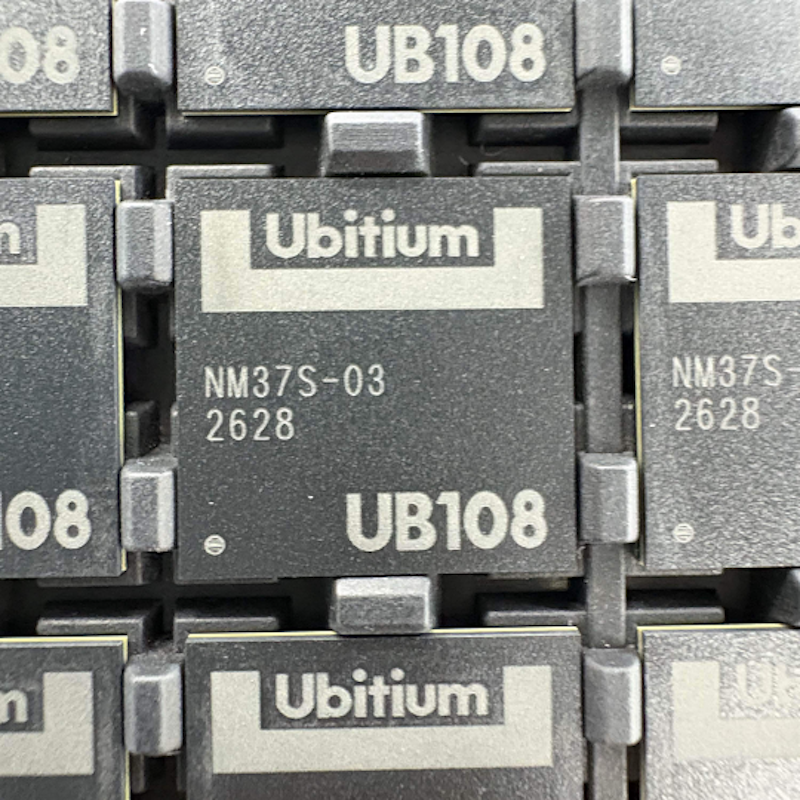
Ubitium’s first chip, the UB108 with 256 processing elements, manufactured on Samsung’s 8nm process, has demonstrated signal processing, AI inference and real-time control running on the same reconfigurable array.
Ubitium plans to tape out its first commercial processor, the UB410 with 4,096 processing elements, and deliver evaluation units in 2027.
Initial customers are building physical AI’s sensing layer: high-resolution radar and audio systems that bring demanding signal processing and AI onto one processor, in markets where today’s embedded chips already sell in volume. Autonomous systems, including drones, are the target applications for the complete perceive, think and act loop.
Investing in Ubitium
Florian Seibel, co-founder and co-CEO of Quantum Systems, says: “An autonomous machine operating in the real world must keep working when communications are unavailable. It has to process its surroundings, make decisions and control itself on board, within strict limits on power and weight.
“Today that means integrating a stack of chips that were not designed to work together, and every one of them costs weight, power and integration time we don’t have. Ubitium is building the one processor that does that whole job. That’s why I invested.”
Jeffrey Peters, partner at Ibex Investors, says: “The pace of AI is only increasing, far exceeding the ability of hardware to keep up and manage.
“Ubitium solves this with a universal reconfigurable architecture that can deploy the latest advances on a single piece of silicon with a single set of development tools. Ubitium is truly hardware at the pace of software.”
Tom Henriksson, general partner at OpenOcean, says: “AI is moving from our screens into the physical world, but tomorrow’s intelligent machines can’t run on a patchwork of repurposed chips.
“Physical AI requires a ground-up hardware revolution. Ubitium’s team has spent decades building exactly that architecture, and with the technology now in silicon they have created the foundational processor for this new era. We’re proud to back them.”
Rudi Severijns, investment director at KBC Focus Fund, says: “When we first invested, Ubitium’s universal processor was a bold bet. First silicon in a single year turned that bet into proof.
“We’re proud to keep backing the team, and we look forward to working with Ibex Investors and OpenOcean as Ubitium brings one processor for physical AI to market.”
Jonatan Luther-Bergquist, general partner, Inflection, says: “Since getting to know Hyun Shin and Martin in the beginning of 2024 and being the first check in, they’ve delivered astonishing results.
“Everything they bet on regarding the market of physical AI systems has come true, and they’re uniquely positioned to deliver compute and intelligence to a huge part of the market: from drones to humanoids. We’re thrilled to join new and existing investors in this round.”
