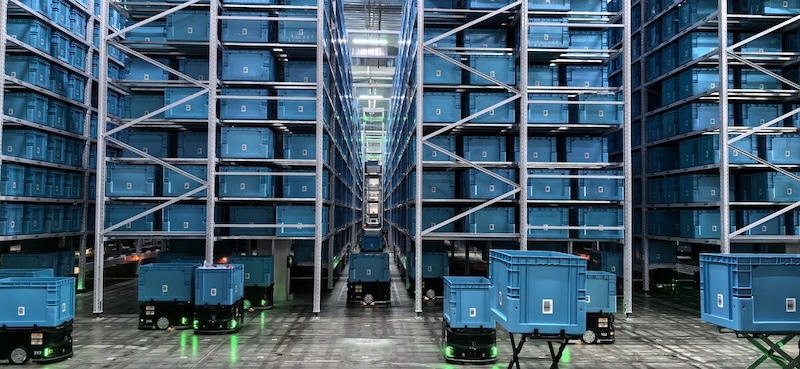
Warehouse automation is no longer viewed simply as a way to improve operational efficiency. As labor shortages persist, fulfilment expectations rise and supply chains become more complex, investment in robotics and intelligent warehouse systems is increasingly being driven from the boardroom.
For many organizations, automation has become a strategic priority, with senior executives focusing on resilience, scalability and long-term competitiveness rather than short-term productivity gains.
Inteq is a UK-based warehouse automation specialist that designs and integrates intralogistics solutions for manufacturers, retailers and logistics providers.
Its portfolio includes autonomous mobile robots (AMRs), automated storage and retrieval systems (ASRS), warehouse execution systems (WES), conveyor systems and other material handling technologies.
Rather than promoting a single hardware platform, the company focuses on bringing together robotics, software and automation technologies into flexible, hardware-agnostic solutions that can evolve as customers’ operational requirements change.
To discuss the trends reshaping warehouse automation, Robotics & Automation News spoke with Jon Roberts, sales director at Inteq.
Roberts works with companies planning and implementing automation strategies across warehousing and fulfilment operations, advising on everything from robotics deployment to software integration and digital transformation.
During the interview, Roberts argues that software has become the defining element of successful automation projects, with Warehouse Execution Systems increasingly acting as the “brain” that connects robotics, equipment and people into a single operating environment.
He also suggests that autonomous mobile robots have now moved beyond the pilot stage to become core warehouse infrastructure, helped by more accessible commercial models such as Robotics-as-a-Service.
The discussion explores why software-first automation strategies are replacing hardware-led approaches, how AI is enabling predictive warehouse operations, the growing role of pallet shuttle ASRS technology, and why businesses that invest in flexible, integrated automation platforms today are likely to be best positioned for the next generation of logistics and fulfilment operations.
Interview with Jon Roberts, sales director, Inteq

Robotics & Automation News: Warehouse automation is becoming a boardroom-level strategy issue rather than simply an operational upgrade. How are you seeing senior management priorities change across logistics and fulfilment businesses?
Senior leadership teams are driving automation decisions now because the cost of falling behind has become harder to justify than the cost of investing. For most businesses, the real risk today is inaction.
This has shifted the conversation: it is no longer whether to automate, but how fast and how far. The consequences of getting it wrong – competitive exposure, resilience gaps, customer experience failures – land at board level. That is where the decision now belongs.
R&AN: Many warehouse operators still worry about integration complexity more than the actual robotics hardware. Why is software orchestration becoming such a critical part of automation projects?
Jon Roberts: The software layer is where automation ROI is won or lost. Warehouse Execution Systems (WES) connect robotics, equipment and people into a unified control layer, giving operations teams real-time visibility and the ability to make faster, better decisions.
Without that orchestration, you end up with a patchwork architecture – often the result of individual systems each integrated as an “island” back to a host Enterprise Resource Planning (ERP) or Warehouse Management System (WMS), working independently but never as one.
The integration question used to be an afterthought. Teams would select hardware first, then figure out how to connect it. That approach fails. Complexity compounds over time, and operators find themselves locked into systems that can’t adapt.
A software-first model – where the WES is designed in from day one, not added on – solves for this by providing integration and flexibility from the outset.
R&AN: AMRs have moved well beyond pilot projects in recent years. What is driving that shift toward mobile robotics becoming core warehouse infrastructure rather than experimental technology?
JR: Two things: proven results and accessible commercial models. The evidence is there. A major fashion retailer we worked with tripled its returns put-away rates, doubled picking efficiency and now processes 99% of returns within 24 hours – using AMRs deployed across its distribution hub over three years.
Robotics-as-a-Service has removed the other barrier. What was previously a significant capital commitment is now accessible to a much wider range of operations.
AMRs mobilise quickly, work alongside people without major reconfiguration, and scale as demand grows. For operations managing seasonal volume spikes or labour volatility, that flexibility is not a nice-to-have.
R&AN: Inteq talks about flexibility overtaking fixed automation. Are companies becoming more cautious about investing in rigid, single-purpose systems that may struggle to adapt to future operational changes?
JR: Yes, and we saw this clearly in practice. One of our retail customers went through a full evaluation of fixed automation before choosing mobile robotics.
They rejected fixed systems precisely because of their inflexibility. When business needs change – new SKU profiles, volume shifts, facility changes – fixed systems become expensive constraints rather than assets.
The lesson here is clear. The business needed a solution that could expand with minimal infrastructure changes. Fixed automation could not deliver that.
The flexibility of mobile robotics – and the software layer underneath it – allowed them to scale without being locked in.
Organisations are increasingly asking: what happens in three years when this needs to change? That question is shifting procurement decisions.
R&AN: AI and data analytics are increasingly being used to make warehouses more predictive rather than reactive. What are some of the most practical real-world applications you are seeing today?
JR: Predictive maintenance is one of the clearest examples of AI delivering real value today. Original Equipment Manufacturers (OEM) increasingly embedding intelligence into equipment software, using condition monitoring and PLC-level data to identify early signs of failure.
Combined with centralised system management through a Warehouse Control System (WCS) platform, these insights enable engineers to intervene before issues escalate, reducing costly downtime in increasingly large and automated operations.
Beyond maintenance, AI is helping optimise task allocation in real time, from routing AMRs to balancing workloads and adapting throughput as demand changes.
While much of today’s AI is advanced optimisation logic, its effectiveness depends on a strong orchestration platform with visibility across systems, data and hardware.
R&AN: Warehouse Execution Systems and orchestration platforms are often described as the “brain” of modern automated facilities. How important is software integration now compared with the robotics hardware itself?
JR: The hardware gets the attention, but the software is the differentiator. A WES that connects robotics, conveyors, humans and data into a single operating picture gives you something no individual piece of kit can: genuine control. You can see the operation in real time and respond to it rather than reacting after the fact.
What that also means is that the hardware becomes interchangeable. If a better technology comes along, a truly hardware-agnostic software platform means you can adopt it without rebuilding from scratch.
Operators who invested in the software layer first are now replacing individual hardware components as they evolve. Those who did not are facing much more disruptive and costly change.
R&AN: Pallet shuttle ASRS systems appear to be gaining momentum as warehouse space pressures increase. What advantages do these systems offer compared with more conventional automated storage approaches?
JR: Several pressures are converging: the cost and scarcity of space, labour availability – reach truck drivers in particular – and the fit for brownfield retrofit into existing buildings. The drive to consolidate into fewer, denser sites adds to it.
Pallet shuttle systems retrieve and store at speed in a fraction of the footprint of conventional racking. For some operations they are simply deep, dense storage; for many they are now one piece of a connected workflow, and that is where the more significant advantage lies.
When you connect a pallet shuttle Automated Storage and Retrieval System (ASRS) with AMRs, conveyors, Automated Guided Vehicles (AGV) and robotic arms, you get end-to-end material handling across piece, case and full-pallet workflows. That combination cuts footprint and reduces operating costs at the same time.
For operations under pressure on throughput, labour and space simultaneously, this connected approach is increasingly the practical answer rather than a premium option.
R&AN: Cybersecurity and operational resilience are becoming more important as warehouses become increasingly connected and automated. How are logistics operators approaching that challenge today?
JR: It is moving up the risk register, and rightly so. As warehouses become more connected – more software, more APIs, more data flowing across systems – the potential for an attack grows. The organisations taking this seriously are treating it as part of their automation design, not something they address after go-live.
And as automation lets operators consolidate multiple operations into a single, highly automated site, the warehouse becomes critical connected infrastructure – an outage no longer affects one process, it can halt the whole estate.
That means keeping systems updated and patched as a matter of course, ensuring new hardware and software releases integrate without disruption, and building redundancy into critical processes.
The orchestration layer matters here too: bringing equipment under one controlled software platform – rather than a sprawl of independent integrations – gives a clearer line of sight on risk and a far simpler, safer upgrade path as standards evolve.
R&AN: Looking ahead to the next three to five years, what do you think will separate the warehouses that successfully scale automation from those that struggle to keep pace with the industry?
JR: Starting with software. The organisations that will lead are those that treat automation as a platform for growth rather than a series of individual problems to solve.
That means software integration designed in from day one, a hardware-agnostic foundation that can absorb new technology as it emerges, and genuine alignment between the C-suite and the operations teams responsible for making it work.
The warehouses that pull ahead will be those where the software is already in place to scale, where data flows cleanly enough to support predictive decision-making, and where the operation can evolve without starting from scratch each time technology changes.
