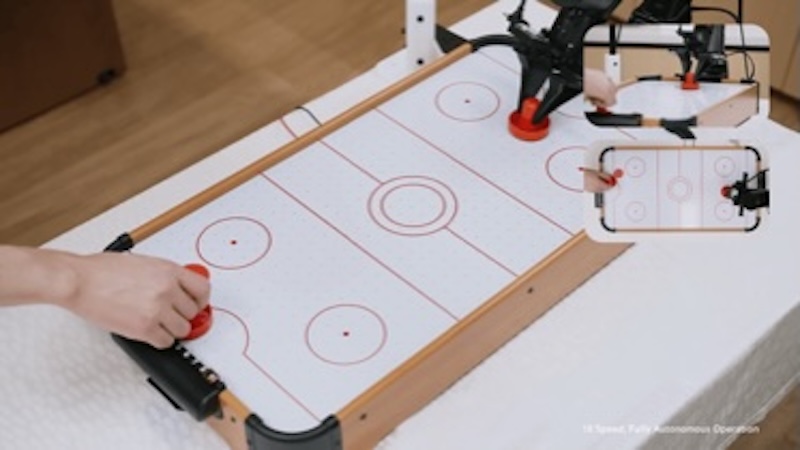
Robbyant, an embodied AI company within Ant Group, has announced the upgrade and open-source release of LingBot-VLA 2.0.
Building upon the foundation of LingBot-VLA 1.0 released in January 2026, this next-generation vision-language-action (VLA) model delivers significant leaps in morphological generalization, degrees of freedom (DoF) support, and deployment efficiency, bringing a more advanced “universal brain” for scalable real-world robotics.
While the embodied AI industry is witnessing rapid advancements in hardware and control systems, the lack of a truly universal brain remains a primary bottleneck for industrial-scale deployment.
LingBot-VLA 2.0 addresses this critical gap by dramatically expanding its pre-training data and architectural capabilities.
LingBot-VLA 2.0 was pre-trained on 60,000 hours of high-quality, real-world physical data. This massive dataset was curated from 50,000 hours of cleaned real-robot interaction data and 10,000 hours of distilled first-person human manipulation data.

Sourced from 20 distinct robot morphologies across 17 leading manufacturers – including Leju, AgiBot, Unitree, AgileX, Galaxea, Galbot, Astribot, RealMan, Franka, ARX, X-Humanoid, Fourier, MagicLab, Spirit AI, Zerith, Flexiv, and Qinglong—the data covers single-arm, dual-arm, bipedal, and wheeled configurations.
In terms of DoF support, LingBot-VLA 2.0 expands its operational capabilities to include head, waist, end-effectors (hands), and mobile chassis, enabling highly coordinated whole-body control.
In terms of dual-arm manipulation, on the Shanghai Jiao Tong University’s GM-100 benchmark, LingBot-VLA 2.0 achieved leading average task progress scores and success rates on AgileX Cobot Magic and Galaxea R1 Pro platforms, outperforming both π0.5 and GR00T N1.7, which demonstrates LingBot-VLA 2.0’s superior cross-morphology generalization.
In long-horizon mobile manipulation tasks tested on the ARX Arm + AgileX Chassis and Astribot S1 platforms, LingBot-VLA 2.0 surpassed π0.5 in both task progress and success rates.
Its robust performance in challenging cross-domain scenarios highlights its advanced capability in executing long-sequence tasks and generalizing mobile manipulation.
To address the high costs associated with post-training and deployment, LingBot-VLA 2.0 introduces a version optimized for highly efficient post-training.
Compared to the previous generation, inference efficiency has been improved by 3 times, with latency strictly maintained under 150 milliseconds. This significantly lowers the barrier for real-time commercial applications.
Robbyant is actively exploring the application of LingBot-VLA 2.0 in real-world business scenarios. In collaboration with hardware partners like Leju and Ti5Robot, and enterprise customers including GuoDa Drugstore and Longsheng Technology, the model is undergoing comprehensive commercial pilot testing in retail sorting, logistics, and industrial environments.
Furthermore, Robbyant is partnering with companies like GenRobot.ai to build standardized data ecosystems.
