
Last-mile delivery is the most expensive, most visible, and most operationally complex part of the supply chain. It accounts for up to 53% of total shipping costs.
It is where customer promises are either kept or broken. And it is the segment under the most pressure from rising delivery volumes, tighter time windows, and customers who now expect real-time visibility as a baseline.
Technology investments in the last mile have accelerated across warehouse automation, telematics, and customer communication. But none of those investments produce consistent results without one thing underneath them: a strong route planning foundation.
Route planning is not a single step in the delivery workflow. It is the decision layer that determines how every other resource in the last-mile operation is used. Let’s examine why that matters and what it means to get it right.
The Last-Mile Problem is a Planning Problem
The inefficiencies that define poor last-mile performance, high cost per delivery, missed time windows, underutilized vehicles, and excessive driver overtime are not primarily execution failures. They are planning failures that manifest during execution.
The Compounding Effect of Poor Planning
When stops are assigned to the wrong vehicles, load capacity is wasted. When sequences are built without time-window intelligence, drivers arrive outside customer availability and fail the delivery on the first attempt.
When shift constraints are not embedded in the plan, drivers work overtime to complete their run, adding labor cost that was entirely avoidable at the planning stage.
These failures do not stay isolated. A missed delivery generates a re-delivery attempt the following day, which adds to that day’s volume and pushes another vehicle over capacity.
Failed first attempts, when concentrated in a geography or time period, cascade into systemic SLA failure that costs far more to recover from than it would have cost to prevent.
Planning Quality Determines Fleet Utilization
Fleet utilization, the proportion of available vehicle capacity actually used in productive delivery, is one of the clearest indicators of planning quality. Operations with mature route planning capability consistently run at 70-80% vehicle utilization.
Those relying on manual planning or basic rule-based tools rarely achieve this much efficiency. The gap represents real vehicles, real fuel, real driver hours, and real capital deployed with no productive return.
What Route Planning Actually Controls in Last-Mile Operations
Strong route planning capability influences every major cost and performance driver in last-mile delivery simultaneously.
Stop-to-Vehicle Assignment
The decision about which stops go on which vehicle, considering weight capacity, volume, vehicle type, geographic zone, and shift window, directly determines vehicle fill rates and the number of vehicles required for a given day’s volume.
A planning engine that optimizes this assignment mathematically, across all vehicles and stops simultaneously, produces consistently better vehicle utilization than any manual allocation process.
Time-window Compliance
Customer and consignee time windows are constraints, not preferences. A route planning engine that embeds time windows as hard constraints in the solver produces sequences where every stop is reachable within its committed window, given realistic travel times and service durations. This is the planning foundation on which SLA performance is built.
Driver Hours Management
Hours-of-service constraints, mandatory break requirements, and shift completion targets must be managed at the planning stage, not discovered mid-shift when a driver realizes they cannot legally complete their run.
Planning engines that manage HOS constraints natively produce schedules that respect driver hours, reduce overtime, and keep the fleet compliant without manual oversight.
Route Planning as the Integration Point for Last-Mile Technology
Route planning does not sit in isolation. It is the integration point where order data, fleet data, and customer data converge to produce an executable plan.
Connecting the Order Pipeline to Fleet Capacity
Orders arrive from the OMS or WMS with delivery addresses, time windows, freight weights, and service requirements. The route planning engine takes that order data and maps it against available fleet capacity, vehicle count, vehicle type, shift availability, and depot location to produce an optimized assignment. The quality of that mapping determines how efficiently the available capacity serves the day’s volume.
Feeding Execution With an Accurate Plan
A route plan that is accurate at departure time with correct sequences and realistic ETAs, and that correctly sequences loads, gives the execution layer a strong foundation. Drivers know where they are going and why the sequence is built the way it is.
Dispatchers have a realistic baseline against which to measure live performance. Customers receive ETAs that reflect actual driving conditions, not theoretical averages.
When the plan is wrong at departure, inaccurate service times, unrealistic ETAs, and poor load sequencing, the execution layer spends the shift compensating for planning failures rather than performing against a reliable baseline.
How Route Planning Capability Defines Last-mile Competitiveness
The last-mile delivery market is becoming more competitive, not less. Customers compare delivery performance across providers. Retailers apply SLA performance criteria to carrier selection. E-commerce platforms use delivery speed and reliability as differentiators in customer acquisition.
Operations that compete on last-mile performance need a planning capability that produces consistently high vehicle utilization, high on-time delivery rates, and low cost per stop every day, at scale, across fluctuating volumes.
That capability is not achievable through manual planning. It requires a purpose-built route planning engine that solves at the complexity level the modern last-mile operation actually presents.
The gap between well-planned and poorly-planned last-mile operations is measurable in cost, customer satisfaction, and driver productivity. It is also closable with the right planning infrastructure in place.
Build Last-mile Performance on a Planning Foundation That Works
The transformation of last-mile delivery starts at the planning stage. Investments in vehicles, drivers, and customer experience tools deliver their full returns only when the underlying route plan is accurate, optimized, and integrated with the execution environment.
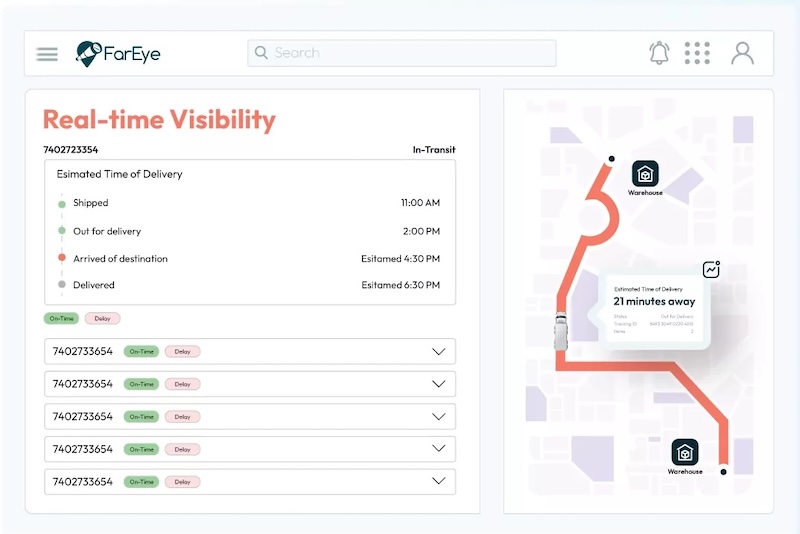
Technology partners like FarEye are built for the complexity of modern last-mile operations, connecting intelligent planning with real-time execution visibility. If your operation is ready to build a stronger last-mile foundation, make sure to schedule a meeting with industry leaders like FarEye today.
