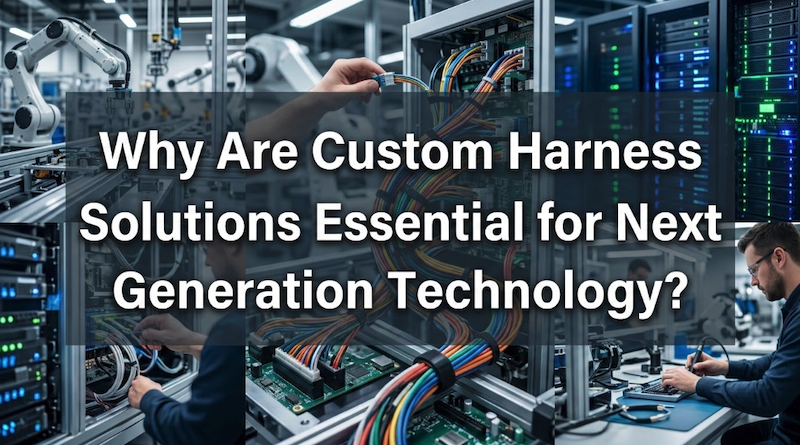
Hardware development has a bad habit of treating wiring as an afterthought. You spend months engineering a new electric powertrain or a high density sensor array.
The mechanicals are perfect. The software is ready. Then someone realizes the physical connections just don’t fit in the remaining space.
Off the shelf components work fine for legacy systems and basic consumer goods. But when you build hardware that pushes boundaries on power density or physical size, standard harnesses become a massive liability.
They take up too much space. They carry unnecessary weight. They fail under new thermal profiles. Custom connectivity is no longer just a nice upgrade. It is a fundamental requirement for modern hardware.
The Hidden Bottleneck in Product Development
Packaging is usually the first place standard parts fail. Modern equipment packs more functionality into a smaller footprint than ever before. You see this heavily in aerospace, robotics, and industrial automation.
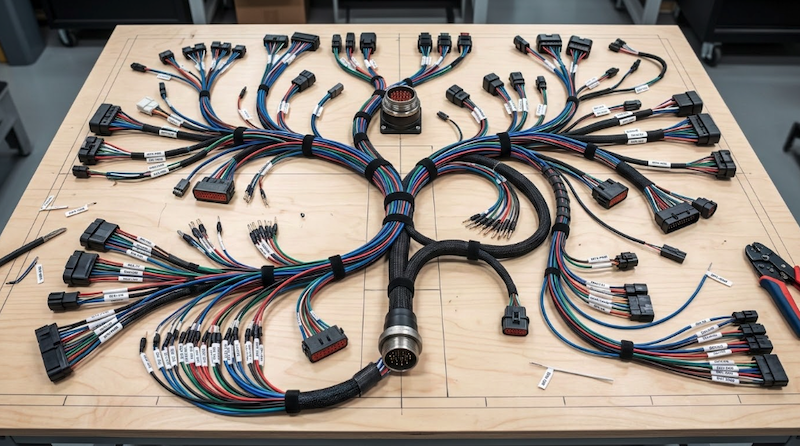
Space is incredibly premium. A standard harness comes with predetermined connector housings and fixed routing paths. If you try to force it into a tight enclosure, you introduce pinch points and mechanical stress on the terminals.
This creates a ripple effect across the entire project. If the wiring doesn’t fit smoothly, you end up redesigning mechanical enclosures late in the development cycle.
That delays production and burns through budgets. Specifying a custom wiring and cable assembly early in the process solves this directly.
Engineers can route paths alongside structural components, choose exact connector angles, and eliminate excess wire loops. You get exactly what you need without compromising the physical design of the product.
Weight savings is another crucial factor. In electric vehicles and aerospace, weight is directly tied to performance and range limits. Custom solutions allow you to specify exact wire gauges and lightweight jacket materials for each specific circuit.
You aren’t carrying a single ounce of copper or plastic that you don’t strictly need. Over a production run of thousands of units, that material savings adds up fast.
Managing Power Density and Thermal Realities
Technology is drawing significantly more power today. Fast charging networks, heavy duty electric machinery, and grid storage systems operate at voltages that were rare outside of power plants a decade ago.
Pushing more current through tight spaces inevitably generates heat. If you rely on standard wiring, you risk thermal degradation or outright failure.
Custom engineering allows you to match the exact thermal and electrical requirements of your system. High voltage harnesses must be designed with specific insulation materials, precise shielding, and exact bend radii to prevent arcing or insulation breakdown.
You can incorporate active cooling lines or specialized heat-resistant jacketing right into the design. Standard harnesses simply do not offer this level of thermal management.
You either overbuild using massive, heavy cables, or you risk dangerous field failures. Customization gives you the exact safety margin required without the unnecessary bulk.
Electromagnetic interference is another major factor with high power density. High power systems generate significant noise. If you run a high power line next to a low voltage data cable in a standard loom, signal integrity drops off a cliff.
Custom layouts allow engineers to physically isolate power from data. You specify precise shielding for specific runs and ensure signal clarity across the entire machine.
The Reality of Sourcing and Production
A lot of companies treat wiring as a simple commodity. Purchasing departments will often try to buy standard cables in bulk to save a few pennies per unit.
This looks great on a spreadsheet but consistently costs more in the long run. When standard parts fail in the field, the warranty claims and service calls wipe out any upfront savings.
The goal is to build something that lasts. That requires finding a true partner for manufacturing. Picking a reputable Wiring harness manufacturer is a core engineering decision. You need a facility that understands your specific industry standards and regulatory requirements.
They should be able to look at your CAD drawings and tell you exactly where a routing path will cause assembly issues on the line. A good manufacturer will help you prototype quickly, test for failure modes, and then scale up production without losing quality control.
Quality control during production is notoriously difficult for complex electrical systems. It requires specialized tooling and rigorous testing protocols like automated continuity checks and pull testing.
When you work with a custom facility, these tests are built around your exact specifications. Every unit that leaves their floor is verified to work in your specific application before it ever ships.
Environmental Hazards and Regional Expertise
Next generation technology doesn’t just sit in climate controlled server rooms. It operates in freezing temperatures, deep underground, and in the middle of oceans.
Standard plastics get brittle in the cold. Saltwater corrodes standard terminals rapidly. Constant vibration from heavy machinery destroys weak crimps.
You have to design for the actual environment. Sometimes that means looking at regions with specific engineering expertise. For example, heavy forestry and mining equipment require serious winterization.
An operation like a wire harness finland facility often has deep experience building connections that survive extreme cold and constant physical shock. They know which polymers remain flexible at subzero temperatures and which connectors repel ice buildup.
By leveraging custom engineering, you tap into this kind of specialized knowledge. You get a product built specifically for the worst conditions it will face.
Chemical exposure is another reality you can’t ignore. Agricultural tech and industrial robots are regularly exposed to fertilizers, hydraulic fluids, and harsh cleaning agents. Standard wire jackets will swell and crack over time.
A custom build lets you specify exactly which chemical resistant compounds to use. You seal the connectors to IP69K standards if necessary so the equipment keeps running. Your maintenance teams spend their time on actual service rather than chasing down random electrical gremlins.
Long Term Value and Field Reliability
At the end of the day, reliability is the only metric that truly matters. Customers don’t care how much you saved on wiring. They care if the machine turns on when they press the button. Next generation hardware is expected to have high uptime and minimal maintenance requirements.
Custom wiring solutions eliminate the most common points of failure. There are no excess connectors vibrating loose. There is no stretched wiring wrapped around sharp metal corners. Every component is designed to work together as a single cohesive system.
This level of integration makes assembly faster on your factory floor and makes repairs significantly easier in the field. When technicians need to replace a component, they are working with clean, logical connection points. Building advanced technology takes massive investment.
Securing that investment means paying attention to how everything connects. Custom harnesses give you control over the physical reality of your product. They ensure your innovations actually perform in the real world exactly how they did on the drawing board.
