The competition among enterprise agile frameworks that dominated practitioner conversations for much of the last decade has largely resolved.
SAFe – the Scaled Agile Framework – has emerged as the dominant approach for large enterprises navigating agile at scale, and its adoption at the organizations with the largest hiring volumes has created a specific and concentrated credential demand with documented salary premiums.
Why SAFe Won the Enterprise Market
SAFe addressed a specific problem that team-level Scrum could not solve: coordination across dozens of teams working on interdependent products and systems. Scrum provides an excellent delivery framework for individual teams.
When fifty such teams are working on components that must integrate and release together, Scrum’s team-level ceremonies don’t produce the cross-team alignment that large-scale delivery requires.
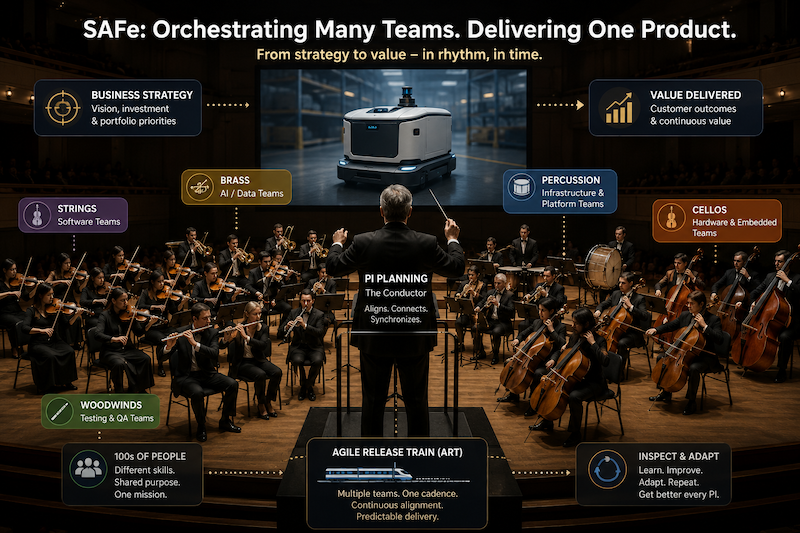
SAFe’s PI Planning – the quarterly event aligning all teams around shared objectives, surfacing dependencies, and coordinating delivery plans – solved this coordination problem in a way organizations could actually implement. With 70 percent of Fortune 100 companies having adopted SAFe, the framework’s market position is now self-reinforcing.
Organizations that have invested in SAFe transformation strongly prefer candidates who already understand the framework, creating the credential requirement that generates the job posting frequency making it worth pursuing.
The Salary Premium
SAFe-certified professionals earn 25 percent more than non-certified peers on average, with typical salary boosts of $12,000 to $24,000 annually. Sixty-two percent of open SAFe roles explicitly list SAFe certification as a requirement, and there has been a 35 percent year-over-year increase in SAFe job postings.
These figures reflect the concentrated demand from Fortune 100 companies that have made large SAFe adoption investments and need practitioners who can operate within them.
A SAFe Agile Certification preparation course covering Leading SAFe – the core SAFe credential – addresses the full framework: Lean-Agile mindset, SAFe principles, Agile Release Train coordination, PI Planning facilitation, and the roles making large-scale agile delivery function effectively.
The Relationship to Scrum Master Skills
SAFe and Scrum are complementary rather than competing frameworks. SAFe provides program-level coordination structure; Scrum provides the team-level delivery methodology operating within that structure.
A professional with both SAFe certification and scrum master certification understands agile delivery at both team and program levels simultaneously – precisely what large SAFe organizations need from their practitioners.
The combination opens roles requiring coordination across teams (SAFe roles) and roles requiring effective team facilitation (Scrum Master roles) with a single, integrated credential profile.
SAFe in Practice: What the Day-to-Day Looks Like
For professionals evaluating SAFe certification from the outside, the practical day-to-day reality of SAFe roles is worth understanding.
Release Train Engineers spend significant time facilitating PI Planning events, coaching teams on SAFe practices, removing impediments at the program level, and tracking program-level metrics including PI predictability and program increment velocity.
The work combines facilitation, coaching, project coordination, and stakeholder communication in a way that draws on both agile methodology depth and organizational effectiveness.
Professionals who thrive in SAFe environments are those who combine genuine enthusiasm for agile principles with the patience and interpersonal effectiveness to coach and facilitate rather than direct and control.
The credential validates the methodology knowledge; the effectiveness in the role depends on the leadership and facilitation capabilities that the methodology knowledge enables.
The SAFe Ecosystem of Certifications
The Leading SAFe credential is the entry point to a larger SAFe certification ecosystem. SAFe Scrum Master validates team-level Scrum within a SAFe context. Release Train Engineer validates the program-level facilitation capability that large SAFe deployments require.
SAFe Program Consultant validates the transformation consulting capability that organizations adopt SAFe with. Each level adds organizational scope and compensation to the previous one.
For professionals who find that they genuinely enjoy the large-scale coordination work that SAFe involves, the certification path is well-mapped and the career progression from team-level practitioner to enterprise transformation consultant is one of the more clearly defined advancement tracks in the agile space.
SAFe certification and genuine hands-on experience in SAFe environments – particularly PI Planning facilitation – is the combination that most consistently produces competitive candidacy for the senior agile roles at Fortune 500 organizations where SAFe adoption has created the largest and most concentrated demand.
SAFe certification combined with hands-on PI Planning facilitation experience is the combination consistently producing competitive candidacy for the senior agile roles at Fortune 500 organizations where SAFe adoption has created the largest and most concentrated demand for certified practitioners.
