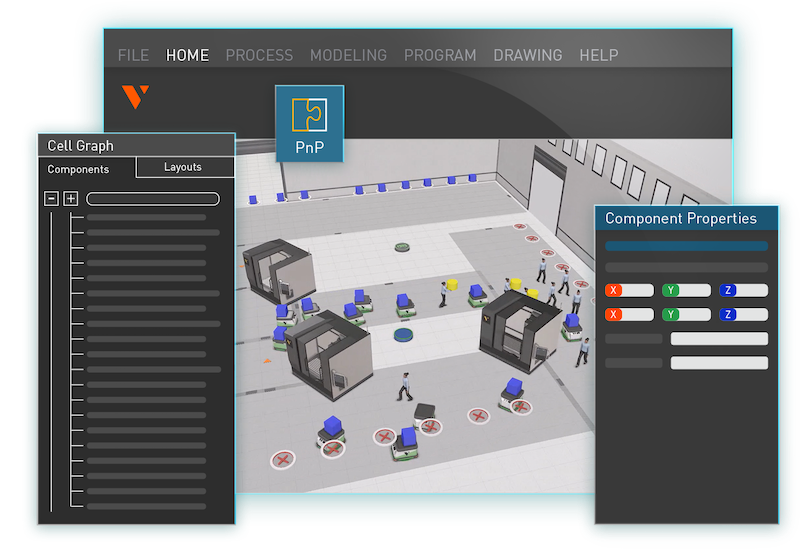
Visual Components, a specialist in 3D manufacturing simulation and robot offline programming, has announced the release of Visual Components 5.1, a major advancement in factory simulation designed to enable manufacturers to manage the growing complexity of autonomous production environments.
The new release introduces highly accurate physics simulation and scalable robot orchestration capabilities, enabling manufacturers to simulate hundreds of autonomous mobile robots, automated guided vehicles, robots, products, and people operating simultaneously across full factory environments.
As factories evolve toward increasingly autonomous, connected, and intelligent systems, manufacturers must manage complex interactions between robots, mobile vehicles, products, material flows, control systems, and people across entire production environments.
Without proper validation before deployment, organizations face risks ranging from traffic bottlenecks and collision hazards to commissioning delays, programming errors, layout inefficiencies, and costly redesigns.
Visual Components 5.1 addresses these challenges by enabling manufacturers to simulate real-world physics, validate controller logic, and model dynamic factory operations with unprecedented scale and accuracy before committing changes on the factory floor.
Mika Anttila, CTO of Visual Components, says: “Manufacturers are under increasing pressure to deploy more autonomous and flexible production systems, but the complexity of those environments is growing faster than many existing tools can handle.
“Our customers need to validate how hundreds of moving resources, robots, vehicles, products, and people interact before anything is installed on the factory floor. With 5.1, we’re giving them a much more scalable and realistic way to do that.”
Factory planning and operations
The 5.1 release delivers improvements across three areas of the platform. On the simulation side, it enables hundreds of AMRs and AGVs to run within a single environment with advanced collision avoidance and up to 10x faster performance compared to previous versions, making large-scale mobile robotics scenarios practical to validate for the first time.
On connectivity, the release adds support for Allen-Bradley PLCs, alongside new virtual commissioning plugins for Nachi and Epson robots, bringing more of the real production system into the simulation loop earlier in the project.
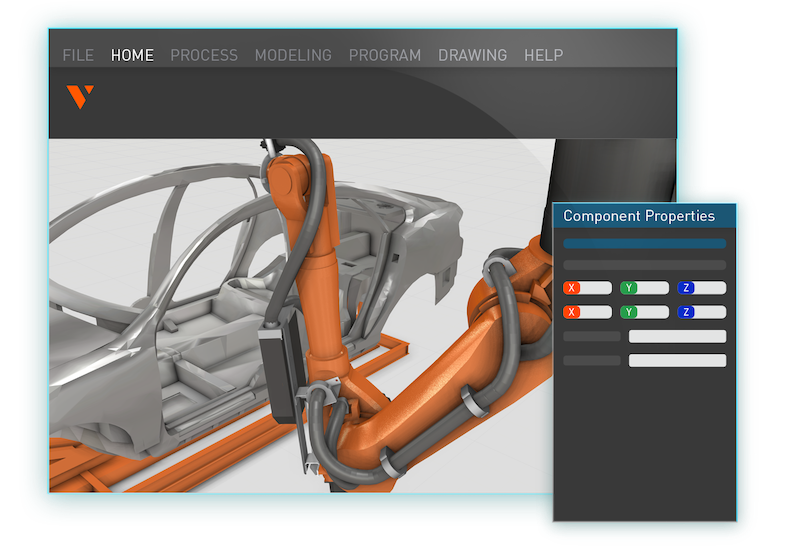
For teams doing robot offline programming, the scripting environment has been upgraded to Python 3, replacing a legacy environment that had become a growing constraint for developers building and maintaining robot programs.
Together, these improvements allow production leaders, factory planners, and automation engineers to validate more of the real system, mobile fleets, control logic, and robot programs, before anything is committed on the factory floor.
Unlike many solutions that focus on isolated aspects of automation, Visual Components 5.1 provides a comprehensive factory simulation platform for simulating entire factory systems, from robotics and material flow to human operations. This approach enables organizations to make confident, data-driven decisions before investing in physical systems.
It reduces reliance on assumptions and manual adjustments, improves collaboration across engineering, operations, and management teams, and leads to smoother commissioning and faster time-to-production.
These capabilities are particularly relevant for industries navigating the shift toward more connected and autonomous production: automotive, electronics, logistics, and healthcare manufacturers who are combining traditional robot automation with mobile fleets and who need controller-accurate validation to reduce commissioning risk across the full system.
Mikko Urho, CEO at Visual Components, says: “Manufacturing environments are becoming increasingly dynamic. Mobile robots, automation, and connected production systems create new opportunities, but also new complexity.
“Before making investments or changes on the factory floor, manufacturers need confidence that their plans will work in practice. Visual Components 5.1 allows manufacturers to validate complex operations earlier in the planning process, reducing risk before deployment.”
