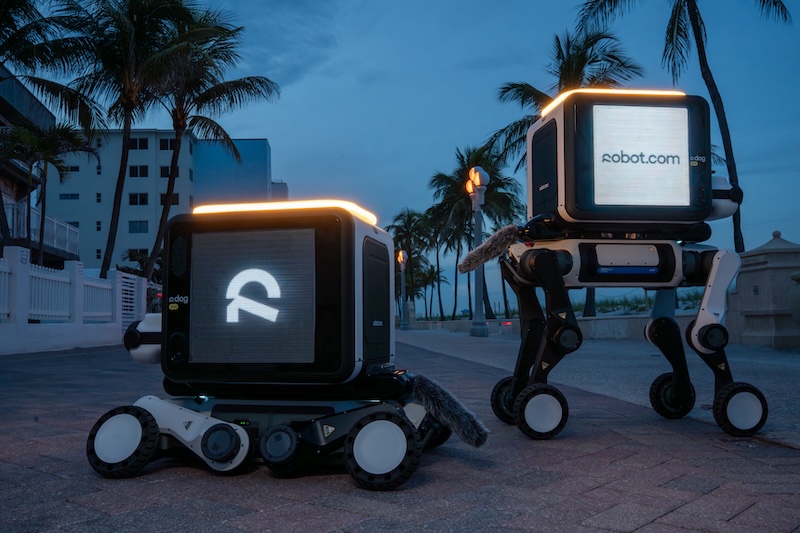
Robot.com, the company putting robots to work in the real world, has unveiled R-dog, its new concept for a four-legged delivery robot built for two distinct and essential roles in robotics: completing the last 100 meters where wheeled robots cannot operate, and turning those same locations into interactive advertising.
R-dog will run on REMI, Robot.com’s fleet management platform and the physical API layer that integrates, controls, and orchestrates every robot in the company’s fleet.
Every delivery eventually reaches the hard part: stairs, curbs, thresholds, uneven ground between a lobby and a door, and many other impediments. While wheeled robots stop there, R-dog was designed as a solution for those last few steps.
Its four legs carry it up and down stairs, over curbs and thresholds, and across the mixed terrain where the final stretch of a delivery actually happens, including dense urban streets, residential neighborhoods, and campus settings such as universities, hospitals, and corporate or industrial sites.
The R-dog concept is built for real payloads, featuring a large onboard compartment that holds multiple items at once. For example, stacked food orders alongside standard e-commerce parcels, so the same robot handles food delivery and package delivery without a hardware change.
When it arrives, unattended auto drop-off completes the handoff and sends the R-dog to its next assignment.
R-dog’s second application is interactive advertising through R-ads, Robot.com’s unified, self-serve advertising suite. The same expressive, approachable design that draws people toward the robot also turns it into a moving, interactive out-of-home ad platform.
Brands will be able to remotely upload and manage campaigns to the R-dog’s dual video screens, and let the robot’s personality do the work.
People notice it, walk toward it, interact with it, and then notice the brand behind the experience. An impression that begins with a smile converts in ways that static signage cannot.
Felipe Chavez Cortes, CEO and co-founder of Robot.com, says: “A decade of building delivery robots has taught us that most robots hit a wall in the final 100 meters, leaving a person to finish the job by hand. R-dog is our answer to that. And we’re equally proud of how we built it.
“REMI is the operating foundation that runs every robot we have. When we wanted to add a quadruped, we didn’t need to build a new operational system from the ground up. We built R-dog to run on what already exists, and that is what makes launching a new robot form factor possible at the pace we move.”
Every Robot.com robot is connected through REMI, the company’s physical API platform and fleet management layer that manages everything from teleoperation to performance and deployment.
Work across every category, from delivery robots to humanoids and four-legged robots, contributes to shared intelligence that improves future tasks across the fleet. This foundation allows Robot.com to deploy new form factors without rebuilding from scratch.
As R-dog moves toward production, Robot.com is expanding its collaboration with FieldAI. Field Foundation Models (FFMs) serve as an operational AI layer that generalizes across robots and environments and serves three roles: enabling safe and reliable operations in dynamic, real-world spaces without prior information or supporting infrastructure; preventing model hallucinations through physics-grounded AI models; and coordinating multiple robots working together.
Ali Agha, founder and CEO of FieldAI, says: “Every delivery ends where Field Foundation Models are strongest, in the dynamic, unpredictable last 100 meters where the map runs out.
“Grounded in physics and uncertainty quantification, FFMs enable R-dog to adapt to those conditions in real time and operate with the safety, reliability, and interpretability required for real-world deployment.”
The R-dog concept joins an expanding portfolio that includes R-kiwi for campus delivery, R-cargo for industrial and warehouse logistics, R-noid for humanoid labor solutions, and R-ads across the fleet.
More than 500 robots are currently deployed across the United States, Canada, Dubai, and MENA, having completed more than 2.5 million tasks to date. R-dog launches now as a concept, with commercial deployments in 2027.
