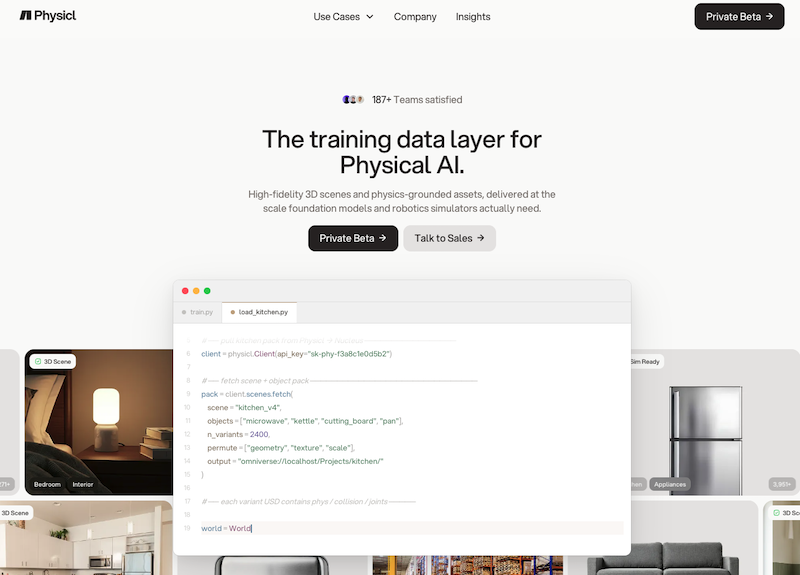
The next leap in robotics won’t come from faster processors or more sophisticated mechanical design. It will come from better data, specifically, from training environments that replicate how the physical world actually behaves.
What is physical AI?
Physical AI refers to 3D assets and simulation environments built with real physical properties embedded at their core, not just how objects look, but how they behave. Weight, friction, inertia, material deformation, surface dynamics, and force response are all baked into the asset itself.
A cardboard box isn’t just a brown cube; it flexes under load, slides predictably across a warehouse floor, and collapses at the right stress points. This distinction, between visual fidelity and physical fidelity, is what separates functional robotics training data from decoration.
The simulation-to-reality problem
The robotics industry has long struggled with what researchers call the “sim-to-real gap.” Engineers build elaborate virtual environments to train robotic systems, log millions of simulated interactions, and deploy confidently, only to watch performance collapse the moment the robot encounters the real world.
The reason is straightforward: most simulation assets are built for visual rendering, not physical accuracy. A robot trained in a visually convincing warehouse still has no grounded understanding of how a wet floor changes traction, how a full pallet distributes weight differently from an empty one, or how a soft object compresses differently from a rigid one.
The robot has learned appearances. It has not learned physics.
This gap is not a minor calibration issue. It is a fundamental data problem. And as robotic applications scale into unstructured environments, logistics, healthcare, construction, home assistance, the cost of that gap compounds with every edge case the simulation never accounted for.
How physics-accurate 3D assets close the gap
When training environments are built around physical AI, assets where material behaviour, mass distribution, and contact dynamics are modelled accurately, the simulation stops being an approximation and starts being a reliable proxy for reality.
A robotic arm trained on physically accurate objects develops grip strategies that transfer. It learns that glass behaves differently from rubber, that awkward centre-of-mass geometries require compensatory adjustments, that friction coefficients matter when surfaces are wet or dusty.
None of this requires additional real-world training. It is encoded in the quality of the simulation data itself.
This is the core insight physical AI unlocks: the robot doesn’t need to re-learn the world when it leaves simulation. It already knows how the world works, because its training environment told the truth.
Robots that learn this way perform better
The evidence from early deployments is consistent. Robotic systems trained on physically grounded simulation data demonstrate faster deployment timelines, lower failure rates in novel environments, and significantly reduced need for real-world fine-tuning.
They generalise better, not because they are architecturally different, but because they were trained on better physics.
As the industry pushes toward autonomous systems operating in complex, unpredictable environments, the quality of simulation data will increasingly determine what is possible.
Physical AI is not a feature addition to robotics development. It is the missing foundation the field has been building toward.
