Modern defense systems, autonomous vehicles, robotics platforms and industrial automation equipment all depend on reliable power conversion.
Rugged DC-DC converters are crucial in maintaining stable power delivery in environments where vibration, shock, electromagnetic interference and extreme temperatures can quickly compromise standard commercial electronics.
What to Look for in a Rugged DC-DC Converter
As aerospace, naval and ground vehicle systems become more electrified, engineers increasingly prioritize converters. They should meet strict military and industrial standards such as MIL-STD-704, MIL-STD-461, MIL-STD-1275, MIL-STD-1399 and MIL-STD-810.
Electromagnetic compatibility and environmental survivability remain core requirements for mission-critical electronics operating in contested and harsh environments.
Before selecting a supplier, procurement teams and system engineers typically evaluate several technical and operational factors:
- Compliance with military standards
- Shock and vibration resistance
- Wide operating temperature ranges
- EMC and EMI filtering performance
- High power density
- Long-term life cycle support
- Modified COTS or custom design flexibility
- Thermal management capabilities
- Reliability testing and quality assurance
Applications such as unmanned systems, radar platforms, naval electronics, satellite communications and mobile robotics often require configurable power architectures that can survive years of demanding field operation.
Best Vendors for Ruggedized DC-DC Power
Below are some of the best rugged DC-DC converter manufacturers for industrial and military applications, focusing on reliability, customization flexibility, environmental performance and engineering support.
1. Advanced Conversion Technology (ACT)
ACT stands out for its engineering-first approach to ruggedized AC-DC and DC-DC power systems. The company specializes in military-grade and harsh-environment power conversion solutions for aerospace, naval, vehicle and industrial platforms.
It supports both standard COTS products and modified COTS configurations. The company’s experience with MIL-STD-704, 461, 1275, 1399 and 810 compliance helps reduce integration risk for defense contractors and system designers.
ACT also emphasizes full life cycle support for long-duration defense and industrial programs. Its solutions are well-suited for 28V military vehicle architectures and high-power kW-class applications.
2. SynQor
SynQor has built a strong reputation in military and railway power applications. The company offers a broad catalog of rugged DC-DC converters specifically designed for MIL-STD compliance.
Its military product line includes converters engineered to meet MIL-STD-1275, MIL-STD-704, MIL-STD-461 and DO-160 environmental requirements.
Defense integrators commonly deploy SynQor’s products in tactical vehicles, communication systems and airborne electronics. The company also provides integrated EMI filtering and transient protection, simplifying deployment in electrically noisy environments.
3. Vicor
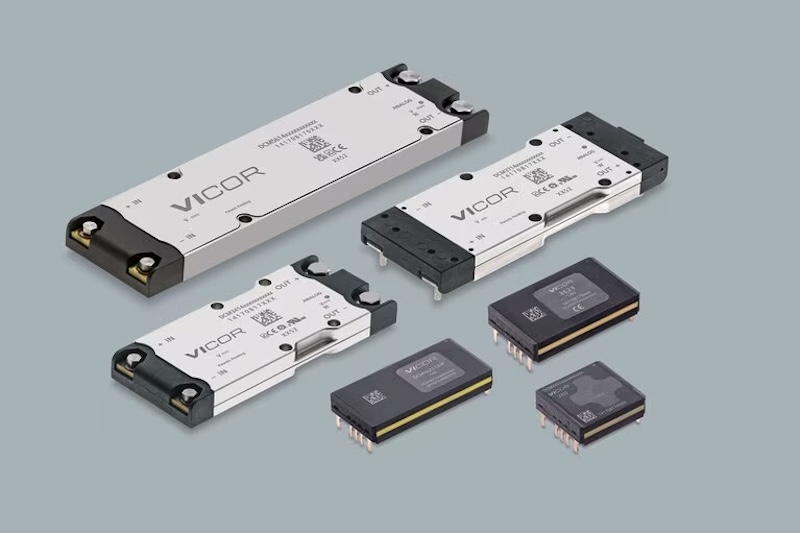
Vicor is well known for its high-density modular power-conversion technology. Engineers frequently use its DC-DC converter modules in aerospace, robotics and high-performance computing applications where efficiency and compact size are critical.
The company’s scalable modular architecture and strong thermal performance make its products attractive for advanced robotics and autonomous systems. Many engineers also appreciate the company’s factorized power architecture for distributed power systems.
4. TDK-Lambda
TDK-Lambda remains a major player in industrial automation and factory electronics markets. Its DC-DC converter portfolio includes ruggedized models suitable for transportation, industrial machinery and process automation systems.
The company’s strengths include global manufacturing scale, strong reliability testing, broad industrial certifications and efficient thermal management.
Industrial automation teams often choose TDK-Lambda solutions for projects that require dependable long-term supply continuity and strong industrial reliability.
5. Crane Aerospace & Electronics
Crane Aerospace & Electronics develops highly ruggedized power electronics for aerospace and defense applications. Its converters are commonly used in avionics, missile systems and space-grade platforms.
The company engineers its products for extreme vibration environments, high-altitude operation, radiation tolerance and long operational life cycles. Its aerospace heritage makes the company especially relevant for mission-critical airborne systems requiring extensive qualification testing.
6. VPT
VPT specializes in rugged DC-DC converters for military, avionics and space systems. The company focuses on high-reliability designs that operate in severe environmental conditions.
VPT solutions often feature wide input voltage ranges, hermetic packaging options, radiation-hardened designs and high MTBF performance. These capabilities make the company attractive for satellite systems, UAVs and other mission-critical defense electronics.
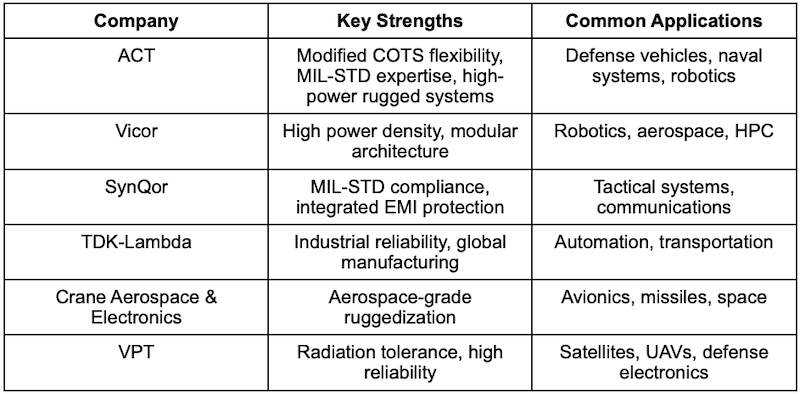
Comparative Summary of Leading Rugged DC-DC Converter Companies
Below is an at-a-glance comparison of the top providers.
Why Modified COTS Matters in Modern Defense Programs
Many military and industrial OEMs now prefer modified COTS strategies instead of fully custom power development. Modified COTS solutions reduce engineering time while still allowing mission-specific optimization.
This approach is especially valuable when:
- Programs face aggressive deployment schedules.
- Legacy platforms require modernization.
- Environmental requirements vary by platform.
- Long life cycle support is necessary.
Companies like ACT that offer configurable architectures and direct engineering collaboration can help reduce procurement complexity while maintaining compliance and reliability standards.
Choosing the Right Rugged Power Partner
Selecting the right rugged DC-DC converter supplier involves more than comparing voltage ranges or power density specifications.
Engineers and procurement teams must also evaluate long-term reliability, standards compliance, customization flexibility and life cycle support.
