Quick answer: The best machinery positioning option for a fabrication facility is the one that meets four documented requirements for the move: clearance, load, movement and floor condition.
Most shops can cover nearly every job with a short list of equipment: hydraulic toe jacks for the lift, low profile machinery sliders or wheeled skates for travel, air casters for very heavy loads on smooth sealed floors, overhead cranes where the building has them and forklifts to supply power and handle loading.
Why is positioning fabrication equipment different?
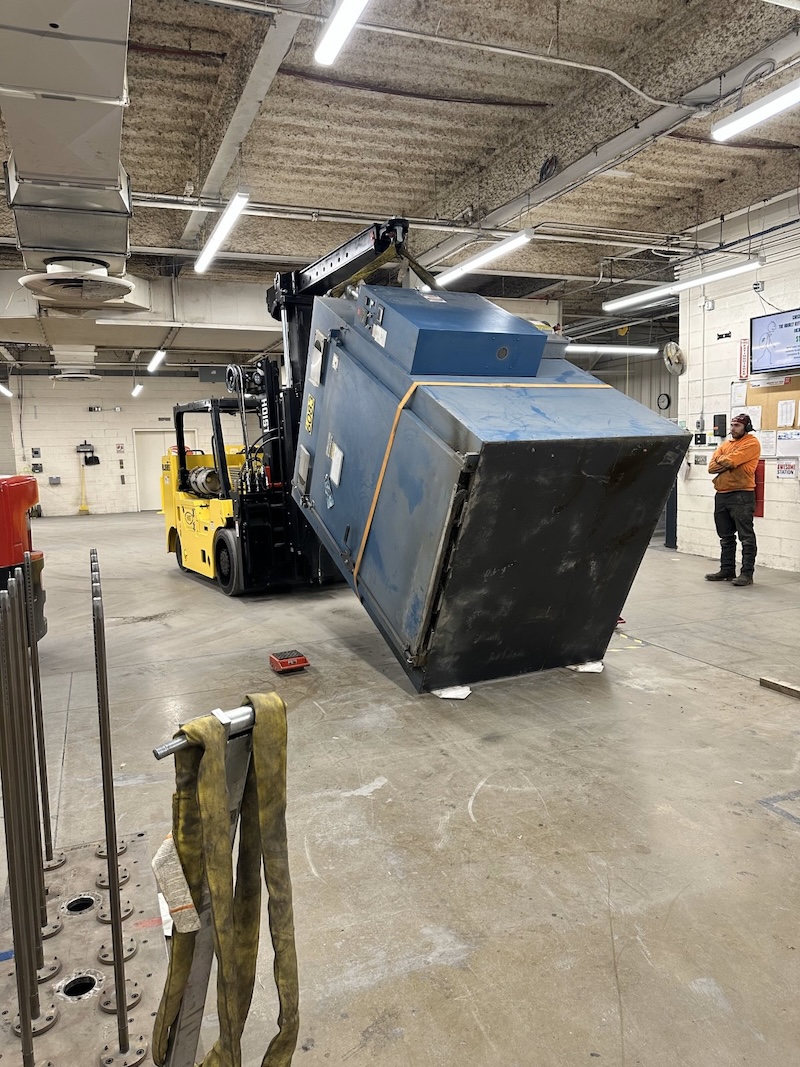
Fabrication equipment is heavy, but weight isn’t the hard part. Press brakes, vertical turning centers and similar machines are often tall and top heavy, which means the real risk during a move is tipping, not lifting.
Add tight bays, low doorways, mezzanines, trench drains, expansion joints and floors scattered with chips and scale, and a move that looks simple on the floor plan gets complicated fast.
Precision adds pressure too. A machine that took a day to level and align has to land in its new position without damage to the frame or the floor beneath it.
That’s why industrial buyers should evaluate positioning equipment against the same four requirements every time, instead of defaulting to whatever is already in the toolroom.
The four requirements to evaluate
- Clearance: How much height does the equipment add under the machine, and how much room is there at doorways, beams and mezzanines?
- Load: What’s the rated capacity per unit, how many units are needed and how is the load spread across the floor?
- Movement: Does the machine travel in a straight line, or does it need to turn, reverse and fine tune its final position?
- Floor: Is the floor smooth and sealed, worn and cracked, dirty, finished or a transition like a dock plate or trailer deck?
The shortlist at a glance
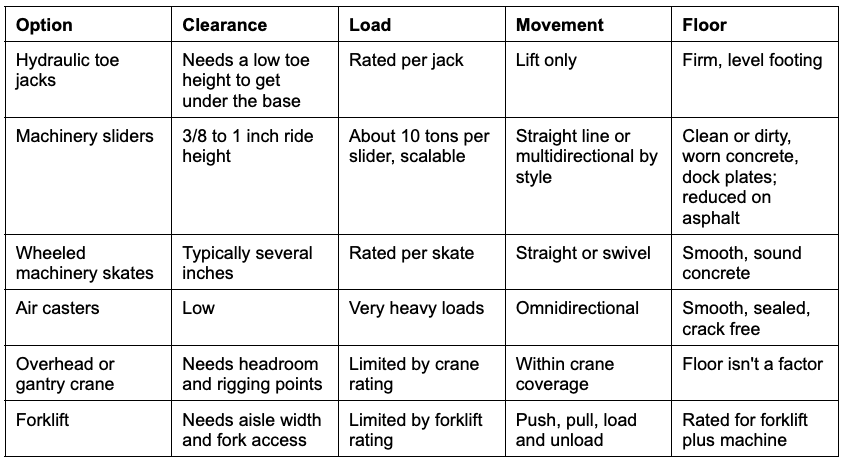
1. Hydraulic toe jacks: the first step in almost every move
Toe jacks slide under a machine’s base and raise it just enough to place travel equipment underneath. Choose jacks rated comfortably above the load share at each lift point, use the machine manufacturer’s approved lift points and raise the machine evenly so the frame doesn’t rack. With tall equipment, lift only as high as the travel equipment requires, because every extra inch raises the center of gravity.
2. Machinery sliders: low profile travel for tight, rough or dirty floors
Machinery sliders replace wheels with a flat engineered plastic pad. Machinery Sliders, a US maker in Port Carbon, Pennsylvania that has supplied riggers and machinery movers since 2014, offers three styles. Here’s how they score against the four requirements, using only the manufacturer’s published specifications.
Clearance. The single direction machinery sliders are 3/8 inch (9.5 mm) thick, and the two multidirectional styles are 1 inch (25 mm) high. The manufacturer’s comparison puts conventional skates at roughly 3.5 to 5.35 inches. For a tall press brake or turning center, that difference keeps the center of gravity low. The manufacturer’s explanation is simple: if a slider shifts mid move, the machine drops less than an inch instead of several, which is far less likely to push it past its tipping point.
Load. Each slider is rated at approximately 10 tons (20,000 lb) under appropriate loading conditions, and capacity scales by adding more sliders. The manufacturer documents a 100 ton press setup that places sixteen single direction sliders under a 6 x 6 inch timber at the leading edge of the frame, which works out to 6.25 tons per pad. Spreading the load across many pads also lowers the pressure on the concrete compared with a few wheels.
Movement. This is where the style matters:
- Single direction: 11-1/2 inches long by 8-1/4 inches wide, with the machine resting on a 7 x 8-1/4 inch surface behind a reinforced 1 inch bumper. It’s built for straight line travel with a forklift pushing or pulling in the direction of the point.
- Multidirectional with a 1 inch hole: An 8 inch round slider held under the machine by a pin or bolt, so the machine can move forward, backward, sideways and turn into final position.
- Multidirectional with a 4 inch recess: For machines on leveling pads or legs up to about 4 inches, which sit in the recess without removal.
Floor. The sliders are rated for concrete, worn or damaged concrete, wood, tile, carpet and dock plates, with reduced capability on asphalt. They’re listed as working on clean or dirty floors, and a 1/2 inch beveled edge helps them ride over cracks, joints and small irregularities. The manufacturer also documents loading a 43 foot roll former on timbers onto an aluminum flatbed trailer using sliders.
Where they don’t fit. Sliders still need a jack to get under the machine and a forklift, winch or crew to supply the push or pull. They’re a wear item, so the sliding surface wears with distance and floor roughness, and coarse asphalt shortens their life sharply. They’re described as semi non marking, so finished floors may show faint marks that need buffing. And a machine needs a suitable support point: a flat base edge for the single direction style, a pin point for the 1 inch style or a leveling pad up to about 4 inches for the recessed style.
3. Wheeled machinery skates: proven for straight runs on sound concrete
Wheeled skates are a rigging staple, and steerable or swivel versions handle direction changes. On smooth, sound concrete over a long run they work well. The tradeoffs are ride height, which raises the center of gravity on top heavy equipment, and concentrated wheel loads that can mark or crack weaker or finished floors. Chips, scale and debris under a wheel can also stop a skate abruptly, so sweep the full path first.
4. Air casters: very heavy loads on the right floor
Air casters float a load on a thin film of compressed air, letting a small crew move very heavy equipment with low push force in any direction. They need a smooth, sealed, crack free floor plus a reliable air supply. Trench drains, expansion joints, gaps and porous concrete are their weak spots, which rules them out in many older fabrication bays.
5. Overhead and gantry cranes: when the building is built for it
If a bay has a bridge crane with the right rating and coverage, it can lift and set a machine without touching the floor at all. The limits are headroom, the crane’s rating, approved rigging points on the machine and whether the destination sits inside the crane’s coverage. Moves that leave the bay usually need a second method.
6. Forklifts: power, loading and unloading
A forklift typically provides the push or pull for sliders and skates and handles truck loading and unloading. Confirm aisle width, the floor’s capacity under the forklift plus the machine and operator training. Fork extensions and attachments should stay within the forklift manufacturer’s ratings.
How should buyers build a positioning kit?
Start with the machines you move most often and score each one against the four requirements. Shops with tall, top heavy equipment and tight clearances get the most out of low profile options. Shops with smooth sealed floors and very heavy loads may justify air casters.
Most facilities end up with a mixed kit, and the manufacturer’s own guidance for rigging crews is to keep at least four sliders of each style on hand, then scale up for larger or longer machines.
What belongs on the move checklist?
- Machine weight, center of gravity and approved lift points from the manufacturer’s documentation
- Clearance measured at every doorway, beam and mezzanine along the route
- Floor capacity confirmed along the full path, including trench covers and joints
- A swept path with chips, scale and debris removed
- Utilities disconnected and tagged, plus a releveling and alignment plan at the new position
Frequently asked questions
What’s the lowest profile option for moving a press brake?
Among the options here, single direction machinery sliders are the lowest at 3/8 inch thick, according to the manufacturer. That keeps the machine’s center of gravity close to the floor during travel.
How many machinery sliders do you need for a 100 ton machine?
The manufacturer documents sixteen single direction sliders under a 6 x 6 inch timber for a 100 ton press, which puts about 6.25 tons on each pad. The right count depends on the machine’s weight, balance and support points.
Can machinery sliders turn a machine into position?
Yes, if you use a multidirectional style. The 1 inch hole version is pinned under the machine and the 4 inch recess version holds a leveling pad, and both allow turning and fine positioning.
Do machinery sliders work on cracked or dirty shop floors?
The manufacturer lists them as working on clean or dirty floors and on worn or damaged concrete, with a beveled edge that helps them ride over cracks and joints. Sweeping the path first is still good practice.
When should a fabrication shop hire a professional rigger?
For anchored or grouted machines, very heavy or top heavy equipment, moves between floors or onto trailers, or any job where the weight, lift points or floor capacity are uncertain.
