Manufacturer runtime specs often use low wattage loads that do not reflect how most homes use backup power during an outage. A real home backup setup usually needs to support a refrigerator, WiFi router, lights, phone charging, and sometimes medical equipment at the same time.
To make the comparison more useful, we modeled these five EcoFlow power stations against a standardized essential home load: a mid size refrigerator, a WiFi router, three LED ceiling lights, and continuous phone charging. The goal is not to show perfect laboratory runtime, but to estimate how each model performs under a realistic outage scenario.
The Standard Home Load We Used
Most spec sheets show runtime for a single low power device. That can be useful, but it does not tell you how a power station will perform when your fridge cycles on during a blackout and your family is also using lights, WiFi, and phone charging.
Our standard home load includes a refrigerator at 150W average draw, a WiFi router at 10W, three LED ceiling lights at 30W total, and phone charging at 20W. Together, that equals roughly 210W of continuous draw.
One more detail matters before looking at the rankings. Rated capacity is not the same as usable AC output. Once you account for inverter conversion losses, standby draw, battery management, and temperature, a practical estimate is about 85% to 90% of rated watt hours. For this comparison, we use 87% average usable capacity.
That means a 2,000Wh power station may deliver closer to 1,700Wh to 1,800Wh of usable AC output in real use. Every runtime estimate below is based on that assumption.
1. EcoFlow DELTA Pro 3: Best for Serious Home Backup
- Capacity: 4,096Wh
- Continuous output: 4,000W
- Expandable capacity: up to 48kWh
- Estimated runtime at 210W load: about 16 to 17 hours
The EcoFlow DELTA Pro 3 is the strongest option in this list if your main concern is longer home backup runtime. With a 4,096Wh battery and 4,000W rated output, it has far more headroom than a standard 1kWh or 2kWh portable power station. EcoFlow also lists 120V and 240V output support, 10ms UPS switchover, and expansion up to 48kWh in a larger home backup setup.
At our 210W essential home load, the DELTA Pro 3 can run for roughly 16 to 17 hours before needing a recharge. That is not a full 24 hours, but it is enough to cover an overnight outage plus much of the following day if you are only running priority loads.
What makes this model different is that it is more than a portable emergency battery. It can become part of a more serious home backup system when paired with compatible EcoFlow home backup accessories and proper electrical setup. That makes it a better fit for homeowners who want to keep more than a few devices running during high risk outage seasons.
The downside is weight, size, and cost. This is not the model you buy if you only need to charge phones and run a router for a few hours. It belongs in a planned backup location, such as a garage or utility area.
Best for: Homes in hurricane zones, wildfire shutoff areas, storm prone regions, or anywhere multi day outages are a realistic risk.
2. EcoFlow DELTA 3 Ultra Plus: Best for Medium to Large Homes
- Capacity: 3,072Wh
- Continuous output: 3,600W
- Surge output: 7,200W
- Expandable capacity: 3kWh to 11kWh
- Estimated runtime at 210W load: about 12 to 13 hours
The EcoFlow DELTA 3 Ultra Plus is a strong choice for households that want large backup capacity but do not necessarily need the size or price of the DELTA Pro 3. EcoFlow lists the DELTA 3 Ultra Plus with 3,072Wh capacity, 3,600W rated output, 7,200W surge output, Smart Output Priority, and scalable capacity from 3kWh to 11kWh.
At a 210W essential load, the DELTA 3 Ultra Plus delivers roughly 12 to 13 hours of estimated runtime. That is enough for an overnight outage, a same day restoration window, or a long evening of backup power for core household needs.
The most useful home backup feature here is Smart Output Priority. Instead of treating every connected device the same, the system can help prioritize key loads and reduce power to less important ones as the battery drops. In practical terms, that means you can preserve more power for the refrigerator, router, or medical equipment instead of draining the battery evenly across everything.
Charging speed should be described carefully. EcoFlow promotes 48 minute fast charging for the DELTA 3 Ultra Plus, but that figure depends on supported high input charging conditions. For regular use, homeowners should check the exact charging method and input source before assuming that every recharge will be that fast.
Best for: Medium to large homes that need strong essential backup, high surge output, and smarter load management during longer outages.
3. EcoFlow DELTA 3 Max Plus: Best Mainstream Family Option
- Capacity: 2,048Wh
- Continuous output: 3,000W
- Surge output: 6,000W
- X-Boost support: up to 3,800W
- Estimated runtime at 210W load: about 8 to 9 hours
The EcoFlow DELTA 3 Max Plus is the best mainstream option for many families because it balances capacity, output, portability, and smart backup features. EcoFlow lists the model with 2,048Wh capacity, 3,000W rated output, 6,000W surge output, X-Boost support up to 3,800W, Smart Output Priority, and scalable capacity from 2kWh to 10kWh.
At our 210W home load, the DELTA 3 Max Plus can provide about 8 to 9 hours of estimated runtime. That is enough for a full evening, an overnight stretch with careful load management, or a shorter outage where you want to keep the fridge, lights, router, and phones running.
Its 3,000W continuous output is more than most essential backup setups need. That extra headroom is useful because home appliances do not always draw power evenly. A refrigerator compressor can spike at startup, and a household may occasionally need to run a higher draw device for a short period.
The Smart Output Priority feature also makes this model feel more advanced than a basic battery. You can prioritize the devices that matter most and reduce less important loads as capacity drops.
Best for: Families of 3 to 5 who want reliable overnight backup for essential appliances without moving into the cost and size of the largest home backup systems.
4. EcoFlow DELTA 2 Max: Best Proven Expandable Pick
- Capacity: 2,048Wh
- Continuous output: 2,400W
- Expandable capacity: up to 6,144Wh
- Battery chemistry: LFP
- Estimated runtime at 210W load: about 8 to 9 hours
The EcoFlow DELTA 2 Max has the same 2,048Wh base capacity as the DELTA 3 Max Plus, so the estimated runtime is similar under the same load. At 210W, it can deliver about 8 to 9 hours of essential home backup.
The difference is positioning. DELTA 2 Max is a proven expandable model with a strong track record and a simple upgrade path. EcoFlow states that it can connect with up to two Smart Extra Batteries for a total capacity of 6,144Wh. At our 210W standard load, that expanded setup would provide roughly 25 hours of estimated runtime before solar or other recharging is considered.
It also uses LFP battery chemistry, with EcoFlow listing 3,000 cycles to 80% capacity. That makes it a strong option for people who care about long term reliability and battery lifespan.
One thing to avoid is calling solar paired operation “indefinite.” Solar can significantly extend runtime during a long outage, but actual performance depends on sunlight, season, panel angle, weather, shading, and your daily load. A better way to say it is that solar can help offset daily essential use when conditions are favorable.
Best for: Households that want a reliable 2kWh system now, with the option to expand toward a 6kWh partial home backup setup later.
5. EcoFlow DELTA 3 Classic: Best Entry Level Home Backup
- Capacity: 1,024Wh
- Continuous output: 1,800W
- Surge output: 3,600W
- X-Boost support: up to 2,600W
- Estimated runtime at 210W load: about 4 hours
The EcoFlow DELTA 3 Classic is the entry point for home backup. It is not designed to compete with larger models on runtime, but it is a useful short outage solution for apartments, small homes, and first time power station buyers.
EcoFlow lists the DELTA 3 Classic with 1,024Wh capacity, 1,800W output, 3,600W surge output, X-Boost support up to 2,600W, 10ms auto switch, and 0 to 80% AC charging in 45 minutes.
At our 210W standard load, the DELTA 3 Classic delivers about 4 hours of estimated runtime. That is enough for short outages, rolling blackouts, router backup, phone charging, LED lighting, and limited refrigerator support. It is not the best choice if your main concern is keeping a full size refrigerator running through a long overnight or multi day outage.
The fast AC charging is a real advantage. If power returns briefly during unstable grid conditions, a short recharge window can restore a meaningful amount of capacity.
Best for: Apartments, smaller homes, low outage risk areas, or as a secondary backup unit for bedrooms, office equipment, routers, and communication devices.
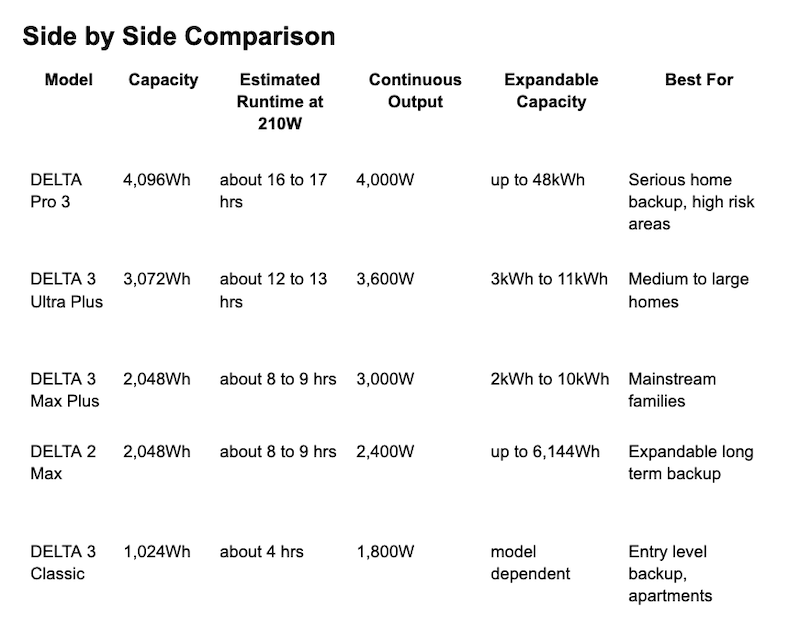
Runtime estimates are based on a 210W continuous essential home load: refrigerator at 150W average draw, WiFi router at 10W, three LED ceiling lights at 30W total, and phone charging at 20W. Estimates assume 87% usable AC capacity.
How to Match Capacity to Your Home’s Actual Needs
Start by listing the devices you must keep running during an outage. For most homes, that means the refrigerator, WiFi router, phone charging, lighting, and any medical equipment. Then add up the watts of the devices you expect to run at the same time.
For example, a 200W continuous load running for 10 hours needs about 2,000Wh of usable output. After accounting for inverter losses and a safety buffer, a rated capacity of roughly 2,400Wh to 2,700Wh is a more realistic target.
As a quick guide, a 1kWh power station is best for short outages and light essential use. A 2kWh model is a better starting point for overnight backup or one day of careful use. A 3kWh to 4kWh model gives you more breathing room for refrigerators, lights, routers, fans, and medical equipment. For multi day outage risk, prioritize expandable capacity and solar input instead of relying only on the base battery.
Which EcoFlow Power Station Should You Buy?
Choose DELTA Pro 3 if you live in a high risk outage area and want the strongest home backup option in this list. It offers the most capacity, the strongest expansion path, and the best fit for a more serious home backup system.
Choose DELTA 3 Ultra Plus if you have a medium to large home and want a strong balance of capacity, high output, and smart load management.
Choose DELTA 3 Max Plus if you want the best mainstream family option. It has enough capacity for overnight essential backup, strong output for mixed household loads, and smart priority control.
Choose DELTA 2 Max if you prefer a proven 2kWh model with a simple expansion path to 6,144Wh. It is a strong fit for users who want to start smaller and add capacity over time.
Choose DELTA 3 Classic if you are a first time buyer, live in an apartment, or mainly need short outage backup for phones, WiFi, lights, and limited refrigerator support.
The safest buying rule is simple: choose based on the devices you must keep running, not just the largest number on the spec sheet. For short outages, 1kWh may be enough. For overnight home backup, start around 2kWh. For serious storm season backup, look at 3kWh to 4kWh and expandable systems.
