When robotic cells must handle a range of variable products within the same machine, mixed-product environments often require repeated programming, application-specific integration, and expensive 3D camera setups. These demands can slow deployment, increase integration cost, and make it difficult to scale automation across operations.
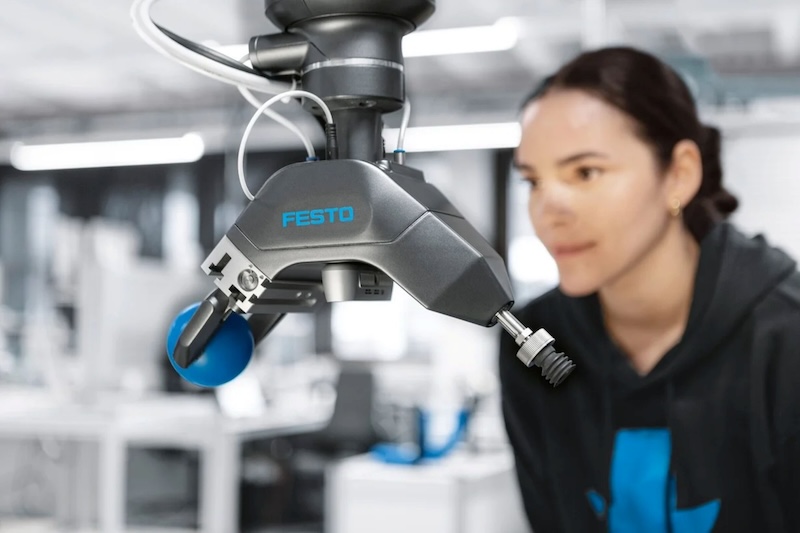
To address these challenges, Festo introduces GripperAI, a universal AI-based software that enables robots to handle a range of items without custom programming. The software operates locally at the cell on a standard industrial PC with a connected 3D camera and automatically adjusts for mixed products without programming or template loading between SKUs.
Deploying GripperAI involves standard integration steps: mounting and aligning the camera, verifying usable lighting, calibrating the robot base to the camera’s frame, and configuring the software’s pick parameters.
After that, for each sighted item, the software calculates a gripping point, selects a tool when multiple ones are available, and the robot’s path control carries out the move. If a grip is missed, the system recalculates and retries, sustaining the operation rather than stopping for reprogramming.
Because the software architecture does not change between camera types, facilities can apply the most economical vision hardware that meets the application requirements. Unless packaging or surface conditions require higher-resolution imaging, most applications can be satisfied with cost-effective 3D cameras.
GripperAI is compatible with most industrial robots, cobots, and Cartesian systems that have a path control system to execute the motion the software specifies.
Because the software is robot-agnostic, cells can be deployed or expanded without locking into a single brand or model, helping to protect existing investments while gaining the flexibility to add capacity with the most cost-effective equipment for the application.
Würth Group, a global leader in fastening and assembly solutions for industrial, construction, and automotive applications, faced the pressure of rising SKU counts and product mix variation at its central distribution hub in Germany.
Now at the center when an item reaches final packaging, a robot equipped with GripperAI uses a tool station with various vacuum and mechanical grippers to ensure it has the correct gripper for the product or package, which can vary from small parts like USB sticks up to boxes weighing 44 lb (20 kg). GripperAI solves the issues associated with manual handling and ergonomics in high-speed operations.
GripperAI capabilities and operational benefits:
- Handles mixed, unknown, and chaotically stored items without template loading between SKUs
- Calculates gripping points automatically and selects the most suitable available tool
- Sustains operation with automatic recalculation and retry if a grip is missed
- Operates locally on a standard industrial PC with connected 3D camera
- Supports cost-effective 3D vision hardware; architecture remains consistent across camera types
- Compatible with most industrial robots, cobots, and Cartesian systems with path control
- Enables deployment and expansion without locking into a single robot brand or model
