Manufacturing had long relied on fixed schedules and manual control. Inventories were adjusted following shortages. Machines were repaired only after they broke down.
Production goals were frequently set on assumptions and not from real operational data. That model is changing quickly.
Artificial Intelligence (AI) and Internet of Things (IoT) connectivity along with robotics are propelling manufacturing into a more predictive configuration.
Facilities are now being engineered to identify inefficiencies before they impact output. The trend is helping manufacturers to increase efficiency, minimize delays and have more consistent production in volatile markets.
Connected Systems Are Replacing Isolated Machines
A key distinction between older automation systems and today’s manufacturing environments is connectivity. In traditional factories, independent machine operation was common. There was limited data collection and departments operated in isolation.
IoT infrastructure now links production equipment, warehouse systems, sensors and monitoring platforms together into a unified operating network. Information is created with every movement. Temperature changes, equipment vibrations, cycle times and material consumption can be monitored in real-time.
This visibility allows plant managers to have a better idea of the real cause of operational bottlenecks. A few seconds of slowness in a robotic arm’s cycle appears unimportant on its own.
However, when multiplied over a full production line it adds up. Connected systems can help identify and correct these inadequacies.
AI is Changing Operational Decision-Making
AI is evolving from a technology in development to a tool that is embedded in manufacturing systems. AI can analyse thousands of production variables and make recommendations in a much quicker time frame than traditional analysis methods. AI software is now used in many facilities to help with:
- Predictive maintenance scheduling
- Inventory forecasting
- Quality assurance monitoring
- Energy consumption analysis
- Workflow optimization
In the custom chip industry, which is sensitive to manufacturing precision, this transition is especially critical to ensuring product reliability and profitability.
Minor inconsistencies during the production process can result in large amounts of money being lost which makes smart systems very valuable.
Robotics is Expanding Beyond Repetition
Industrial robotics was once all about repetitive motion. The modern robotic systems are supposed to be flexible, adaptable, and capable of communicating and working with a human worker.
In production processes where constant changes are needed, collaborative robots are now taking on responsibilities for packaging, inspection, assembly and material transportation.
The bionic hand is also a source of inspiration for some companies in the field of human-assistive technologies, especially in contexts where precision handling and ergonomic safety are essential.
Smart Manufacturing Still Depends on Physical Infrastructure
As much as people talk about AI software and the new generation of robots, physical infrastructure is still a priority need.
In automated environments, robust tooling, maintenance frameworks, and quality industrial hardware continue to play a vital role in supporting production requirements.
Specialized tools like extra deep impact sockets are needed for heavy maintenance work and for assembly jobs with large industrial machinery, even at a very automated facility.
Technicians still use the Super DEEP impact socket when servicing equipment in high torque applications in certain manufacturing industries. The factory of the future may be all digital, but it needs solid mechanical foundations.
Endnote
The combination of artificial intelligence and IoT connectivity with robotics doesn’t automatically make a factory autonomous.
Rather, it is slowly making the manufacturing sector a more integrated, data-driven and resilient business that puts the emphasis on making informed decisions at every point of operation.
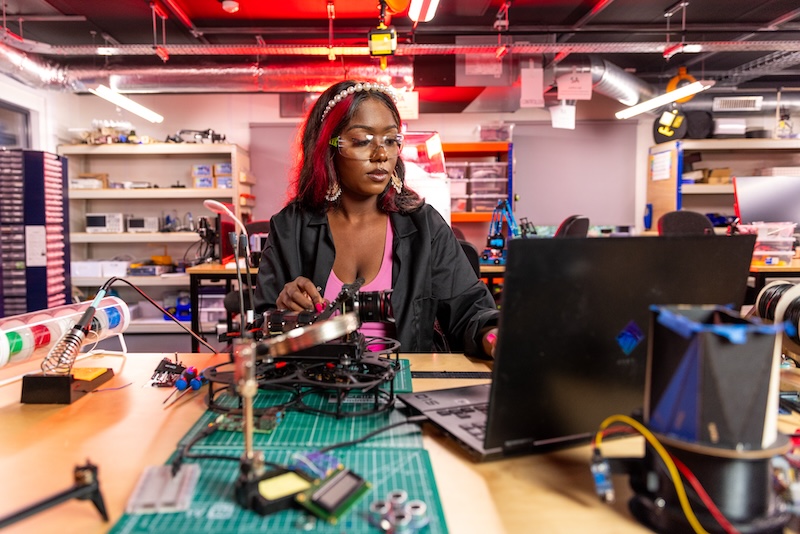
Main image by This_is_Engineering from Pixabay
