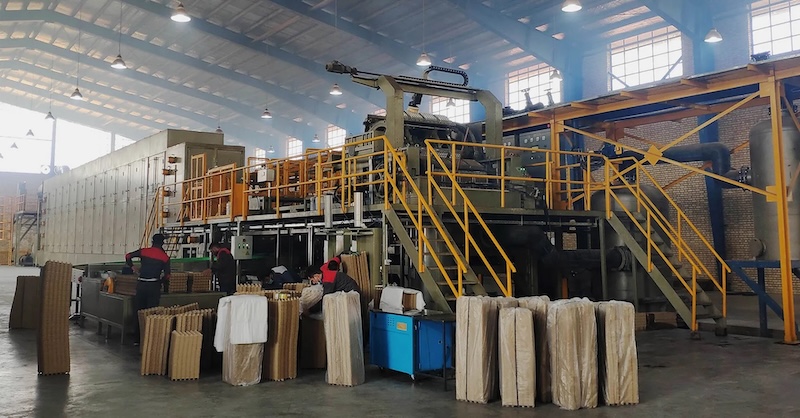
As global manufacturers accelerate the transition toward sustainable production, HGHY’s pulp molding equipment and automation systems are becoming critical components of modern eco-friendly manufacturing operations.
Stricter environmental regulations, rising labor costs, and a steady climb in demand for recyclable products have pushed more manufacturers toward fully automated molded fiber production lines – and HGHY has emerged as a key supplier meeting that demand at scale.
HGHY’s equipment covers a broad range of molded fiber products: from egg tray machines and egg carton machines serving the agricultural and food packaging sectors, to molded fiber tableware lines producing plates, bowls, and food service items as plastic-free alternatives for restaurants, catering, and retail.
Beyond food-related applications, HGHY industrial packaging lines serve the electronics, consumer goods, medical, and e-commerce sectors.
Across all of these product categories, the underlying technology – automated pulping, precision forming, controlled drying, and centralized process monitoring – follows the same principles, scaled and configured to the specific output requirements of each line.
The Shift Toward Automated Molded Fiber Manufacturing
Industrial manufacturers are under real pressure: reduce plastic consumption without sacrificing product protection, production speed, or consistency. HGHY’s machinery addresses those competing demands across a wide range of applications.
Egg tray and egg carton producers benefit from high-speed automated lines capable of handling large daily output volumes with minimal labor. Food service manufacturers use HGHY tableware equipment to produce plates, bowls, and takeaway containers that meet both functional and sustainability requirements.
Industrial packaging customers rely on HGHY lines to replace foam and plastic protective inserts across sectors including electronics, home appliances, medical devices, and e-commerce logistics.
What distinguishes modern HGHY production lines from earlier generations is their integration. Automatic pulping, precision forming, controlled hot pressing, automated trimming and stacking, and centralized process monitoring are no longer separate stations bolted together – they operate as a unified system.
The result is higher throughput, lower dependence on manual labor, and a level of product consistency that semi-automatic lines simply cannot match.
Centralized Monitoring is Changing How Factories Are Managed
HGHY’s production lines are built around centralized control systems that give operators a clear view of the entire manufacturing process from a single interface.
Production efficiency, mold temperature, pressure stability, energy consumption, moisture levels, and defect rates can all be tracked in real time, rather than discovered after the fact.
That visibility changes how plants are managed. When a parameter drifts out of range, operators can respond immediately – adjusting settings, investigating equipment, or stopping a run before defective products accumulate.
For large-scale operations where downtime and waste are costly, that level of process control has a direct impact on output quality and operating costs.
Robot-Free Automation: A Step Forward in Production Design
One of the more significant developments in HGHY’s latest generation of equipment is the move away from robotic handling systems entirely.
Where earlier automated lines relied on industrial robots to transfer products between forming, pressing, trimming, and stacking stages, HGHY’s redesigned production lines accomplish the same result through integrated mechanical conveying and transfer systems – no robots required.
This is a meaningful practical advantage for manufacturers. Robotic systems add capital cost, require specialized programming and maintenance expertise, and introduce potential failure points that can halt an entire line.
By engineering the transfer and handling functions directly into the production line itself, HGHY has simplified the overall system while maintaining – and in many cases improving – throughput and consistency.
The result is a fully automated production line that is easier to operate, less expensive to maintain, and more accessible to manufacturers who may not have the technical infrastructure to support robotic systems.
A high-volume egg tray operation, a tableware producer running multiple shifts, or an industrial packaging manufacturer supplying tight-tolerance components can all benefit from the same principle: automation that does not depend on complexity to deliver results.
Sustainable Packaging and Tableware Demand Continues to Expand
Global demand for environmentally responsible products is not slowing down. Single-use plastic bans and extended producer responsibility regulations are accelerating adoption of molded fiber alternatives across multiple sectors simultaneously.
In food service, plastic plates, bowls, and containers are being replaced by molded fiber tableware that is compostable and made from renewable materials. In retail and e-commerce, foam protective inserts are giving way to custom-formed fiber packaging.
In agriculture and food supply chains, egg trays and egg cartons made from recycled paper fiber remain one of the most established and cost-effective examples of sustainable packaging at scale.
HGHY systems are designed to process a broad range of renewable raw materials – including recycled paper, sugarcane bagasse, bamboo fiber, wheat straw, and wood pulp – giving manufacturers flexibility in sourcing while supporting circular economy commitments.
The same raw material versatility that makes an egg carton line cost-effective also supports a tableware line producing compostable plates for a food service customer with specific sustainability targets.
High-End Industrial Packaging Applications Are Expanding
Molded fiber was once seen as a low-cost, low-precision option suited mainly to agricultural products like egg trays. That perception has changed substantially.
HGHY high-precision forming and thermoforming systems now produce complex industrial packaging for consumer electronics, home appliances, medical devices, automotive components, precision instruments, and luxury goods – product categories where surface finish, structural performance, and dimensional accuracy matter as much as environmental credentials.
Advanced hot press technologies have narrowed the gap between molded fiber and premium plastic packaging in terms of appearance and protective performance, while maintaining the sustainability advantages that increasingly drive purchasing decisions at the brand level.
Energy Efficiency is Becoming a Competitive Advantage
Energy costs represent a significant share of operating expenses for any large-scale manufacturing facility, and molded fiber production is no exception. Drying is the most energy-intensive stage of the process, and HGHY’s drying and heating systems are designed with that in mind.
Multi-layer metal drying lines, servo-controlled forming units, heat recovery systems, and automated airflow and temperature control all contribute to reducing energy consumption without compromising output quality or throughput.
For plants operating at industrial scale – whether producing millions of egg trays per day or high volumes of tableware and industrial packaging – those efficiencies add up quickly.
Lower energy costs improve margins and, increasingly, factor into the broader sustainability metrics that large customers and investors are paying close attention to.
The Future of Eco-Friendly Manufacturing
The manufacturing industry is moving in one direction: less plastic, more automation, greater accountability for environmental impact.
HGHY’s product range – spanning egg tray machines, egg carton machines, molded fiber tableware equipment, and industrial packaging lines – positions it at the intersection of several converging trends: the global push away from single-use plastics, the growth of sustainable food service and retail packaging, and the ongoing shift toward automated production in emerging and developed markets alike.
Manufacturers that invest in integrated molded fiber production systems today are better positioned to meet that shift than those still relying on older, less flexible equipment.
For HGHY, that is not a temporary opportunity – it is the direction the industry is heading, and the company has built its product line accordingly.
Main image: HGHY double rotary egg tray machine
