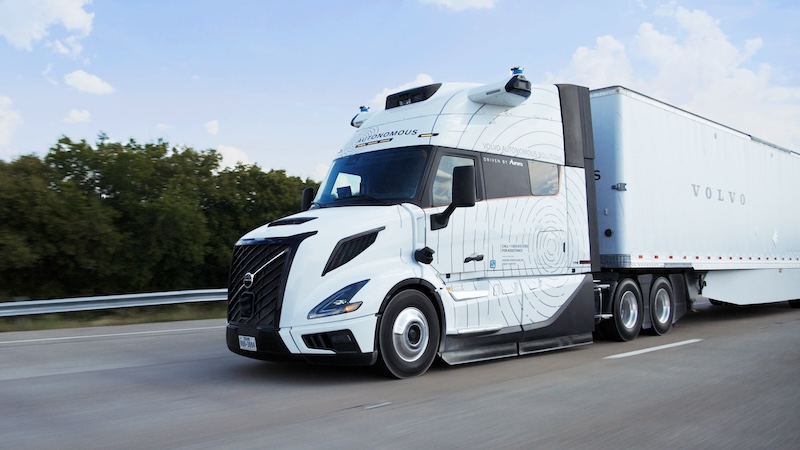
As the global logistics industry grapples with persistent driver shortages, rising operating costs, and increasing pressure to improve efficiency, autonomous trucking is beginning to move beyond promise and into early-stage commercial reality.
For much of the past decade, the technology has been described as “almost ready” – a phrase that has invited both optimism and skepticism.
Today, that characterization is starting to shift. Autonomous trucks are now hauling real freight on public roads, albeit within limited routes and often still under human supervision, marking a transitional phase between pilot programs and true large-scale deployment.
Among the companies at the forefront of this shift is Volvo Autonomous Solutions, the dedicated business unit of Volvo Group focused on developing and deploying self-driving transport systems.
Rather than treating autonomy as an add-on, Volvo is pursuing a more integrated approach – embedding autonomous capability directly into its truck platforms, manufacturing processes, and operational ecosystem.
The aim is not simply to prove that autonomous driving works, but to demonstrate that it can be delivered reliably, repeatedly, and at industrial scale.
Central to this effort is the Volvo VNL Autonomous truck, produced at the company’s New River Valley facility in Virginia alongside conventional vehicles.
Developed in collaboration with autonomy partners such as Aurora and Waabi, the platform reflects a broader industry shift toward combining OEM-grade engineering with increasingly sophisticated AI-driven driving systems.
In this Q&A, Robotics & Automation News speaks with Shahrukh Kazmi, chief product officer at Volvo Autonomous Solutions, about what has materially changed in recent years to bring autonomous trucking closer to viable deployment.
Kazmi discusses the growing importance of system-level integration, redundancy, and operational readiness – factors that are proving just as critical as advances in the driving software itself.
While significant hurdles remain – spanning technical validation, regulatory approval, and public trust – the trajectory is becoming clearer. The industry is moving out of the experimental phase and into one defined by execution.
The key question now is not whether autonomous trucks can operate, but how quickly they can scale into dependable, commercially viable networks.
Interview with Shahrukh Kazmi, chief product officer, Volvo Autonomous Solutions
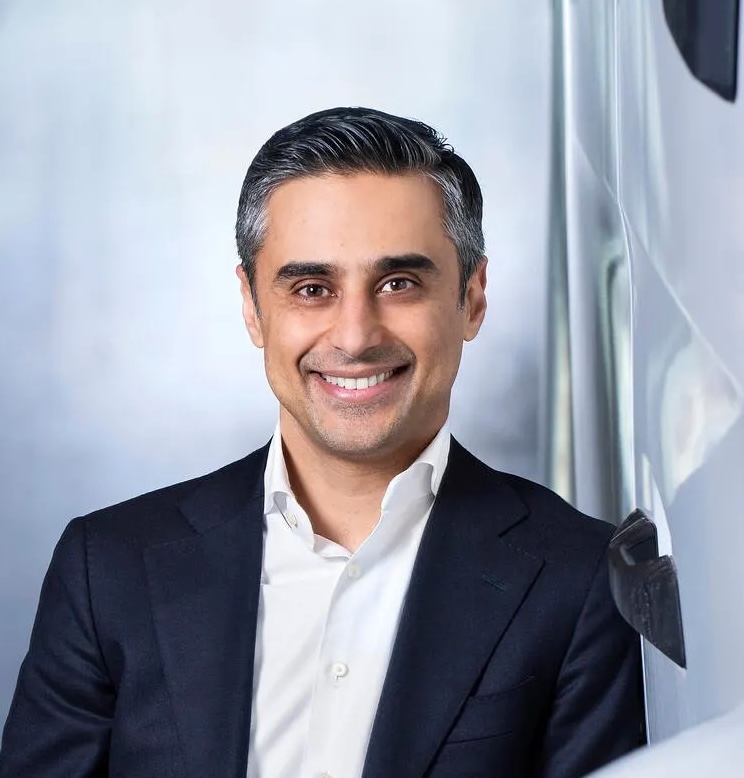
Robotics & Automation News: Autonomous trucking has been described as “almost ready” for several years. From Volvo’s perspective, what has fundamentally changed to make driverless operations now a realistic near-term goal?
Shahrukh Kazmi: Several things have come together at the same time.
First, the technology has matured, and we now have a truck platform engineered specifically for autonomy: the Volvo VNL Autonomous, currently being manufactured on a pilot line at our New River Valley (NRV) plant in Dublin, Virginia.
Second, autonomy is no longer only about the driving software. We have built more of the full ecosystem required to run autonomous transport in real operations, including uptime, fleet management, and operational processes. Third, our partner programs have advanced significantly.
With Aurora, we are already hauling freight for customers such as DHL and Uber Freight. Those runs are autonomous today, while still including a safety driver onboard. With Waabi, we have completed the first hardware integration between the Volvo VNL Autonomous and the Waabi Driver.
And finally, broader acceptance is growing. Autonomy is becoming more familiar to the public, for example through the continued expansion of autonomous taxis into more US cities.
R&AN: Volvo emphasizes redundancy across critical systems like steering, braking, and power. How does this architecture change the overall design and cost of an autonomous truck compared to a conventional vehicle?
SK: Designing for autonomy requires additional hardware and fault-tolerant architecture. In the case of the Volvo VNL Autonomous, that means approximately 200 additional parts, which naturally adds cost and weight. At the same time, we mitigate complexity through Volvo Group’s CAST principle (Common Architecture and Shared Technology).
In simple terms, CAST is about building trucks around shared parts, standards, and interfaces so that new technology can be integrated, upgraded, and supported efficiently.
The Volvo VNL Autonomous is built on the same underlying platform as our conventional trucks, which helps us share production methods, maintain quality, and reduce unnecessary variation even as we add autonomy-specific systems.
R&AN: The Volvo VNL Autonomous platform is being built in the same factory as standard trucks. How important is OEM-level manufacturing integration in moving from pilot programs to true commercial scale?
SK: It is essential. Building the truck at Volvo’s largest facility in North America means we apply the same manufacturing discipline, production processes, and quality assurance used for our standard trucks. Just as importantly, the self-driving technology is integrated on the production line, not bolted on afterward.
That tighter integration helps ensure OEM-grade build quality and makes it easier to scale, service, and upgrade the technology over time. It is a key step in moving from a pilot mindset to repeatable commercial delivery.
R&AN: Volvo is working with autonomy partners such as Aurora and Waabi. How do you balance responsibilities between the vehicle platform and the autonomy stack when delivering a complete system to customers?
SK: We keep responsibilities clear. Volvo builds the vehicle platform, and our partners Aurora and Waabi develop the self-driving software.
Delivering a complete customer solution depends on tight integration and coordinated validation, but the ownership lines are straightforward: we focus on the truck and its autonomous-ready architecture, while the partners focus on the driving system.
R&AN: What are the biggest remaining barriers to removing the safety driver entirely: is it primarily technical, regulatory, or operational?
SK: It is all three, and there is another important dimension: earning trust through evidence over time. Removing the safety driver requires technical maturity, the right operational model, and regulatory readiness, but it also requires demonstrating to authorities and stakeholders that the system can perform safely and reliably throughout its full lifecycle, not just in a limited demonstration.
R&AN: From a product perspective, what does a viable commercial deployment actually look like: specific routes, use cases, or customers, rather than broad industry promises?
SK: A viable commercial deployment is one that consistently delivers the core benefits autonomy promises: increased capacity, 24/7 operation, fleet flexibility, operational efficiency, and improved safety.
In practice, that means deployments designed around real operational performance, meeting customer expectations on uptime and on-time delivery, not just showing that a truck can drive autonomously.
R&AN: Given the long timelines and high expectations around autonomous trucking, how do you define success for Volvo Autonomous Solutions over the next three to five years?
SK: Success for us is disciplined, industrial progress: moving autonomy from “it works in a demo” to “it works every day, at scale.” From the outside, autonomous driving can look convincing because you can point to pilots, defined-route operations, and highly visible milestones. But visibility and hype are not the same as readiness.
The next phase is about industrialization: proving the system can run repeatedly, safely, and reliably under real-world variation, while meeting commercial requirements like uptime and delivery performance.
That is why we are focused on industrial readiness: building trucks engineered for autonomy with the right redundancy and deep integration, manufacturing them with OEM rigor at NRV, and aligning the truck, the autonomy software, and day-to-day operations so they behave as one system.
Over the next three to five years, our measure of success is demonstrating that this can be scaled in a repeatable way, turning pilots into sustainable commercial operations.
