By Michael Santora, CEO at Logic Robotics
Cities across the globe are wrestling with a stubborn challenge: congestion. While traffic often comes to mind first, logistics experts point out that the real bottleneck in many urban environments lies at the curb.
Trucks not only clog intersections as they navigate narrow streets, but also occupy scarce curb space for extended periods while unloading.
Competition for that space, from rideshares, taxis, sidewalk cafes, bike lanes, trash, and delivery vans, has intensified in recent years, leaving cities with limited options for efficient goods movement.
To keep pace with rising delivery demand and sustainability goals, municipalities are beginning to reimagine the supply chain. Unmanned aerial vehicles (UAVs), commonly known as drones, are emerging as one potential solution.
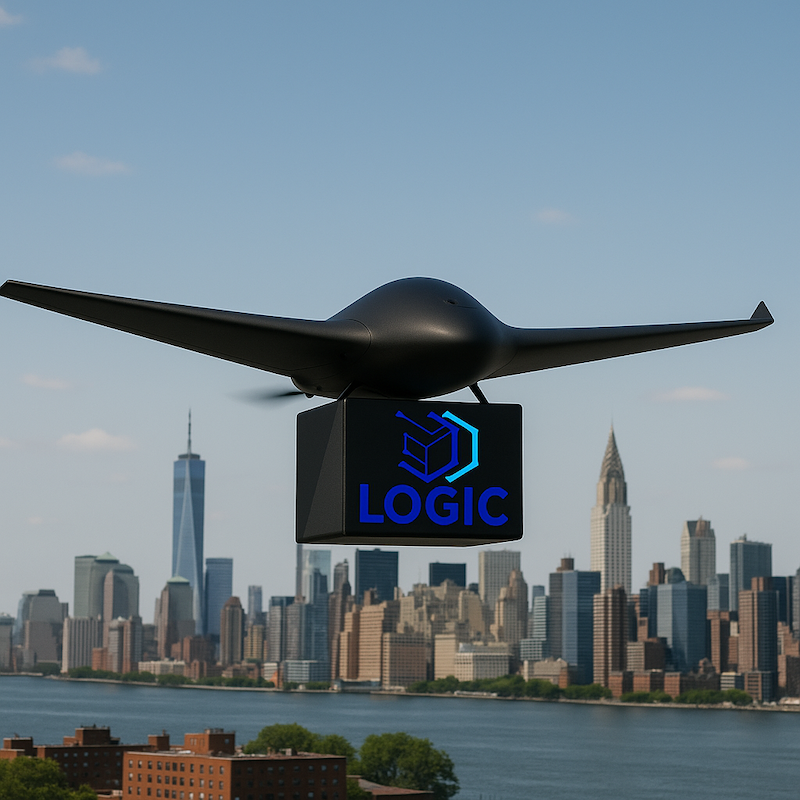
Their ability to bypass traffic and leap geographic barriers positions them as promising tools for reducing pressure on ground infrastructure. Yet, as with any new mode of transport, the value of UAVs depends on how well they integrate into the broader logistics ecosystem.
Point-to-point efficiency
In New York City, the potential is already on display. Consider the movement of a shipping container from the new Brooklyn Marine Terminal to Wall Street. By truck, the trip demands highways, tunnels, tolls, and miles of surface streets – an hour or more, even in ideal conditions.
A drone, on the other hand, could cover the same distance across the East River in under ten minutes. The city’s Economic Development Corporation has even begun converting the Lower Manhattan heliport into a UAV cargo terminal, underscoring the seriousness of this shift.
Point-to-point delivery, especially across natural obstacles like rivers, is one of the most compelling applications of UAVs in urban environments. By skipping the curb altogether, drones could eliminate some of the most frustrating inefficiencies of city logistics.
The ultimate vision for UAV delivery resembles a scene from “The Fifth Element” – a future where deliveries arrive directly to a window or sky lobby far above the ground, bypassing a building’s mailroom and vertical circulation core entirely.
While that might sound like science fiction, it’s a powerful way to think about the immense circulation space vertical urban logistics could one day unlock.
In fact, large retailers are already piloting UAV solutions at scale. Walmart has completed over ten thousand successful drone drops, mostly in suburban neighborhoods, where lightweight packages are gently lowered into backyards by tether.
While this is still a far cry from high-rise deliveries in the city core, these programs show the technology is more ready than many think, and set the stage for where cities should aim next.
However, questions remain: where does the cargo go once it lands? How do drones connect with trucks, warehouses, or bicycles for the next leg of the journey?
The efficiency gained in the air can be quickly lost on the ground if UAVs are not integrated seamlessly with established logistics nodes. Without clear, automated, and standardized handoffs, preferably managed by robotic systems rather than manual processes, even the most advanced aerial networks risk becoming inefficient outliers in the broader supply chain.
In urban cores, safety must remain paramount; drone mishaps over water merely risk cargo, but failures above busy sidewalks or roads could threaten people and property. That’s why perimeter landing zones make sense, but they need seamless links to inland destinations where the real activity happens.
History offers some cautionary tales. For example, when New York rapidly expanded its bike lanes in the early 2000s, planners initially overlooked how new technologies like e-bikes would interact with that infrastructure. Today, cyclists and fast-moving e-bikes share the same lanes, often at odds with the original design.
The lesson is clear: infrastructure must not only accommodate current technology but anticipate where it is headed. Cities that build drone networks for today’s needs, without accounting for rapid advances, risk being quickly outpaced by technological change.
Forward-thinking legislation will be critical. Municipalities must adjust zoning to permit aerial landing points on buildings, incentivize the construction of drone-friendly infrastructure, and, perhaps most importantly, establish robust, uniform rules for loading and unloading.
Without industry-wide consistency and a focus on future-proof solutions, drone logistics systems risk devolving into a patchwork of incompatible methods, undermining both safety and efficiency.
Infrastructure above the street
Urban supply chains are largely constrained to a few layers: streets, sidewalks, and sometimes subways. But high-rise cities contain vast, unused vertical space. Every floor of a skyscraper represents a potential node for goods movement.
UAVs open the door to this dimension, making it possible to deliver directly to a sky lobby or office floor, bypassing the ground level altogether.
The architecture to support this shift is still in its infancy. Many rooftops are already crowded with HVAC systems or solar panels, leaving little room for drone landing pads.
Some of the most forward-looking developments may combine functions, green roofs that double as UAV pads, or sky lobbies designed as both communal spaces and transloading points. Such ideas require city planners and private developers to think holistically about the future of building design.
Building collaborative ecosystems: The “Last Link” challenge
While the flight itself is efficient, the drone-to-ground handoff remains a weak link. At present, UAV companies use a variety of proprietary unloading methods. Without standardization, drones risk becoming outliers in an otherwise tightly synchronized supply chain.
Industry veterans suggest that, much like the standardization of pallets or shipping containers, UAVs will need to converge on one or two dominant unloading methods. This step is crucial because an efficient supply chain depends on seamless connectivity.
If drones cannot integrate smoothly with warehouses, vans, or bikes, the efficiency they provide in the air is quickly lost on the ground.
Public-private partnerships will be key to making UAV logistics viable at scale. Municipalities could accelerate progress by sponsoring competitions, challenging drone and infrastructure companies to design complete end-to-end ecosystems.
Rather than treating drones as standalone novelties, cities need to envision how they interact with every node, from ports to warehouses to residential towers.
At the same time, regulators must develop frameworks flexible enough to adapt as technology evolves. What seems futuristic today, such as passenger drones ferrying people between skyscrapers, may be commonplace within a decade. Infrastructure designed without that possibility in mind risks obsolescence before it is even built.
Integrating drones into the supply chain
The promise of UAVs lies not just in their speed or novelty, but in their ability to fit into a multimodal logistics network. For this to happen, drones must be connected to trucks, trains, and warehouses through robots that can move cargo seamlessly between modes.
Without this integration, UAVs risk being confined to niche applications, unable to deliver their full potential for urban logistics.
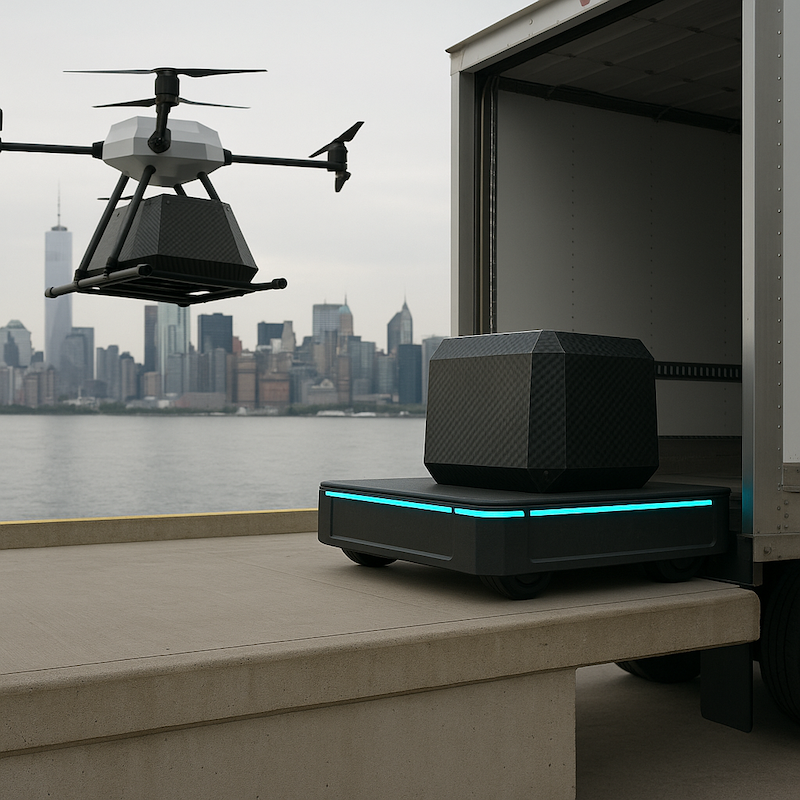
This is where companies like Logic Robotics are stepping in. Logic has developed a universal robotic system designed to autonomously link drones into the larger delivery ecosystem, ensuring that UAVs do not remain isolated nodes. Their intermodal robots can receive cargo from drones, organize it within warehouses, or transfer it onto trucks, barges, or trains.
Just as importantly, Logic has built its platform to be adaptable: as the industry converges on standardized unloading methods, their system is designed to remain compatible.
Logic’s work with partners across defense, logistics, and manufacturing underscores the versatility of this approach. By focusing on interconnectivity, Logic aims to make drone delivery not just a futuristic concept, but a practical and scalable solution for cities already struggling with congestion.
A path forward
For UAVs to transform urban logistics, cities will need to act boldly. That means:
- Planning infrastructure that anticipates future capabilities, not just present-day drones.
- Standardizing loading and unloading methods to avoid fragmentation.
- Adjusting zoning laws to support aerial access points in buildings.
- Encouraging collaboration between public agencies and private innovators.
If these steps are taken, drones could shift from being experimental tools to integral components of the urban supply chain. By bypassing congested curbs, leveraging unused vertical space, and linking seamlessly with ground transport, UAVs have the potential to redefine how goods move through cities.
Urban congestion will not be solved by simply swapping trucks for drones. True transformation requires rethinking how cities regulate their supply chains from the ground up, and in some cases, from the sky down. UAVs offer a powerful opportunity, but only if they are integrated into multimodal networks that emphasize efficiency, safety, and scalability.
By adopting universal, adaptable systems that automate the handoff between air and ground, cities can realize the full potential of UAVs. The future of logistics will not belong to a single mode of transport, but to the ecosystem that unites them all.
About the author: Michael Santora is the founder and CEO of Logic. Michael’s vision takes a different approach to logistics and supply chain automation to accelerate urban logistics, dark warehouses, and integrated intermodal transportation.
