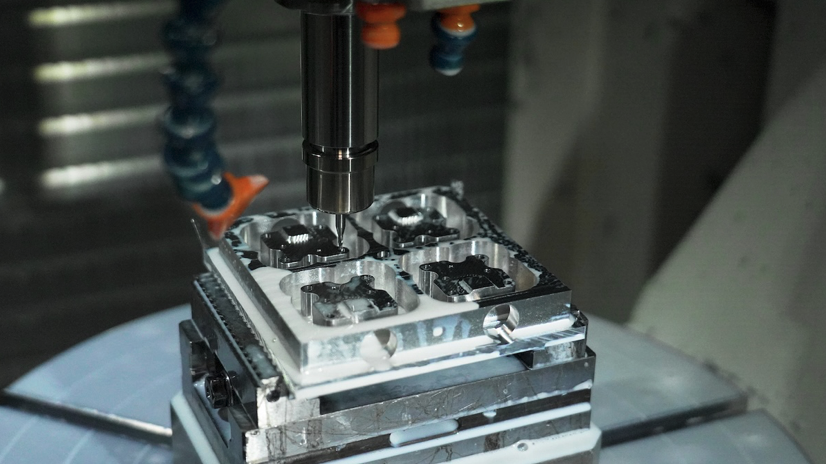
Thermal management components must move heat away from power electronics while maintaining the mechanical relationships required for assembly.
Heat sinks, cooling plates, inverter housings, and similar parts can contain fins, deep cooling holes, fluid passages, and controlled contact surfaces. For CNC milling parts, dimensional errors can alter flow paths, mounting alignment, fin geometry, or thermal contact.
Thermal Management Begins with Accurate Mechanical Features Each part that is being cooled is part of a greater mechanical/thermal environment.
In order to provide adequate heat transfer, a heat sink needs to have good solid-to-solid contact with a heat generating component, the mounting holes on the heat sink need to line up with the housing it will be installed in, and the cooling passages must be placed and sized as required in order for coolant to reach the desired area.
In CNC machining services, these mechanical features need to be examined by their functional ability. Gaps formed at the interface of the heat sink with the heat source could create additional thermal resistance; misaligned or improperly positioned mounting holes may cause assembly stresses; and variations from the specifications in the size of the cooling passages could alter fluid flow and pressure drop.
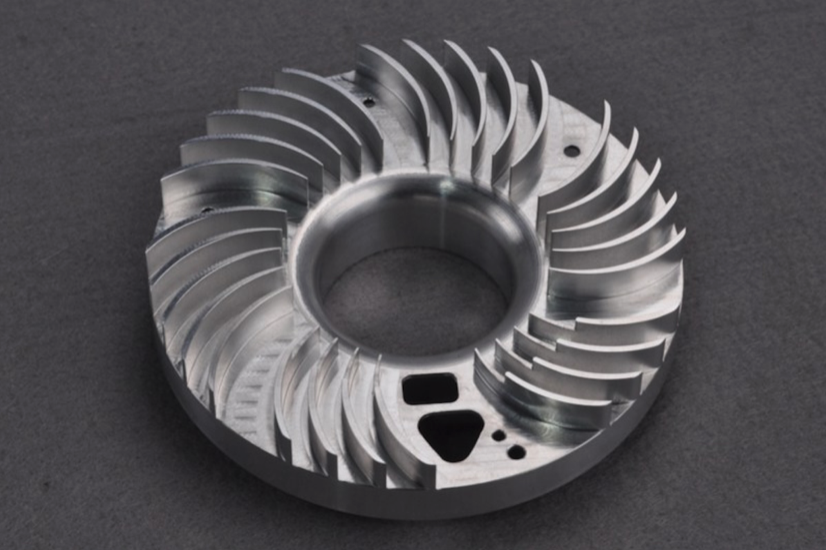
WayKen’s traction inverter housing represents a practical application. The aluminum 6061 housing has external heat-sink fins and contains an interior pocket with two 11mm diameter x 106mm deep cooling holes.
Coolant flows into one end of each hole, flows through the interior passage removing heat from the traction inverter, then leaves out of the opposite end.
WayKen applied liquid cooling using its spindle to supply coolant directly to the deep holes which helped maintain lower temperatures and remove machining debris. There were over fifty GD & T requirements referenced throughout the seven datum reference planes contained in the housing.
Machining Fins Flow Channels and Thermal Contact Surfaces
Fins increase surface area, but their thickness, spacing, and height must remain consistent enough for predictable heat dissipation. Deep channels and holes create additional challenges because tool reach, chip evacuation, and coolant delivery become difficult as depth increases.
WayKen’s industrial turbine heatsink project involved machining a large aluminum heatsink with a dense fin structure. The part was approximately 400 mm long, 200 mm wide, and 80 mm high, with fins as thin as 1 mm.
The heatsink also required H7 bores for bearing and shaft assembly. Its fins measured only 0.48–1.1 mm thick, so WayKen adjusted toolpath parameters repeatedly to prevent breakage and deformation.
For CNC milling parts, roughing and finishing should be separated where delicate features are involved. Bulk material can be removed aggressively, leaving controlled stock for finishing. Smaller tools and lighter passes can then establish final geometry. Thermal contact surfaces deserve particular attention.
Flatness and surface finish affect the area through which heat passes into a cooler or heat sink. Burrs, tool marks, or excessive roughness can create gaps that increase thermal resistance.
How WayKen Balances Heat Dissipation Precision and Manufacturability
There may be both delicate features involved in heat transfer and stiff areas needed for fastening when designing thermal components. Thus, proper tooling, cut directions, work holding, and machining order have to take into account these contradicting requirements.
When choosing CNC machining for the traction inverter case study, WayKen took into consideration not only machine capabilities but also machining efficiency and cost as well.
CNC machining services are more straightforward and efficient if the machine is able to reach all required features without adding unnecessary complexity to the design.
WayKen machined the inverter housing in one setup where it was possible, using datums to preserve relationships between the features. Otherwise, already machined datums or holes were used as references.
WayKen used CNC mill-turn machining in case of the turbine heatsink because its many fins could be machined via milling while the fine holes needed turning to provide accuracy and concentricity. The two critical bores were machined with tolerance H7 while 2 mm holes were reamed.
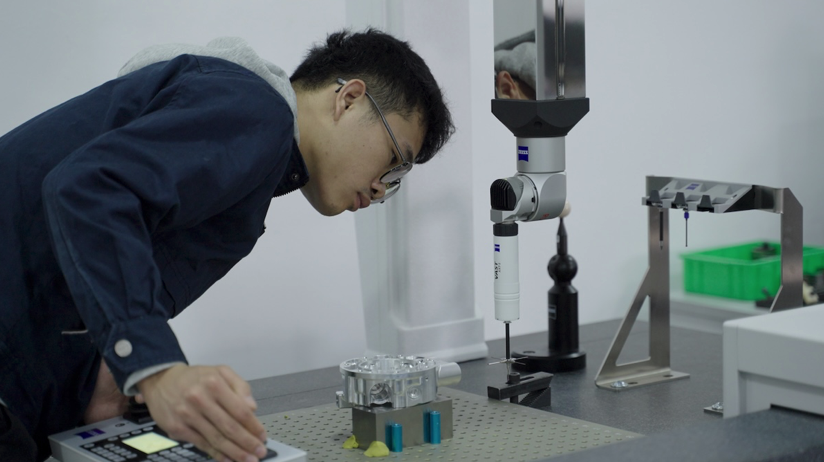
Inspection came next in WayKen process. The company used Zeiss CMM machines to measure all the GD&T requirements of the inverter housing and provided the sample parts along with a first-article inspection report.
In case of CNC milling parts, inspection should focus on thermal contact surfaces, fin geometry, cooling hole sizes, mounting features, and datums.
Conclusion
Thermal management components require manufacturing decisions that support both heat transfer and mechanical assembly. Fin geometry, cooling-hole dimensions, surface condition, datum relationships, and contact-surface accuracy can all affect performance.
The WayKen examples show how machining strategy, coolant delivery, controlled setups, mill-turn processing, and CMM inspection address these requirements.
When CNC machining services treat thermal and mechanical features as one system, cooling components can remain functional, manufacturable, and consistently reliable across demanding low-volume production projects.
