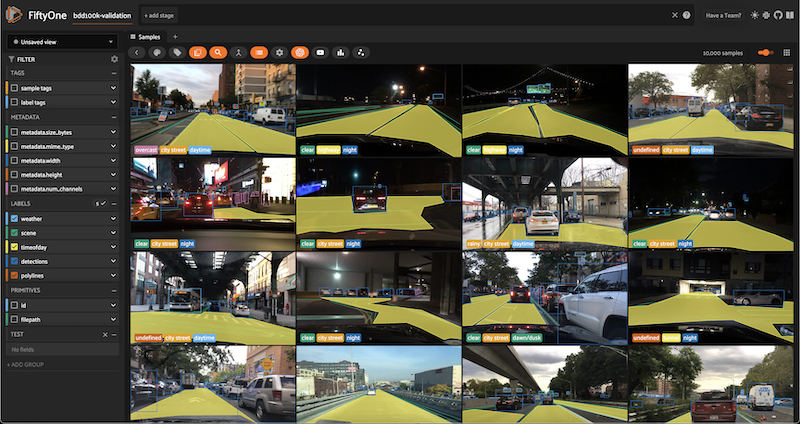
Voxel51 has launched version 3.0 of its data platform, adding new tools designed to help robotics and physical AI developers manage the huge quantities of camera, video and sensor data generated by machines operating in the real world.
The basic problem Voxel51 is trying to solve is straightforward: robots need large amounts of real-world data to train and improve the AI models that allow them to perceive and interact with their surroundings.
A robot might collect video from several cameras alongside lidar, location information and other sensor readings. Developers then need to search through that information, identify useful examples, label what happened, and decide which data should be used to train or test their AI models.
As fleets grow, doing this manually becomes increasingly difficult.
Voxel51 3.0 brings several of those tasks together in one platform, enabling developers to search, organize, label and evaluate data collected from robots and other physical AI systems.
Brian Moore, CEO of Voxel51, says: “We saw this play out with our customers building autonomous systems and perception models. The teams that got their data infrastructure right from the start were able to move faster.
“Physical AI and robotics is at that same inflection point. The companies building that foundation today are going to have a real advantage as their data and models scale.”
One of the main additions is Voxel51 Agent, an AI assistant designed to automate some of the work involved in managing robotics datasets.
Rather than simply answering questions through a chat interface, the agent can perform tasks across the development process, including finding relevant data, selecting useful examples, labeling data and evaluating results.
For example, a robotics developer dealing with hundreds of hours of recorded sensor data might need to find occasions when a robot encountered a particular object or unusual situation. Voxel51’s search and AI tools are designed to make those examples easier to locate without engineers manually reviewing entire recordings.
Adonai Vera, product manager at Voxel51, says: “Physical AI teams don’t need another chat interface sitting on top of their data. They need an agent that can maintain context across the model development lifecycle and orchestrate actions across the full data flywheel.”
Finding the important moments
Voxel51 3.0 also introduces an expanded search system combining semantic search, conventional text queries and metadata filters.
Its multimodal time-series capabilities allow developers to view synchronized streams from different sensors and search for particular moments within long recordings.
This is particularly relevant to robotics because a single machine can simultaneously generate information from cameras, lidar and other sensors. Understanding an event may require engineers to examine several of those sources together.
The platform also includes annotation tools for 2D images, 3D data and video. Its Agentic Labeling capability can use vision-language AI models to automate some of the process of identifying and describing objects and events contained in the data.
Voxel51 has also added tools for tracking where data comes from and how it changes. Activity logs, editing histories and dataset versioning allow developers to identify which information was used to train a particular model.
The company says its architecture is model-agnostic, allowing customers to use their own foundation models or specialized AI models for tasks including inference, automated labeling and evaluation.
Turning robot experience into training data
The broader idea behind the platform is that experience gathered by robots in the real world can be fed back into the development process.
If a robot encounters an unusual object, lighting condition or situation that causes its AI system to struggle, developers can identify that event in the recorded data, label and analyze it, and potentially add it to the training data used to improve subsequent versions of the model.
As more robots operate for longer periods, however, the amount of recorded data grows rapidly. Voxel51 argues that the ability to identify the small proportion of useful training examples within those large datasets is becoming an important part of physical AI development.
According to the company’s State of Physical AI 2026 report, teams it classifies as exceptional are three times more likely than struggling teams to spend more than half of their project time working with data.
Voxel51 3.0 is intended to support that process from the initial raw recordings through to searchable and labeled datasets that can be used for AI training and evaluation.
Voxel51 partners with Nebius
Voxel51 is also working with AI infrastructure company Nebius to combine its data management technology with cloud computing resources.
The companies are hosting hands-on workshops where developers can run Voxel51 workflows using Nebius AI Cloud.
The partnership addresses two related requirements of physical AI development: managing the large quantities of data generated by machines and providing the computing power required to process that information and train AI models.
Evan Helda, head of physical AI at Nebius, says: “Physical AI is the next major frontier for AI because it brings digital intelligence into the world of atoms.
“But getting there will take more than better models. Robotics teams need the compute, cloud platform, and data infrastructure to turn every deployment, failure and edge case into a faster next iteration. That’s the kind of foundation we’re building with partners like Voxel51.”
Voxel51 says its platform is used by companies including Berkshire Grey, Ford, Porsche and Precision Planting.
The new Voxel51 3.0 platform is also available through a free self-service version for developers wanting to begin working with the system.
