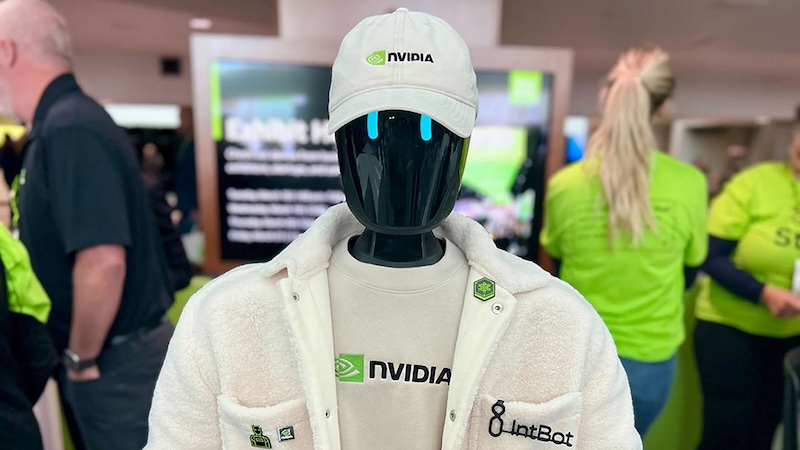
According to Intbot, CES 2026 made one thing clear: “Robots have mastered movement”. On the show floor, they danced, backflipped, played ping pong, and posed for selfies, solid proof that hardware capability is no longer limiting their development.
What’s still missing? How robots behave autonomously in the real world, outside scripted demos and controlled settings.
IntBot, a humanoid robotics company focused on social intelligence, says the industry is entering a new phase where differentiation will be defined less by mechanics and more by judgment, context, and presence.
As hardware converges, the ability for robots to understand people and respond appropriately in real time is becoming the deciding factor for real-world adoption.
At CES, conversations with customers, partners, and platform manufacturers reflected this shift: Demand is rising for robots that can combine interaction and task execution, carry a consistent presence across hardware platforms, and function reliably in live environments. Not just on a show floor.
“CES confirmed that we’ve entered a new phase,” said Lei Yang, CEO of IntBot. “Robots are no longer in a single wave of experimentation. The market is stratifying by maturity, and the difference-maker now is social intelligence: the ability to understand people, context, and environment in real time.”
From spectacle to early adoption
CES 2026 highlighted a widening divide between hardware-first robots and those built to operate autonomously around people.
While task automation like laundry handling or coffee preparation remain largely experimental, social robots designed for public environments are moving into early adoption, with actual commercial use cases emerging.
IntBot is among the few companies already deploying humanoid robots 24/7 in live environments, including hotels and other high-traffic settings. These robots don’t just perform isolated tasks; instead, they must engage continuously and naturally with guests and staff.
“Robots in human spaces can’t rely on scripts or spectacle,” Yang said. “They need judgment, presence, and social awareness. Without that, they won’t scale.”
Conversations at CES reinforced that the next 12-24 months will be defined by execution: deployment speed, reliability, and real-world performance.
The show also revealed growing interest from robot manufacturers looking to integrate social intelligence software into their platforms, reflecting a shared understanding: Capable machines still lack a critical layer for real-world operation.
The missing layer: Social intelligence
IntBot is building that layer.
Through its interaction middleware layer, IntBot enables natural, context-aware communication between humans and robots at scale.
Its social intelligence platform gives robots situational awareness, personality, and the ability to respond appropriately in dynamic environments, turning capable hardware into interactive, autonomous systems.
The company has moved beyond pilots to repeatable deployment. With established hotel solution partners, proven 24/7 autonomous operation in live environments, and a foundation built for scale, Intbot’s growth is now constrained by rollout and demand, not technology readiness.
“Coming out of CES, it’s clear the market is ready for robots that support human service where attention and presence matter,” Yang said. “Social intelligence isn’t optional, it’s the starting point. And that’s exactly where IntBot is focused.”
