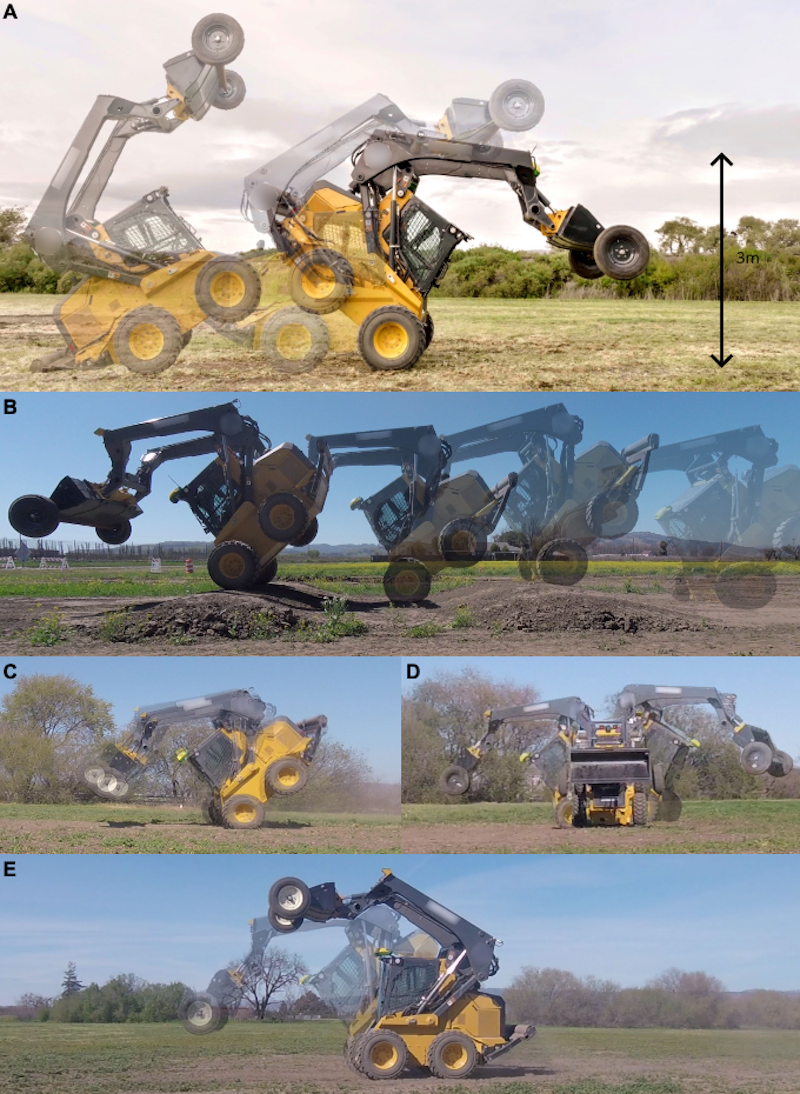
An international team of researchers has demonstrated how artificial intelligence trained in simulation can enable heavy construction machinery to perform complex autonomous maneuvers previously mastered by only a small number of highly skilled human operators.
The research, published in Science Robotics under the title “Heavy metal acrobatics: Learning dynamic control for skid-steer loaders”, brings together researchers from ETH Zurich, Gravis Robotics, Blue River Technology and Intel.
Using reinforcement learning, the team trained a five-metric-ton John Deere 332G skid-steer loader to balance on its two front wheels, navigate uneven terrain, follow driving commands, spin in place and return safely to a four-wheel position.
Beyond the acrobatic demonstrations, the research addresses fundamental engineering challenges associated with automating heavy machinery in industries including construction, mining, agriculture and material handling.
From simulation to reality
Hydraulic machinery presents particular challenges for autonomous control because of the nonlinear behavior of its actuators, unpredictable delays and complex physical dynamics.
The size and weight of construction equipment also make extensive real-world experimentation potentially dangerous and expensive.
To overcome these challenges, the researchers collected operational data from the physical machine and used it to develop a neural network capable of predicting the behavior of its hydraulic actuators.
The team then trained individual control policies in simulation using reinforcement learning, without relying on demonstrations from expert human operators.
Once trained, the AI controllers were transferred to the physical machine, running on a standard laptop without requiring a graphics processing unit.
Comparing AI with conventional control
The researchers compared their reinforcement learning (RL) approach with a conventional model predictive control (MPC) system.
While both approaches demonstrated comparable performance in several tasks, the reinforcement learning system proved more capable in certain demanding maneuvers.
| Maneuver | Reinforcement learning | Model predictive control |
|---|---|---|
| Transition from four to two wheels | Successful | Unsuccessful |
| Stationary balancing | Successful | Successful |
| Maximum wheel angular velocity while balancing | ±4 rad/s | ±3.5 rad/s |
| Spinning in place | Successful | Successful |
| Balancing during arm movements | Successful | Successful |
| Traversing uneven terrain | Successful | Unsuccessful |
| Controlled soft landing | Successful | Unsuccessful |
Source: Science Robotics, Heavy metal acrobatics, November 2026.
Notably, despite being trained exclusively on flat terrain, the reinforcement learning controller successfully navigated terrain with undulations measuring up to 75 cm in height.
The conventional controller maintained balance but was unable to traverse the obstacles.
However, the AI system was not universally superior. The conventional controller exhibited less oscillation at higher spinning speeds.
Beyond acrobatics
The researchers suggest that the techniques could eventually enable construction vehicles to load themselves onto trucks without ramps, negotiate obstacles and perform recovery maneuvers in difficult operating environments.
Controlled balancing could also reduce tire scrubbing and ground damage when machinery operates on sensitive terrain.
The researchers write: “We believe that training individual control skills is a prerequisite to achieving more complex and longer-horizon tasks.”
Future research could incorporate lidar and cameras to improve environmental awareness, alongside higher-level AI systems capable of selecting the appropriate control skills for different situations.
Although the experiments do not establish commercial readiness, they demonstrate how simulation-trained AI could provide a foundation for more sophisticated autonomous control of full-scale hydraulic machinery.
Main picture: A series of images showing a five-metric-ton John Deere skid-steer loader performing autonomous acrobatic maneuvers using AI controllers trained in simulation. Credit:
Lorentz et al, Science Robotics (2026).
