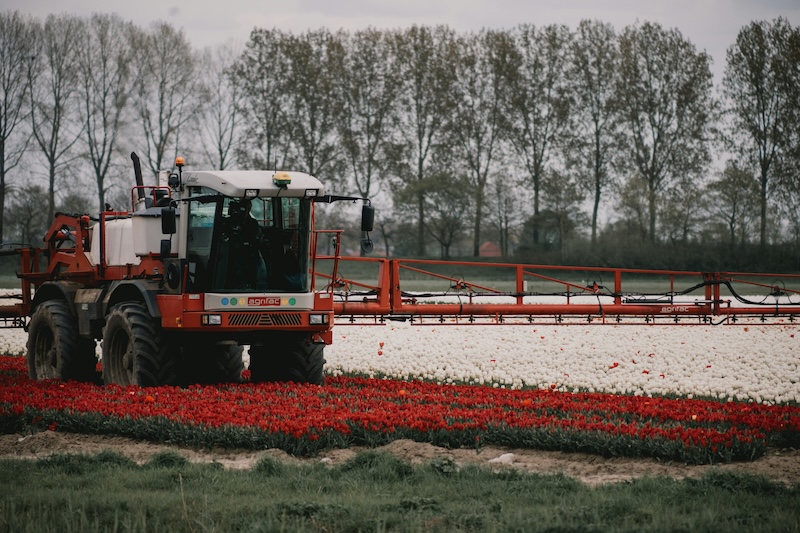
Holland’s tulip fields look like a postcard. Behind the color sits a highly mechanized industry that plants, scans, tops, lifts and sorts bulbs on a tight seasonal clock.
Most people only see the bloom. For growers, the flowers are a short and slightly inconvenient phase in a year that is really about the bulb underground.
That bulb has to be planted, protected, harvested, cleaned, graded and stored before it can be sold. More and more of that work now runs on specialized machines, vision systems and early-stage robotics.
Fewer Growers, Bigger Fields
The push toward automation starts with farm structure. According to Statistics Netherlands, the number of Dutch bulb growers fell by 40 percent between 2000 and 2016, to just over 1,600. Over the same period, the average farm roughly doubled in size, from around 8 to 16 hectares, or about 20 to 40 acres.
Bigger farms with fewer people need machines that can cover more ground in less time. Seasonal labor is also harder to find and more expensive than it used to be. When a job has to be done across hundreds of rows in the same few weeks, every hour saved by a machine counts.
Disease control is a good example of the pressure. Growers have long relied on trained workers walking the rows to spot infected plants. Wageningen University researchers note that detecting by hand is labor-intensive, and they have tested a research tractor carrying ten lit cameras that photograph tulips while deep learning software looks for signs of Tulip Breaking Virus.
The work is part of a public-private program called Bollenrevolution 4.0, which brings together growers’ groups, researchers and machine builders.
Autumn Planting Sets the Pace
The cycle starts in autumn. Planting machines drop bulbs into prepared beds at a set depth and spacing, then cover them with soil in a single pass.
Precision matters more than it might seem. Even spacing gives each bulb room to grow, and straight rows make every later pass easier, from spraying to harvesting. Many growers now use GPS guidance on their tractors to keep those rows consistent across large fields.
Over winter, fields are often covered with a layer of straw. It helps protect the bulbs from frost and keeps the light, sandy soil from blowing away in coastal winds.
Spring Brings Tourists, and the Topping Machines
The fields reach peak color in April. That is when visitors pour into the bulb region, and plenty of them arrive on a spring tulip river cruise. Many tulip-time itineraries include a stop at Keukenhof, where the display gardens sit right next to working bulb farms.
What those visitors rarely see is what happens a few weeks later. Growers send topping machines through the rows to cut the flower heads off.
It looks harsh, but it serves a clear purpose. Without a flower to feed, the plant sends its energy back into the bulb. Topping also removes petals that could otherwise drop, rot and spread disease.
Lifting the Bulbs in Early Summer
Once the foliage dies back in early summer, the harvest begins. Bulb harvesters lift the bulbs from the sandy soil, shake off the dirt and carry them up conveyors into crates or bins.
The machines have to be gentle. A bruised or cut bulb can rot in storage and infect its neighbors, so harvester design focuses on soft handling as much as speed.
Timing is just as important. Wet weather can delay lifting, and a short harvest window leaves little room for breakdowns. That is one reason growers value machines that are simple to service in the field.
Inside the Processing Shed
After the field, the bulbs head indoors for a series of steps that are increasingly automated:
- Cleaning: Remaining soil, roots and old plant material are removed.
- Peeling: Loose outer skins are stripped away so bulbs can be inspected and sold looking clean.
- Grading: Bulbs are sorted by size, which determines their price and their next use, from retail packs to replanting.
- Storage: Climate-controlled rooms manage temperature and airflow until bulbs ship or go back into the ground in autumn.
Camera-based sorting is spreading here, too. Vision systems can measure size and flag defects faster and more consistently than people working along a belt.
Automating the Indoor Harvest
Not every tulip is grown for its bulb. Cut tulips sold in shops are mostly forced indoors, with bulbs placed in containers and brought into bloom in greenhouses.
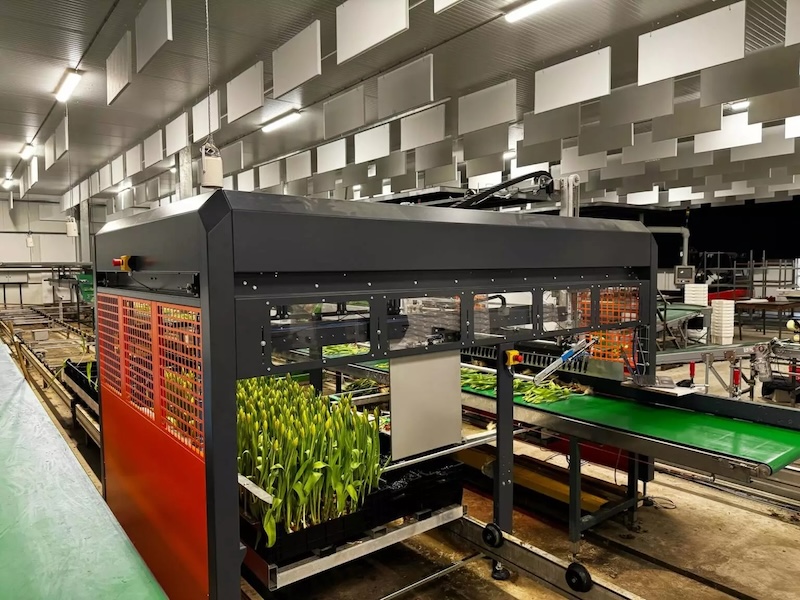
Harvesting those flowers has traditionally meant a lot of handwork. That is starting to change. According to AIPH, the international association of horticultural producers, Dutch machine builder Bercomex debuted a Tulip Picker in January 2025 that fully automates the harvesting of tulips from containers.
The machine works with any container type, aims to minimize damage and keeps defective bulbs in the container so they don’t contaminate the flow.
Where Robotics Fits Next
Field robotics in agriculture is still a small market compared with factory automation. The International Federation of Robotics, in its World Robotics report, says that about 19,500 agricultural robots were sold in 2024, down 6 percent, while total professional service robot sales rose 9 percent to roughly 200,000 units.
Bulb farming offers some clear openings, though. Autonomous scouting for disease, smarter sorting and fully automated forcing lines all address real labor gaps.
The challenges are just as clear. Robots have to work in wet, sandy fields, handle a fragile product and pay for themselves over a very short season. Machines that can switch between tasks across the year are likely to have an edge.
Data is the other piece of the puzzle. Every scan, sort and harvest produces information about bulb health and yield. Growers who connect those streams can spot problem fields earlier and plan the next season with fewer surprises.
The Postcard and the Production Line
Holland’s tulip country is a tourist icon, but it is also an industrial system that has been refined over generations. The color draws the crowds. The machines keep the bulbs coming.
As labor tightens and vision technology improves, more of that system will run on sensors and software. The fields will look the same from the road. What happens in the rows, and in the sheds behind them, is changing fast.
Main image by Sofie D. on Unsplash
