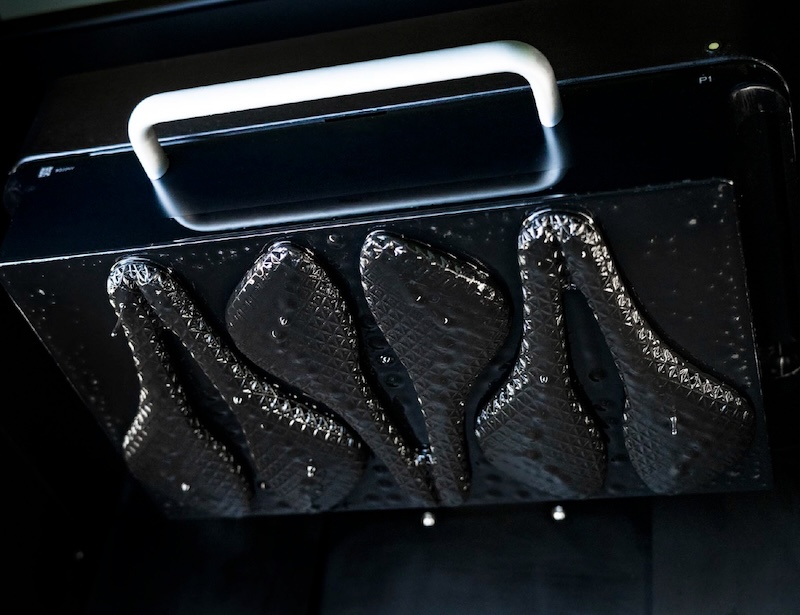
Carbon 3D, a product development and additive manufacturing technology company, says it has “reached a major milestone”, with more than 1 million cycling saddles now produced on its end-to-end additive manufacturing platform.
The milestone reflects the growing role of Carbon Digital Light Synthesis (DLS) in high-performance cycling, with leading brands worldwide using digitally programmed lattice structures to deliver precisely tuned cushioning, support and mechanical performance in end-use products. Carbon now partners with 11 saddle brands across the globe and has more than 60 saddle models in production.
The landmark comes ahead of Formnext 2026 (Frankfurt, November), where Carbon will put real-world production performance at the center of its show presence. At Hall 12.1, Booth F109, the company will showcase customer applications already in production with leading global brands across sectors that, as well as cycling, include custom footwear, protective equipment, mobility seating, medtech, industrial and automotive.
Phil DeSimone, CEO of Carbon, says: “Reaching one million saddles is an important milestone, but it represents much more than a production number. It shows what happens when digital manufacturing moves beyond prototyping and becomes a trusted way to make products at meaningful scale.
“Together with saddle brands and production partners, we have created an entirely new category of cycling products – moving from the first applications of lattice technology to products being ridden every day by consumers and by athletes competing at the very highest level of the sport.”
Carbon technology has become increasingly established within performance cycling, enabling brands to replace traditionally manufactured foam cushioning with programmable lattice structures whose mechanical response can be tuned across different areas of a saddle.
This capability has now been proven at the highest levels of professional cycling – for example, at the 2026 Tour de France, where Tadej Pogačar once again raced on a custom fizik Argo Adaptive saddle, produced using Carbon Digital Light Synthesis technology and tailored through fizik’s One-to-One program to his individual pressure profile and riding position.
Selle Italia represents one of the latest brands to extend the possibilities of customizing digitally manufactured saddles with the launch of Unica, produced by Carbon partner Prototek. Unica uses pressure-mapping data captured from the individual cyclist to engineer a unique internal lattice structure around that rider’s pressure distribution, manufactured in Carbon’s EPU 46 material.
Unica becomes the second fully customizable saddle made with the Carbon platform, demonstrating how digital production can make individualized performance products commercially viable – and unlock radically better products.
Beyond cycling, this shift is also evident across other categories, including through brand collaborations such as Vivobarefoot’s VivoBiome Tabi Gen 02, which uses a scan-to-print model powered by Carbon DLS to translate individual foot-scan data into personalized, made-to-order footwear.
Together, these applications reflect how Carbon is helping brands move complex product concepts into repeatable commercial production, while making customization practical at production scale.
Supporting this growth is Carbon’s expanding global manufacturing ecosystem, which now includes over 40 production partners worldwide. The network enables brands to access qualified Carbon production capabilities closer to their markets, helping them transition from product development to scale commercial manufacturing and providing additional capacity as applications scale.
DeSimone says: “The strongest proof of what Carbon can do is in the trust our customers put in Carbon technology, and the products our customers are putting into the world. Brands do not need more examples of what additive manufacturing might be capable of one day – they need evidence that it can deliver today. One million saddles is one very visible example of this.
“Similarly, if you look at our EPU Pro family of high-performance elastomers, more than 1,000 metric tons have now shipped since launch – and that is just one family of materials being used with the Carbon platform.
“The even bigger story, of course, is the breadth of products now being made with Carbon’s technology and the businesses building repeatable production around it. That is what we are excited to bring together at Formnext.”
