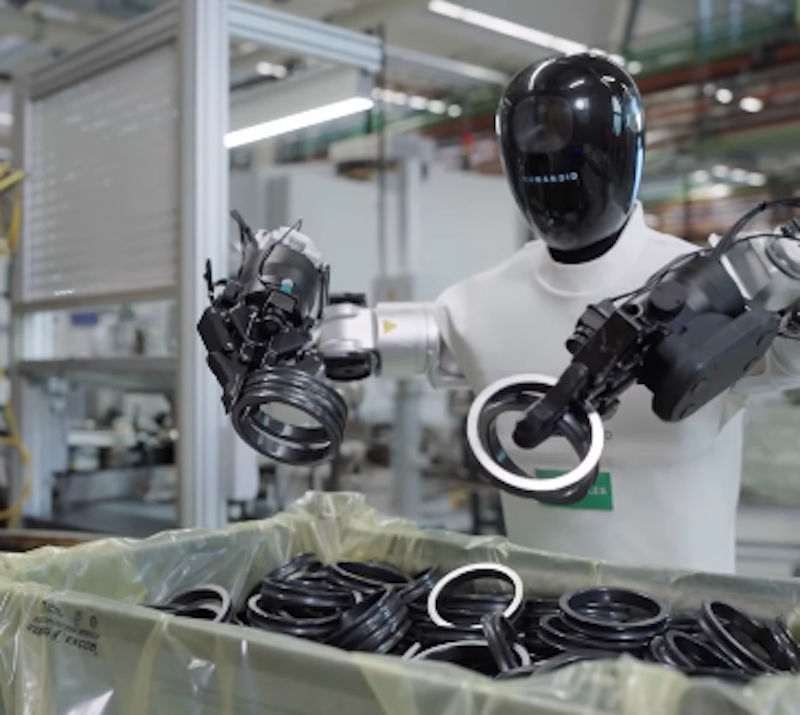
Humanoid, a UK-based AI and robotics company, is expanding its collaboration with Nvidia to build the computing foundation for a new generation of AI-powered humanoid robots.
The companies are working together to develop a high-performance robotic edge runtime for Humanoid’s next-generation robots.
By integrating Nvidia’s advanced technologies into its platform, Humanoid will be able to run increasingly sophisticated AI directly onboard its robots, enabling them to perceive, reason and respond to the physical world in real time.
These capabilities will be critical as humanoid robots move from controlled environments toward large-scale, real-world deployment.
As part of this work, Humanoid is integrating Nvidia’s latest robotics and edge computing technologies, including Nvidia Jetson Thor, Nvidia Isaac OS, Nvidia Holoscan Sensor Bridge and Holoscan SDK.
Together, they will provide the foundation for processing large volumes of sensor data, running AI models onboard, and coordinating perception, reasoning and control in real time.
Nvidia technologies already play an important role across Humanoid’s development stack. Since its early days, Humanoid has used Nvidia Isaac Lab and Nvidia Isaac Sim open frameworks to train and simulate models before deploying them on physical robots, creating a connected workflow from training and simulation through to real-world operation.
A key part of the new architecture is Nvidia Jetson Thor onboard compute. By moving to the platform, Humanoid has been able to consolidate two onboard computers into a single system and maintain the computing capacity, with potential additional headroom in the future.
At the same time, Jetson Thor’s unified CPU and GPU memory reduces unnecessary data movement and latency and simplifies how different workloads share computing resources.
Humanoid is also integrating Nvidia Holoscan Sensor Bridge to create a faster path between the robot’s sensors and its AI models.
Camera data can be placed directly into GPU-accessible memory, reducing unnecessary data copies and CPU workload and enabling lower-latency processing across perception, inference and control.
Beyond increasing computing performance, the work with Nvidia helps Humanoid simplify the robot’s overall architecture.
Nvidia Isaac OS, an open, deterministic runtime framework, provides a GPU-native runtime for coordinating multiple robotics workloads, while Multi-Gigabit Ethernet provides up to 100Gb of bandwidth for sensor data and command and control signals.
Together, these technologies can reduce hardware and software complexity, making the platform easier to develop, test and ultimately scale.
Artem Sokolov, founder and CEO of Humanoid, says: “Nvidia has been an important technology partner for Humanoid from the early stages of our journey, and our work together continues to evolve as our robots become more capable.
“Building general-purpose humanoid robots requires significant computing power and an architecture that can bring sensing, AI and control together in real time.
“Nvidia’s robotics platform gives us a strong foundation to do that. Together, we can unlock new levels of autonomy and bring more capable humanoid robots into the real world.”
The companies will continue working together as Humanoid advances its robotics platform and prepares its next generation of robots for increasingly complex real-world applications.
