Household electrification is becoming mainstream in parts of Europe. According to the European Heat Pump Association, Lithuania recorded Europe’s highest heat pump sales rate in 2025, with 46 units per 1,000 households. Each new unit adds another controllable load to the grid.
Utilities, building owners, and energy startups need software that coordinates these loads with solar generation, energy storage, and tariffs. Generic platforms support common devices but often struggle with custom hardware, local rules, and energy-sharing models.
This roundup compares 10 vendors with quick summaries and detailed profiles to help you shortlist top custom energy management development companies.
Companies at a Glance
Use this quick overview to compare each company’s main energy software focus and the published work behind its profile.
- HBM: Custom EMS platforms, data integrations, and modernization of existing energy solutions, with published work for Inno2Grid and Energi.ai.
- Relevant Software: EMS, smart grid, energy storage, and utility billing development, backed by more than 100 in-house engineers and delivery experience since 2013.
- Andersen: Energy software for solar, wind, heating, and electric utilities, including a four-year transformer data platform project.
- SoftServe: Energy and utilities transformation services, with published AI gas-lift optimization work for Vital Energy.
- Chetu: Utility software covering SCADA, demand-side management, and billing integrations with platforms such as EnergyCAP.
- Critical Software: Smart meter software with experience in GBCS, DUIS, DLMS, and Zigbee protocols.
- Sapphire Software Solutions: Facility energy platforms with IoT meter integration, AI forecasting, and tariff-based billing.
- Concetto Labs: Renewable energy and consumption monitoring apps, including blockchain-based peer-to-peer energy trading.
- TrooTech: Energy distribution management and integrated SCADA systems with demand response and fault detection.
- PerfectionGeeks: Packaged EMS development across three service tiers, starting with a two- to three-month Starter package.
Comparison of the Top Custom Energy Management Development Companies
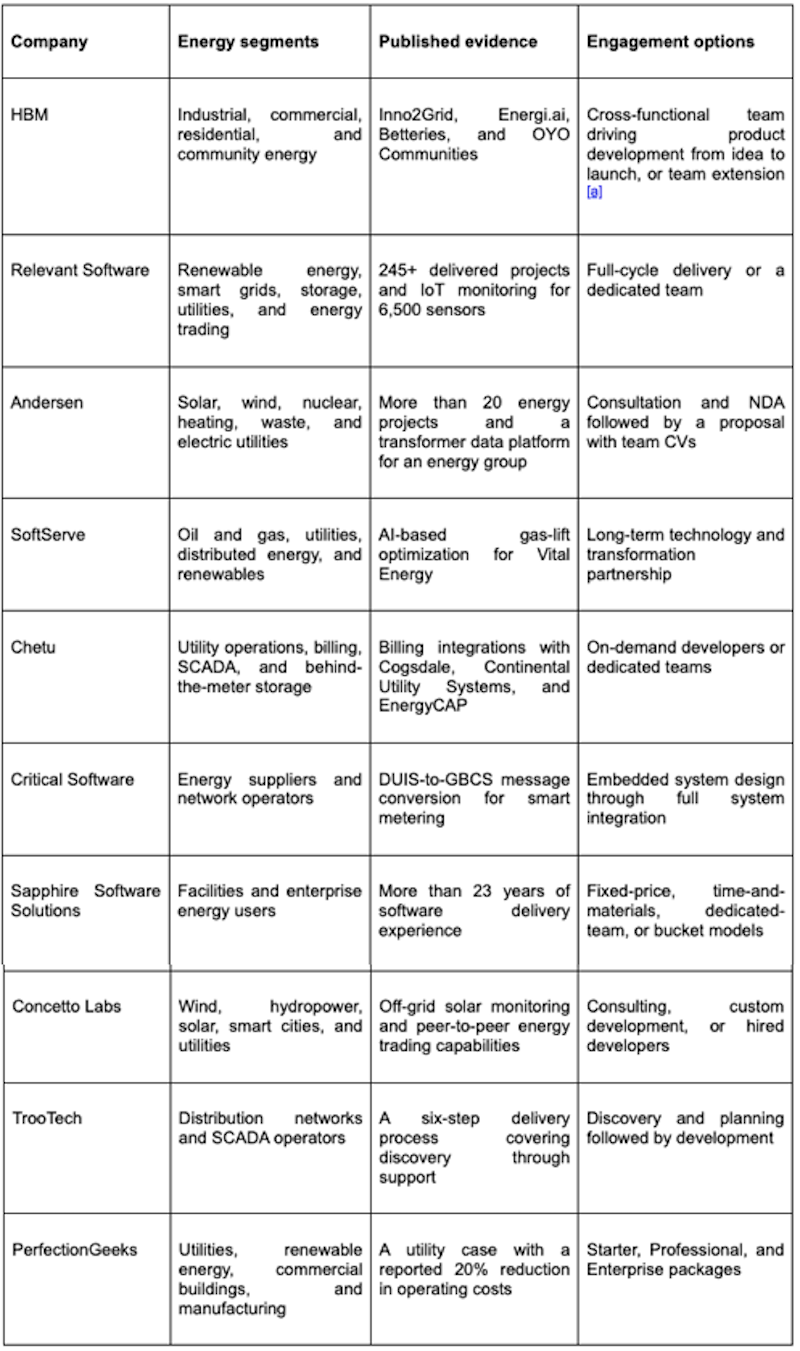
Choosing the right energy management development partner depends on its experience in your energy segment, proof of similar project work, and an engagement model that fits your team. The table compares 10 companies across these criteria to help you build a focused shortlist.
1. HBM
HBM is one of the top custom energy management development companies for platforms that connect sensor data, grid infrastructure, and business software. One team covers backend, integrations, data, AI, and user interfaces.
Its (b)services include custom EMS development; system, grid, and utility integrations; AI-driven analytics, forecasting, and optimization; data management; UX/UI design; test automation; and cloud and infrastructure management.
HBM either scales a client’s team with senior experts or provides a full cross-functional team that builds a solution from the ground up.
Published projects show the range of this work. Inno2Grid uses a home energy platform with gateway software, cloud services, and user apps.
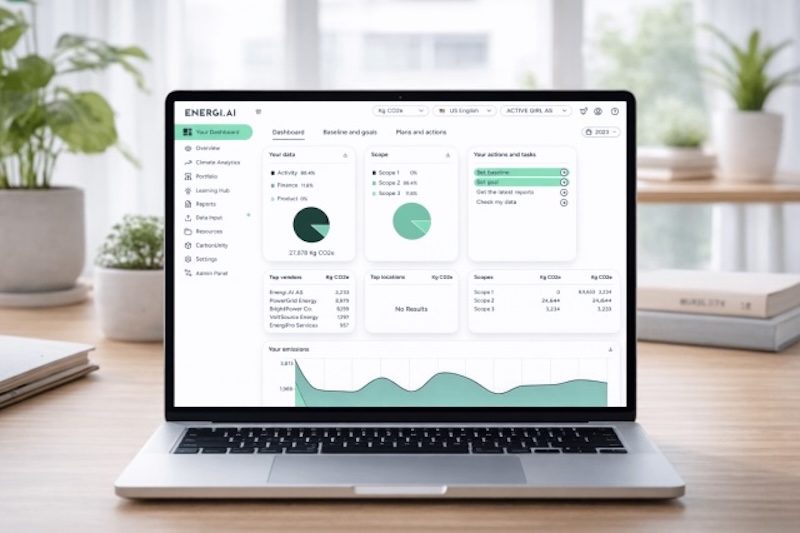
Energi.ai helps businesses understand, manage, and reduce emissions, energy use, and sustainability risk, while Betteries manages circular economy energy devices through a cross-platform app. OYO Communities supports collective self-consumption.
HBM also develops settlement and payment workflows, grid and utility integrations, and carbon modules that support emissions control based on manually entered data.
Beyond new builds, the company optimizes existing infrastructure, improves quality and performance, and adds AI, data consolidation, and analytics to live platforms.
HBM brings more than 16 years of product development experience, a robust Delivery Framework, and a focus on quality and maturity (around 90% of its engineers hold senior roles).
2. Relevant Software
Load balancing and real-time consumption tracking sit at the center of Relevant Software’s energy management work. Its broader capabilities cover renewable generation monitoring, smart grids, storage optimization, demand response, billing, ETRM, and SCADA systems.
Using data from client sensors, SCADA platforms, and energy markets, the company trains AI models to forecast demand and power output.
Its security services separate OT and IT environments and align controls with ISO 27001 and GDPR. Relevant Software reports 245+ delivered projects since 2013, more than 100 in-house engineers, and a team made up of 92% senior specialists.
3. Andersen
Over 4 years, Andersen developed a data management platform for a multinational energy company. The system processes electricity data from transformers across dozens of subsidiaries, ranks components by failure risk, and recommends corrective action. Its published technology stack includes Angular and Node.js.
Beyond this project, Andersen works across solar, wind, nuclear, heating, waste management, and electric utility software. The company reports more than 50 energy specialists and over 20 projects for energy businesses.
A typical engagement begins with an expert consultation and optional NDA, followed by a proposal with estimates, timelines, and engineer CVs.
4. SoftServe
SoftServe applies AI, IoT, and real-time monitoring to energy challenges such as operational efficiency, emissions reduction, and asset performance. Its utility capabilities include grid operations, infrastructure maintenance, electrification, distributed energy resources, and renewable integration.
For Vital Energy, the company used data and AI algorithms to optimize gas-lift systems and increase production.
Other oil and gas services address methane emissions, asset integrity, and subsurface data management. In 2026, NVIDIA named SoftServe its NPN Advanced Technology Partner of the Year for Energy and Utilities.
5. Chetu
Chetu’s utility software portfolio spans asset management, billing, smart grid data processing, demand-side management, SCADA, distribution management, and behind-the-meter storage. AI capabilities include neural network demand forecasts, fault diagnostics, and automated demand response.
Its billing integrations support Cogsdale, Continental Utility Systems, and EnergyCAP. Chetu also connects energy platforms with GIS, customer information, and interactive voice response systems.
Behind-the-meter software integrates equipment from multiple OEMs, while field tools provide mobile data capture, GPS-based service routing, and AR and VR training.
6. Critical Software
Embedded development forms the core of Critical Software’s smart metering practice. The company works from early solution design and prototyping through full implementation, with protocol experience across GBCS, DUIS, MMC, DLMS, and Zigbee in HAN and WAN networks.
One published project converts DUIS messages into GBCS commands to support interoperability between vendors. The company also benchmarks meter hardware and software, develops HAN and WAN communication drivers, and integrates smart meter networks with ERP and CRM platforms. Its stated clients include energy suppliers, service users, and network operators.
7. Sapphire Software Solutions
Sapphire Software Solutions’ energy platforms center on real-time consumption dashboards, live alerts, and IoT connections to meters, sensors, and other energy equipment. Machine learning models forecast consumption, identify anomalies, and optimize performance.
Automated tools support sustainability and regulatory reporting, while smart billing features account for dynamic tariff rates. Role-based web and mobile interfaces serve administrators, facility managers, and technical teams.
Clients can choose fixed-price or time-and-materials delivery, a dedicated team with 160 assured hours per month, or a bucket model.
8. Concetto Labs
Concetto Labs’ energy software targets wind, hydropower, and solar operators. Its platforms combine monitoring, automation, and real-time analytics, while mobile apps help households and businesses track consumption.
For solar energy, the company lists panel monitoring, generation forecasts, battery management, and remote oversight of off-grid and rural installations.
Blockchain capabilities support peer-to-peer energy trading, billing, and compliance. Grid tools add predictive analytics and compliance tracking, with APIs connecting the platform to CRM and IoT systems.
9. TrooTech
TrooTech combines real-time energy monitoring with predictive maintenance, automated demand response, and custom reporting. Its distribution management modules dynamically balance loads and automatically detect grid faults.
A connected SCADA layer handles alarms, visualization, reporting, data archives, and smart grid device management.
Projects move through 6 stages: discovery and planning, design and prototyping, Agile development, testing, deployment, and support. Depending on the scope, delivery can take anywhere from several weeks to several months.
10. PerfectionGeeks
Instead of using one delivery model, PerfectionGeeks divides its EMS services into Starter, Professional, and Enterprise packages.
Starter projects cost between $12,000 and $25,000 and take two to three months for a single facility. Professional systems support multi-site operations and typically require three to five months.
Available features include real-time dashboards, consumption analytics, alerts, predictive maintenance, forecasting, and API integrations. Enterprise packages add SCADA connectivity, smart grid integration, and AI-based optimization.
One published utility case reports a 20% reduction in operating costs, while a renewable energy case covers solar generation and consumption analytics.
Contract Terms That Protect Your EMS Investment
A capable vendor still needs a clear contract. Include these terms to protect ownership and control scope:
- Source code and data ownership: Your company owns the repository, data models, and device adapters from day one, with full access throughout the project.
- Protocol versions: The statement of work lists every standard and version in scope, such as OCPP 2.0.1 and OpenADR 3.0.
- Testing on real hardware: Each release must pass agreed tests using your devices before acceptance.
Regulatory change budget: Set an annual budget for updates to tariffs, grid codes, protocols, and reporting requirements. - Exit and handover terms: Require runbooks, architecture records, technical documentation, and team training with the final release.
Myths About Custom Energy Management Systems
Common misconceptions can distort EMS budgets, timelines, and architecture decisions. Address these myths before development begins to set realistic expectations.
A Platform License Always Costs Less
A licensed platform has a lower upfront cost, but that doesn’t guarantee a lower total cost of ownership. Fees may increase with the number of devices, sites, users, data points, or API calls. Custom integrations, premium analytics, storage, support, and data export can add further costs.
Compare both options over at least five years using your expected fleet growth. Include license fees, integration work, infrastructure, support, upgrades, and the cost of replacing the platform if it can’t support a future device or business model.
A license often suits a standard asset mix, while custom development may offer better long-term value when integrations and operating rules are unique.
Integration Can Wait Until the Final Phase
Device, grid, billing, and business system integrations carry much of the technical risk. They influence the data model, security architecture, latency requirements, and control logic. Leaving them until the end can expose problems after the core platform is already difficult or expensive to change.
Use the proof of concept to test the hardest integration, not the easiest one. Connect real hardware, process live data, and send the results to a downstream system such as billing or ERP.
Set acceptance criteria for data accuracy, latency, connection loss, and recovery. This gives the team evidence that the architecture works before development expands.
One Dashboard Works for Every User
Operators, finance teams, managers, and customers use energy data for different decisions. Operators need live asset status, alerts, and controls.
Finance teams care about tariffs, costs, invoices, and settlement. Managers need trends and performance indicators, while customers usually need a simpler view of consumption and savings.
Define user roles and decisions before designing dashboards. Each view should show the right level of detail, use suitable update intervals, and restrict access to sensitive controls or financial data. Role-specific dashboards reduce clutter and make it easier for users to trust and act on the information they see.
Launch Ends the Project
An EMS continues to change after launch. Device manufacturers release new firmware, protocols gain new versions, tariffs change, and grid operators revise their requirements. The platform must also handle security updates, growing data volumes, new assets, and changing reporting needs.
Plan post-launch ownership before development ends. Assign responsibility for monitoring, incident response, protocol updates, cloud costs, and release management. Maintain a product roadmap and reserve an annual budget for updates.
Clear support terms, documentation, and knowledge transfer will help your team keep the system reliable without depending permanently on the original vendor.
Wrapping Up
Energy management software determines whether heat pumps, EV chargers, and batteries deliver measurable value. Without a platform that coordinates devices using tariffs, solar output, and grid signals, the hardware runs on default settings, and much of the potential savings remains unrealized.
Start by listing every device type and business system across your sites. Shortlist three custom energy management development companies and send each one the same scoping questions. Their answers will show which partner understands your hardware, tariff requirements, and operating model.
