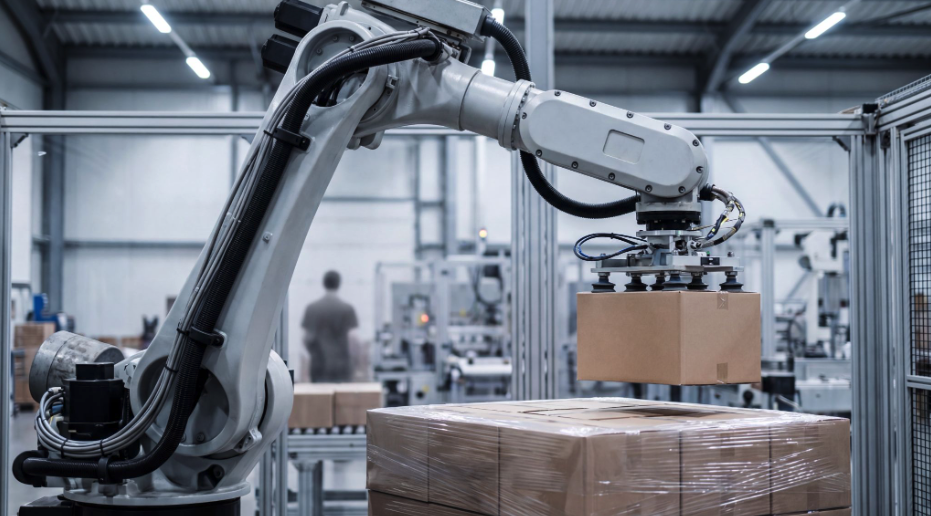
Inconsistent parts cause problems for automated assembly lines because machines repeat the same motion every cycle. They cannot adjust when a part is slightly different.
An operator who spots a warped bracket sets it aside. A feeder or robot keeps going until it jams, rejects a good assembly, or lets a bad one through. Most of this variation starts before parts reach the line, so it is easiest to control at the source.
Why do small part differences stop automated equipment?
Small part differences stop automated equipment because each station is set up for one nominal part. That means the exact size and shape on the drawing. Every tool, robot path, and force limit assumes that part. That is why standardizing the workpiece is an early step in building a robotic production cell.
A vibratory bowl feeder orients parts using tooling cut to match their shape. Parts that are too thick or warped can jam in that tooling or fall back into the bowl. A robot running a fixed program picks at a taught position and grips a shifted part off-center. Fastening and press-fit stations compare torque or force against set limits and flag anything outside them.
Variation also adds up across mating parts, which engineers call tolerance stack-up. A shaft at the top of its tolerance and a bore at the bottom of its tolerance are each within spec. Pressed together, they may need more force than the station allows.
Where does part variation come from?
Part variation usually comes from the process that made the part. Part variation usually comes from the process that made the part. That is why one lot can run cleanly, and the next can jam, even when the drawing has not changed. Each process has its own typical sources:
- Stamped parts: burr height, edge shape, and flatness change as the die wears.
- Molded plastic parts: flash grows as the mold wears, and each cavity in a multi-cavity mold can produce a slightly different part.
- Machined parts: diameters and surface finish shift with tool wear and machine temperature.
- Plated or coated parts: coating thickness varies between batches and suppliers.
A part can meet its drawing and still cause trouble. Drawing tolerances describe what the finished product needs. They say little about how a feeder or gripper handles the part. Operators on manual lines sorted out those differences by hand, so handling limits were rarely written down.
This applies to bought-in parts whether they come from a molder, a machine shop, or custom metal stamping services. Adding handling limits such as flatness, burr direction, or flash to the drawing closes the gap.
What problems do inconsistent parts cause on the line?
Inconsistent parts lead to short stops, false rejects, and defects that slip through. Inconsistent parts lead to short stops, false rejects, and defects that slip through. Each one happens when a station receives a part it was not set up for.
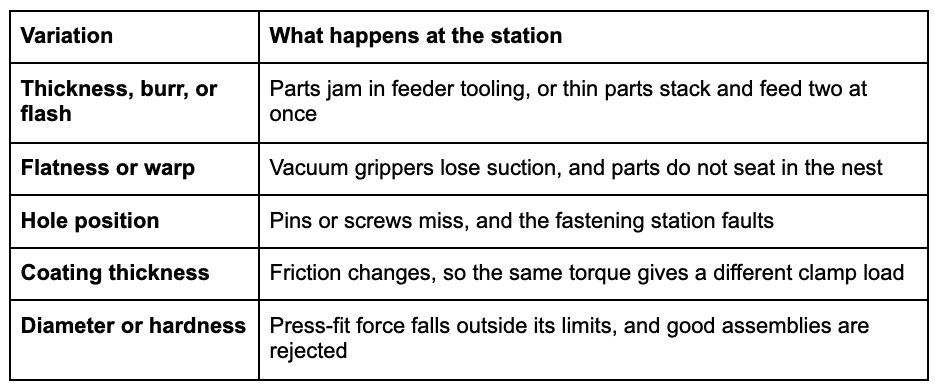
Short stops are easy to ignore, but 20 stops of 45 seconds each cost 15 minutes of output per shift. Escaped defects cost the most, because a part that sits slightly wrong can fail after the product ships.
How much variation is too much?
Variation is too much when parts regularly land near the edge of what a station accepts. That range is often called its acceptance window. Engineers measure how well a supplier’s process fits inside a tolerance with a process capability index.
The basic version, Cp, compares the width of the tolerance with the natural spread of the parts the process makes. A Cp of 1.00 means the parts use the full tolerance, and higher numbers leave more room at the edges. A related index, Cpk, also checks whether the parts are centered in the tolerance or drifting toward one side.
For a centered process, a Cp of 1.00 puts about 0.27% of parts outside the tolerance. At a Cp of 1.33, that drops to about 64 parts per million. On a station feeding 20,000 parts a day, that is about 54 bad parts a day versus about one. This is why small variation matters more on automated lines. They run so many cycles that a tiny reject rate becomes a daily problem.
Measure capability against the station’s acceptance window, which can be narrower than the drawing tolerance. Otherwise, a supplier can report a good Cpk and still ship parts that jam.
Can vision systems and flexible feeders handle inconsistent parts?
Vision systems and flexible feeders handle more variation than fixed tooling, but they work by skipping parts they cannot use. Skipped and failed picks still cost cycle time. Even AI-guided bin picking systems designed for part variability are quoted at up to 95% pick success. That leaves about one pick in 20 to retry.
How can manufacturers keep parts consistent before they reach the line?
Manufacturers keep parts consistent by agreeing on handling limits with suppliers and testing parts before production starts:
- Add handling limits to the drawing. List flatness, burr direction, flash, and coating range wherever the equipment is sensitive to them.
- Test parts from several lots. Run them through the actual feeder before approval, including parts made late in a tool’s life.
- Ask for capability data. Request Cpk on the critical features, measured against the station’s acceptance window.
- Require change notice. Ask suppliers to report changes to material source, tooling, or plating before they ship.
- Track rejects by lot. Log jams with lot numbers so a spike can be traced to a specific shipment.
Conclusion
Inconsistent parts cause problems because automated equipment is built around one version of each part. When a part differs, the line stops, rejects good work, or passes bad work. This is easier to prevent at the supplier than to fix at the station.
Set handling limits on the drawing, check capability against the acceptance window, and trial real production lots before launch.
